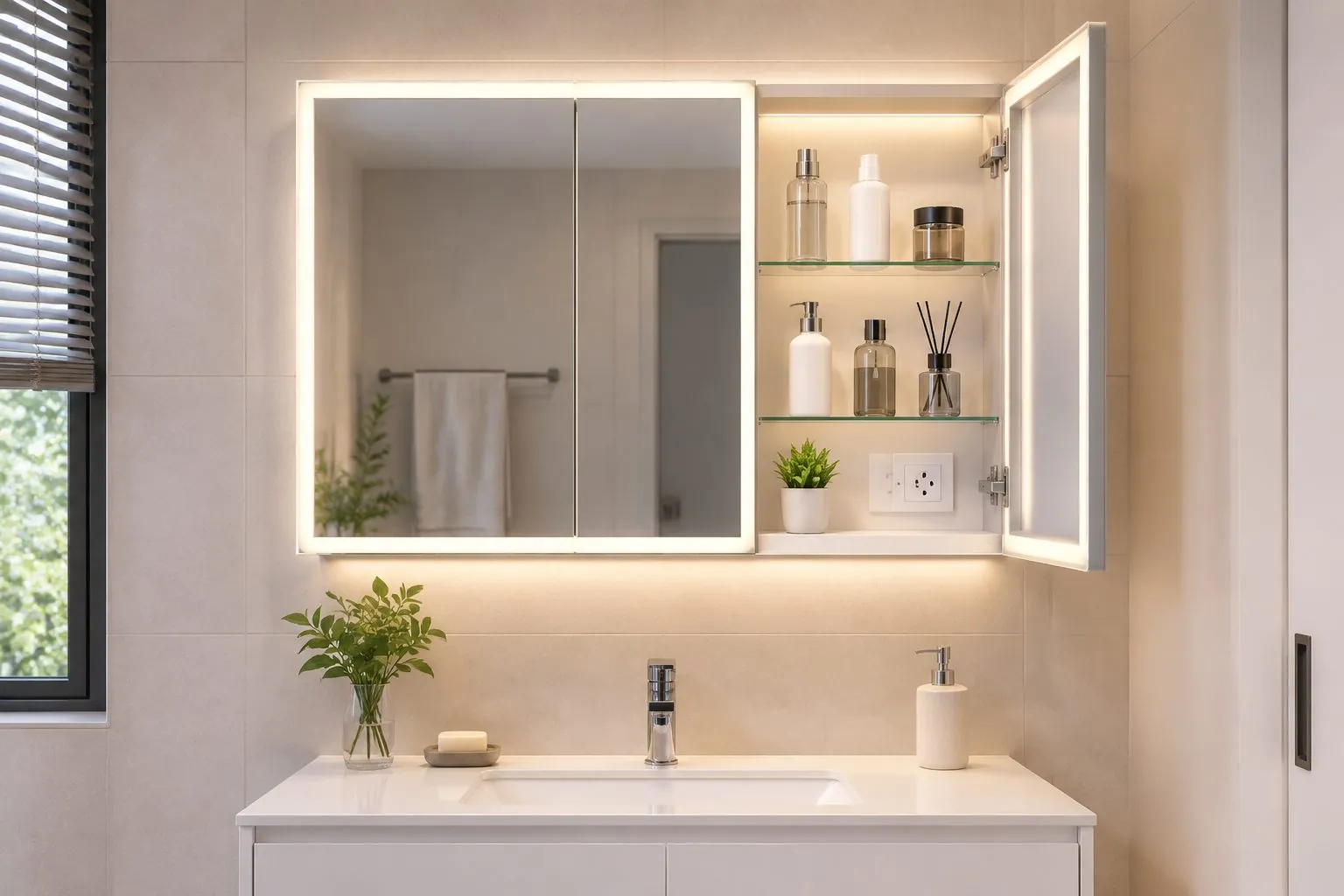
A buyer guide to LED mirror cabinets: which features matter, how to specify lighting, market certifications, IP ratings, site wiring, humidity-proof materials and inspection.
What Should Buyers Expect From an LED Mirror Cabinet?
An LED mirror cabinet should give even, shadow-free face lighting, a clear mirror after showers, safe power for small appliances and storage that does not swell in humidity. If a unit does only the first of these well, it is a decorative mirror with a box behind it, not a project-grade product.
For project buyers such as hotels, developers and bathroom distributors, the cabinet is also an electrical product installed in a wet room. That means the purchase decision must cover electrical safety documents, ingress protection, replaceable components and the installer's wiring work, not only appearance.
- Lighting: front-lit or edge-lit LEDs placed for face illumination.
- Demisting: heated pad behind part of the mirror.
- Power: shaver socket or USB inside the cabinet, where local rules allow.
- Storage: moisture-resistant body with adjustable shelves.
- Controls: touch, motion sensor or wall switch.
Which Features Matter Most, and Which Are Optional?
Prioritize lighting quality, demisting and body material; treat clocks, Bluetooth speakers and color-changing lights as optional extras that add failure points. Hotels in particular benefit from simpler specifications with fewer electronic functions to maintain.
| Feature | Value to User | Maintenance Risk | Recommended For |
|---|---|---|---|
| Front-lit LED face lighting | High | Low with quality drivers | All projects |
| Demister pad | High in showers | Low | Hotels, apartments with showers |
| Internal shaver socket or USB | Medium to high | Low to medium | Hotels, premium homes |
| Motion sensor switching | Medium | Medium; false triggers | Night light function |
| Adjustable color temperature | Medium | Medium | Premium residential |
| Internal cabinet light | Medium | Low | Deep cabinets |
| Clock, speaker, display | Low | Higher | Only where specifically requested |
How Should LED Lighting Be Specified?
Specify LED lighting by position, color temperature, color rendering and switching. Brightness alone does not describe good bathroom lighting.
- Position: light from the sides or a frame around the mirror lights the face evenly; a single strip above casts shadows under the eyes.
- Color temperature: warm white feels relaxed, neutral white is better for makeup and shaving. Many hotels standardize one value across all rooms for consistency.
- Color rendering: a high color rendering index makes skin tones and makeup look natural; ask the LED supplier for the stated value.
- Diffusion: frosted or sandblasted mirror bands hide individual LED dots.
- Switching: touch switch on the mirror, a wall switch linked to the room lighting, or a sensor.
Stated LED performance values come from the component supplier and should be documented per model. Arcova does not publish its own lighting test values; these are confirmed per specification.
Night Light and Hotel Lighting Scenes
Hotels increasingly ask for a low-level light at the bottom of the mirror cabinet that guests can leave on at night. It can be switched by a motion sensor or linked to the room's lighting control system. If the hotel uses a central lighting control system, confirm the interface early: some systems need a specific driver type or a dry contact, and the mirror cabinet must be ordered to match. Changing drivers after production is costly.
- Agree on which circuits are controlled by the room key card or control system.
- Decide whether the demister runs only with the main light or on its own switch.
- Keep night light brightness low so it does not disturb sleep.
Which Electrical Standards and Certifications Apply?
The applicable standards depend on the destination market, and the safest approach is to ask for certification of the complete lit mirror cabinet or its key components to the rules of that market. Typical frameworks buyers ask about include CE marking for Europe, UKCA for Great Britain, and listing by a recognized testing laboratory for North America; the exact standards are confirmed with the component supplier and certification body.
| Market | Commonly Requested Marking or Listing | Who Provides It |
|---|---|---|
| European Union | CE marking with relevant low-voltage and EMC documentation | Product or component manufacturer |
| Great Britain | UKCA marking or accepted equivalent | Product or component manufacturer |
| United States and Canada | Listing by a recognized testing laboratory | Testing laboratory via manufacturer |
| Australia and New Zealand | Regulatory compliance marking for electrical equipment | Importer and manufacturer |
| Other markets | Local certification | confirmed per project |
This table is a general orientation, not legal advice. Before ordering, confirm with your local electrical consultant which documents your inspector or hotel brand standard requires, and request them from the supplier in writing. Arcova holds CE among its certifications; specific certificates for lit mirror cabinets and components are confirmed per model.
What Does the IP Rating Mean in a Bathroom?
The IP (ingress protection) rating states how well an electrical product resists solids and water. In bathrooms, the required rating depends on how close the product is to the bath or shower, which many regulations define as bathroom zones.
- The first digit refers to solid particles, the second to water.
- Products closer to water sources require higher water protection ratings.
- A mirror cabinet above a basin is usually outside the wettest zones, but local rules decide.
- The rating applies to the tested product configuration; modifications can invalidate it.
Ask for the IP rating of the complete unit and of the driver. Required ratings per zone are set by local wiring rules, which the site electrician must follow. The rating for each Arcova model is confirmed per component.
How Should Power Be Supplied and Wired on Site?
Power for an LED mirror cabinet should be planned during first-fix electrical work, with the cable entry point matching the cabinet's drawing. Most problems on site come from a power point in the wrong position or the wrong type of connection.
- Mark the cable entry position on the bathroom elevation from the cabinet shop drawing.
- Decide between a hard-wired connection and a plug connection, according to local rules.
- Decide whether the lighting is switched from the mirror, a wall switch or both.
- For recessed cabinets, coordinate the cavity with the wall framing and avoid pipes.
- Have a qualified electrician connect and test the unit; the installer should not modify wiring.
Drivers generate heat and eventually fail, so place them where they can be reached without removing the whole cabinet. Accessible drivers make hotel maintenance much faster.
How Do Recessed and Surface-Mounted Units Differ Electrically?
Recessed units hide cables and drivers inside the wall cavity, which looks clean but makes access harder; surface-mounted units keep drivers inside the cabinet body or behind a removable panel. Choose based on maintenance access as much as appearance.
- Recessed: cable enters at the back of the body; driver often behind an internal panel; requires cavity depth and fire-stopping where walls are rated.
- Surface-mounted: cable enters through the back panel; driver accessible from inside; easier for refurbishments.
- Semi-recessed: mixes both; visible side reveal must be finished.
In hotels with fire-rated or acoustic partition walls, a recessed cabinet creates an opening in the wall that may need fire-stopping or acoustic backing behind the cabinet. This must be agreed with the architect and fire consultant before the wall is built. Where this is complicated, a surface-mounted or shallow semi-recessed unit is often the simpler and safer choice.
Which Cabinet Materials Survive Bathroom Humidity?
Aluminium and PVC bodies are the most resistant to steam, while moisture-resistant board bodies work well when every edge and hole is sealed. The electrical parts are only as reliable as the box that protects them.
- Seal all drilled holes, cable entries and cut-outs after machining.
- Use stainless or coated fixings to prevent rust stains.
- Choose glass shelves or sealed board shelves.
- Keep a small air gap so moisture can escape rather than condense on the driver.
The mirror itself also needs protection. Moisture reaching the silvering from the edges causes black edge corrosion over time, which is a common complaint in humid bathrooms. Ask for sealed or coated mirror edges and a protective backing, and avoid harsh cleaning chemicals on the mirror edge. Safety backing film also holds fragments together if the mirror breaks, which many markets require for mirrors in bathrooms; specific requirements are confirmed per destination.
Body Material Comparison
- Aluminium: does not swell, light, good for drivers' heat dissipation; fewer color options unless powder-coated.
- PVC board: waterproof and economical; less rigid on wide units.
- Moisture-resistant board with lacquer or melamine: matches the vanity finish exactly; relies on edge sealing.
- Plywood with veneer: premium look; requires a well-sealed finish and good ventilation.
What Should Be Inspected Before Shipment?
Every lit mirror cabinet should be function-tested before packing, because faults found on site cost far more to fix. A pre-shipment check should cover electrical, mirror and cabinet items.
- Light-on test, switching, sensor and demister function on every unit.
- Visual check of the mirror for scratches, silvering defects and edge chips.
- Hinge and soft-close test on each door.
- Labels with model, electrical data and certification marks as required by the market.
- Drivers, brackets and manuals packed with the correct unit.
Inspection photo reports organized by room type help remote buyers confirm the batch before it leaves the factory.
For hotel orders, it is also sensible to order a small number of spare drivers, demister pads and mirror doors with the main batch. Components can change model over the years, and spares from the original batch guarantee an exact match for maintenance teams.
How Can Arcova Help With LED Mirror Cabinet Projects?
Arcova supplies LED Mirror Cabinets alongside our vanities, tall linen cabinets and over-toilet storage cabinets, with shop drawings that coordinate wall cavities, cable entries and basin positions. We hold ISO9001, BSCI and FSC certifications, provide inspection with photo reports, and offer 24-hour online technical support during installation. See our bathroom vanities, review our quality process, or send your bathroom schedule.