A step-by-step pre-shipment inspection checklist for custom cabinetry: timing, sampling, packing and labelling, dimensions, finish, hardware tests and what a useful report includes.
What Is a Pre-Shipment Inspection for Cabinetry?
A pre-shipment inspection (PSI) is a check of finished, packed cabinetry before the goods leave the factory, carried out while you can still request repairs or replacements at low cost. It confirms that quantity, dimensions, finish, hardware, packing and labelling match the approved order.
For custom cabinetry the PSI is especially important because every project is different. Unlike a catalog product that has been made thousands of times, a project order may include hundreds of unique sizes, several finishes and room-specific packing. A defect found on site means missing parts, delayed installation and expensive air freight for replacements. The same defect found at the factory usually means a short repair before loading.
A PSI does not replace a good quality system at the factory. It is a final verification that the system worked for your specific order.
Which defects does a cabinetry PSI typically catch?
The same groups of defects come up again and again in cabinetry inspections. Knowing them helps you write a focused checklist:
- Wrong or missing parts in cartons, especially fillers, plinths, scribe panels and hardware bags
- Color or gloss differences between doors made in different batches
- Edge banding gaps, glue lines and chipped corners
- Drilling errors that prevent hinges, handles or drawer runners from fitting
- Surface damage caused by stacking or weak packing before loading
- Hardware substituted with a different brand or model from the specification
- Carton labels that do not match contents or room codes
Most of these are easy to fix at the factory and difficult to fix on a construction site in another country.
When Should the Inspection Take Place?
Schedule the PSI when production is complete and at least 80% of the goods are packed, which is a common industry practice for final random inspections. At that point the inspector can see representative finished goods while the factory still has time to correct problems before the booked loading date.
For large or phased projects, a single final inspection is often not enough. Consider this sequence:
- Pre-production check: confirm materials, approved samples and shop drawings before cutting starts.
- During-production inspection: check the first finished units of each type, typically when a meaningful share of production is complete.
- Pre-shipment inspection: final random check of finished and packed goods.
- Loading supervision: optional check that the right cartons go into the right container in the right order.
Book the inspection date in writing and leave buffer days before the vessel cut-off so rework does not force you to miss the shipment.
What Should You Prepare Before the Inspector Arrives?
The inspector can only check against the references you provide, so prepare a clear inspection package. Missing references are the main reason inspections produce vague results.
- Purchase order and final packing list with quantities by unit type and room
- Approved shop drawings with revision numbers
- Signed finish samples or photos of the master samples kept at the factory
- Hardware specification with brand and model for hinges, slides and lift systems
- Material specification, including board grade and emission standard
- Packing and labelling requirements, including carton marks and room codes
- Defect classification and acceptance levels agreed with the factory
- Any special checks, such as moisture content or functional tests
Send this package to both the inspector and the factory in advance. The factory should know exactly what will be checked, so issues are fixed before inspection day rather than discovered during it.
How Many Units Should Be Inspected?
Most buyers use random sampling based on ISO 2859-1 (often called AQL sampling), where sample size depends on lot size and the inspection level. The agreed acceptance levels determine how many defects are allowed in the sample before the lot fails.
| Defect Class | Meaning | Common Practice |
|---|---|---|
| Critical | Safety risk or legal non-compliance | Zero tolerance |
| Major | Affects function, installation or saleability | Low acceptance level agreed in contract |
| Minor | Cosmetic issue unlikely to cause rejection by end user | Higher acceptance level agreed in contract |
The exact acceptance levels are a commercial decision and should be written into the purchase contract. For custom cabinetry, pure random sampling has a weakness: a project may contain many unique parts that appear only once. Ask the inspector to combine random sampling with targeted checks of high-risk items such as tall units, islands, corner cabinets, painted doors and any size that was revised late.
What Should Be Checked for Quantity, Packing and Labelling?
Start with quantity and packing, because a perfect cabinet that is missing or mislabelled still stops the site. This part of the check is quick and catches some of the most costly problems.
- Count cartons against the packing list by unit type and room
- Open sample cartons and check contents against the carton label
- Confirm that hardware bags, handles, fillers and plinths are packed with the right units
- Check carton marks: project, unit number, room, carton number and total cartons
- Check corner protection, edge protection and padding for painted or high-gloss surfaces
- Perform a drop test on sample cartons if specified in the contract
- Check moisture protection where goods face long sea freight
Labelling by unit and room is one of the most effective ways to save installation time. Installers can move cartons directly to the right apartment instead of opening and sorting on the ground floor.
How Do You Check Dimensions and Construction?
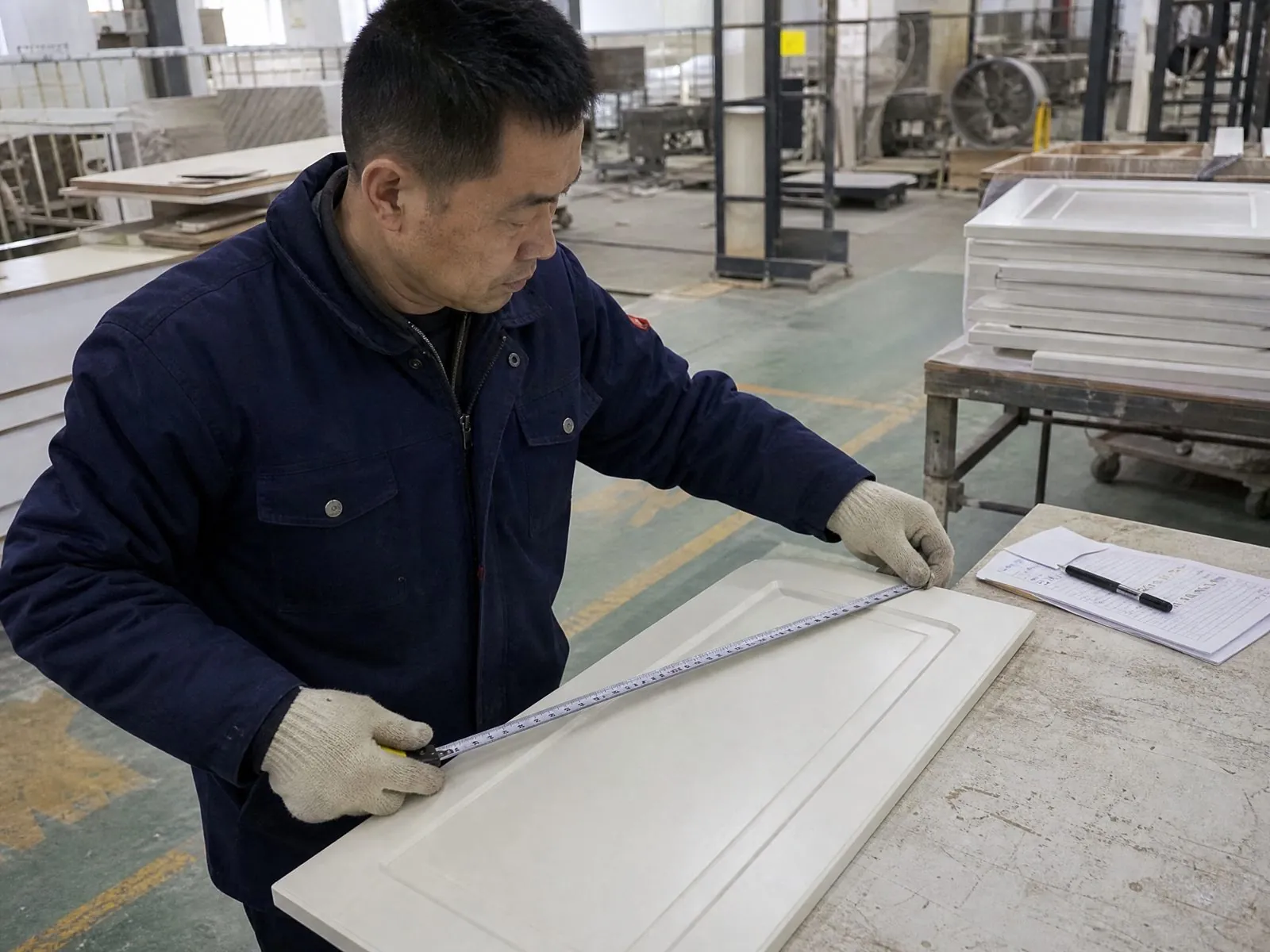
Measure sample units against approved shop drawings and record actual values, not only pass or fail. Recorded measurements help you see whether errors are random or systematic.
| Check Item | How to Check | What to Record |
|---|---|---|
| Overall width, height, depth | Tape or rule against drawing | Actual size and deviation |
| Diagonals of carcass | Measure both diagonals | Difference, as a sign of squareness |
| Door and drawer front sizes | Measure against drawing | Actual size and gaps after fitting |
| Hole positions | Check against hardware template | Misaligned or missing holes |
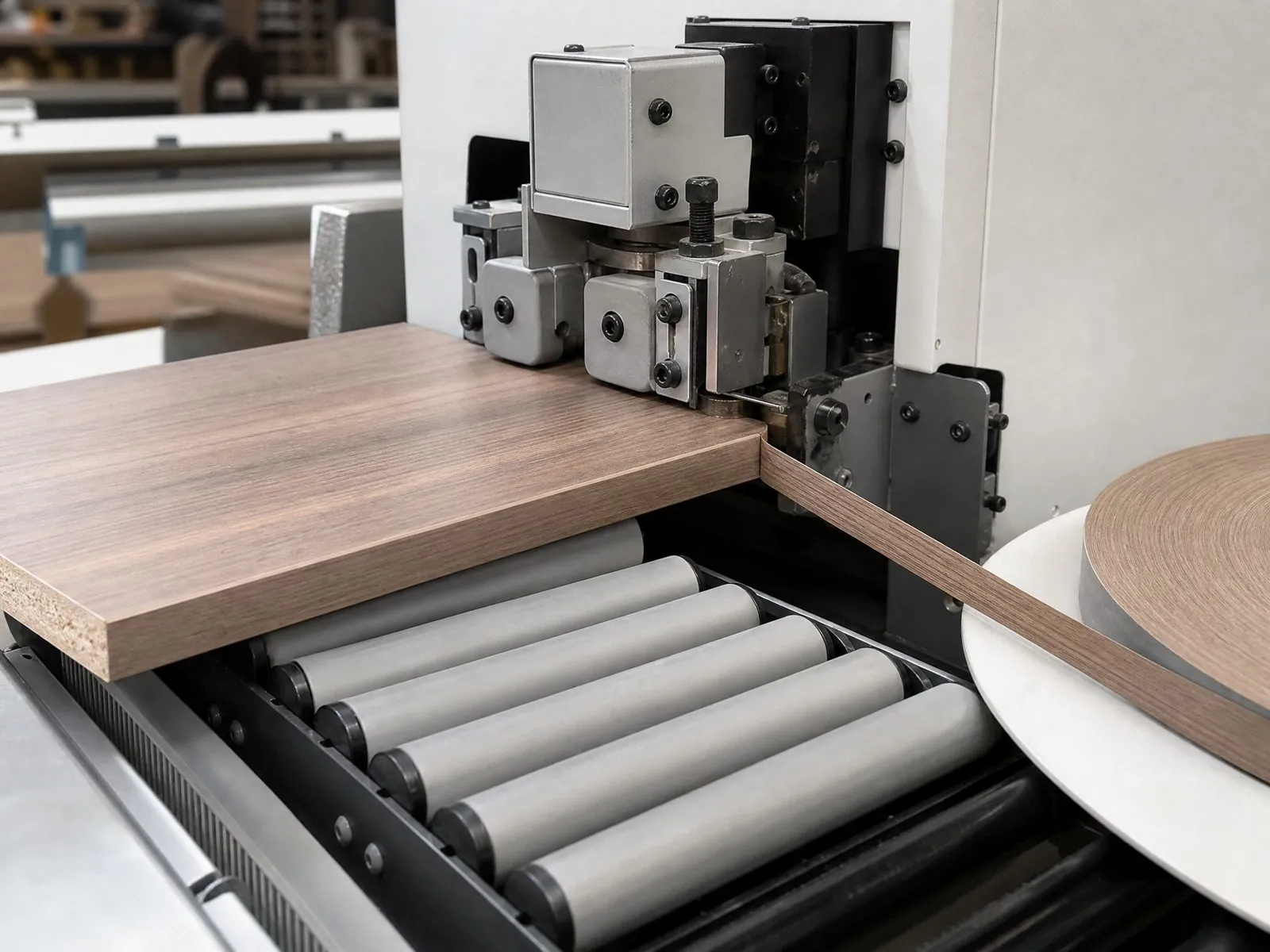
| Edge banding | Visual and touch check on all edges | Gaps, peeling, glue lines, sharp corners |
| Joints and assembly | Check connectors, dowels and glue | Loose joints, missing fittings |
| Back panels and shelves | Check fit and support | Gaps, sagging, missing shelf pins |
Tolerances should be agreed before production. Typical tolerances vary by component and market, so write the values you accept into the contract; where a factory standard has not been agreed, mark it as confirmed at quotation rather than leaving it to the inspector's judgment.
How Should Finish and Appearance Be Inspected?
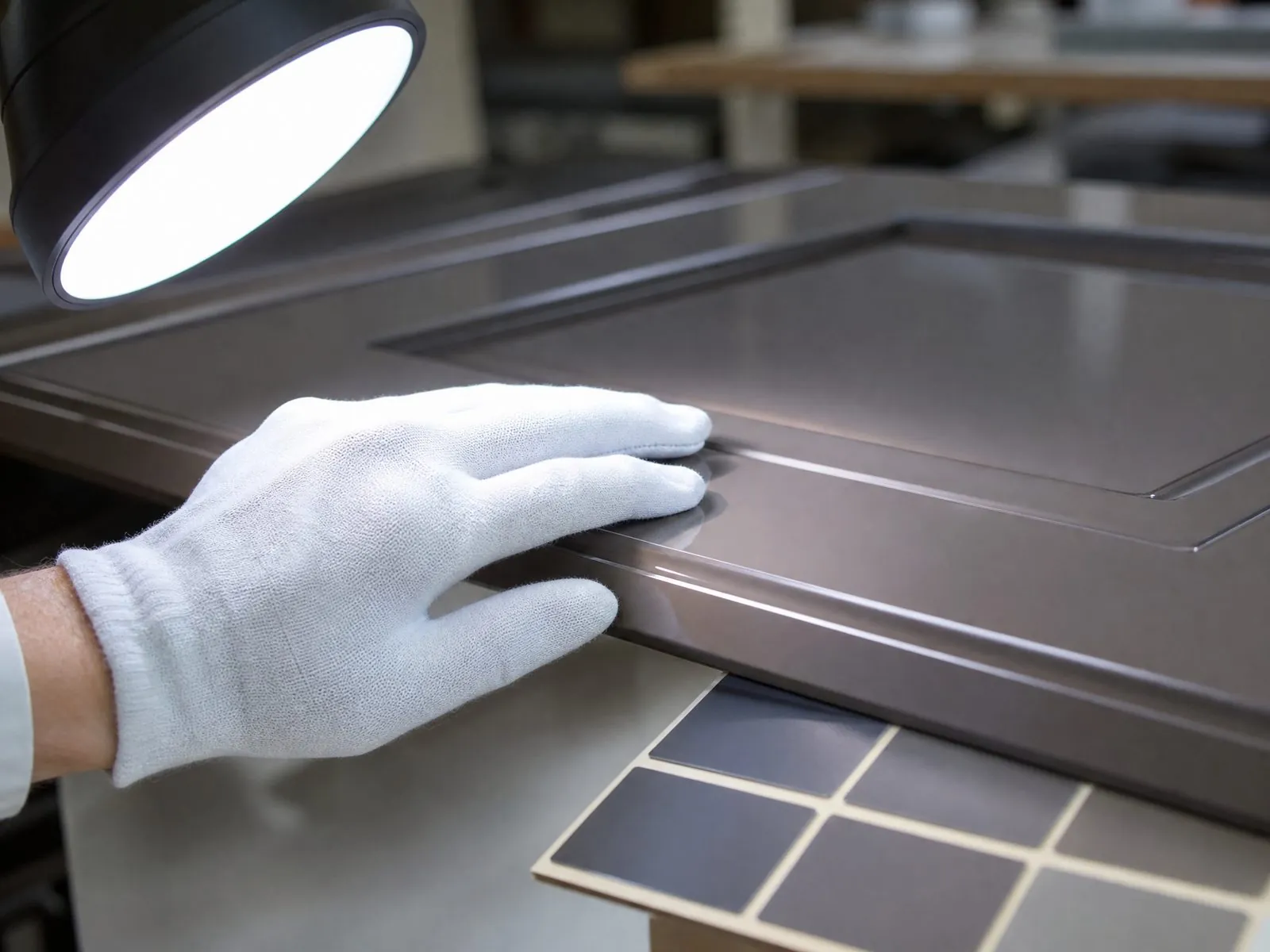
Inspect finish under consistent lighting, at a defined viewing distance, against the signed master sample. Appearance disputes are common because "acceptable" means different things to different people unless the method is fixed.
- Color and gloss: compare doors from different production batches side by side and against the master sample.
- Surface defects: check for dust particles, orange peel, runs, sanding marks and bubbles on painted doors.
- Wood veneer: check grain direction and matching across adjacent doors.
- Melamine and PET: check for scratches, chips at edges and pattern alignment on wood grain decors.
- Visible and hidden faces: agree which faces are visible after installation, since standards for hidden faces can be lower.
Ask the inspector to take close-up photos with a ruler or coin for scale, plus overview photos. Photos without reference make it hard to judge whether a defect is serious.
How Do You Test Hardware and Function?
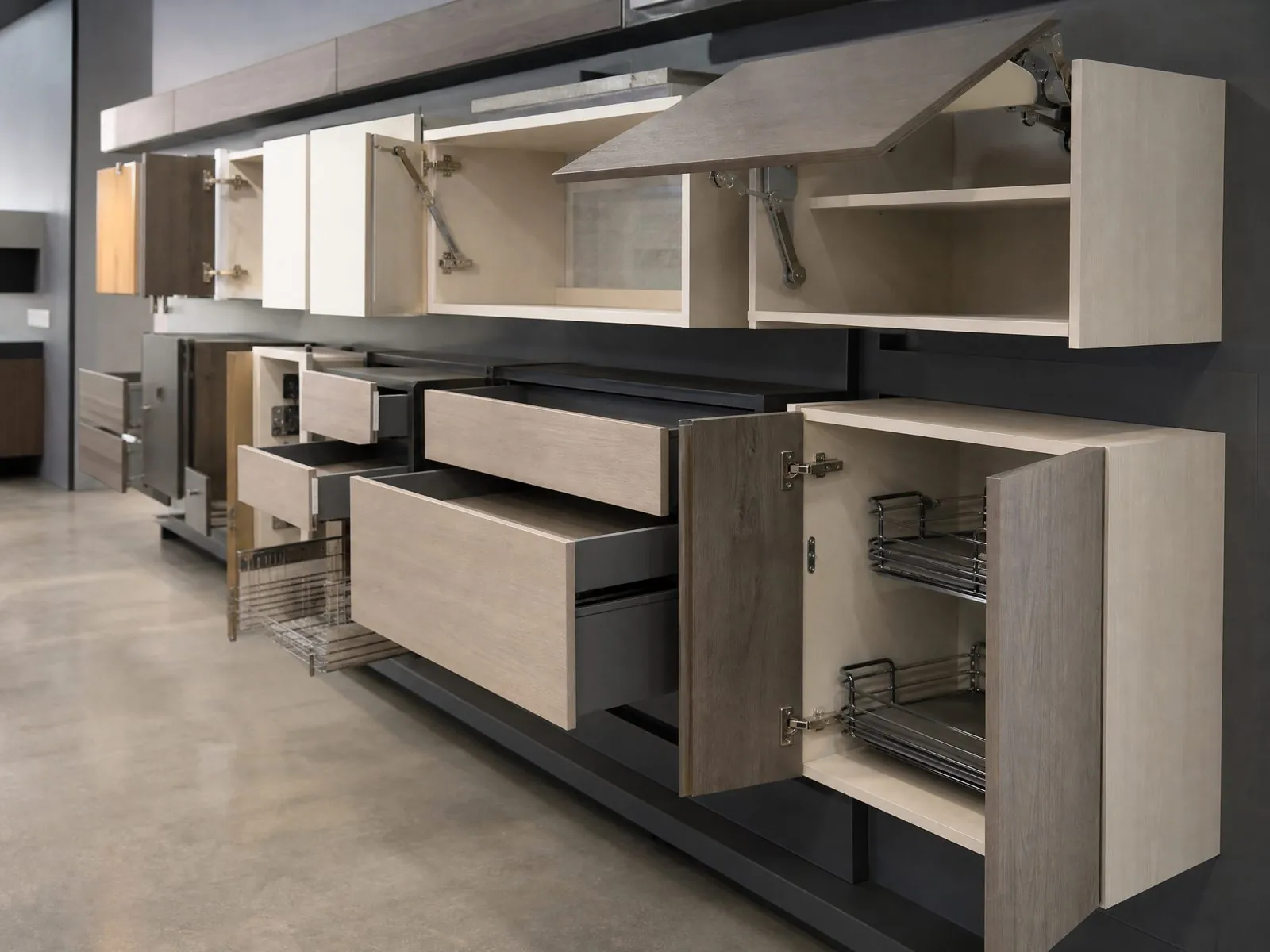
Functional tests confirm that cabinets work as specified, and they should be done on assembled sample units, not on loose parts. Hardware problems are often invisible until a door or drawer is used.
- Confirm hardware brand and model against the specification, including hinges, slides and lift systems.
- Open and close doors repeatedly; check soft-close action, alignment and gaps.
- Open drawers fully and check runner smoothness, soft-close and front alignment.
- Load drawers and shelves in line with any load test agreed in the contract.
- Check lift-up systems on wall cabinets hold their position.
- Check handles and knobs for secure fixing and correct position.
- Test any integrated lighting or electrical components, if included.
If hardware is shipped loose for site fitting, check that the correct quantities and models are packed with each unit.

What Should the Inspection Report Include?
A useful report gives a clear result, the evidence behind it and the actions required. Ask for a report format that includes:
- Overall result: pass, fail or pending with reasons
- Order information, inspection date, sample size and acceptance levels used
- Quantity and packing findings
- Defect list by class, with photos, location and quantity
- Measurement records against drawings
- Function test results
- Recommendations for rework and whether a re-inspection is needed
When an inspection fails, agree a rework plan, a re-inspection date and who pays for the re-inspection. Releasing goods "with comments" should be a deliberate decision, not a default.
Who should carry out the inspection?
Buyers can use their own staff, a local agent or an independent inspection company. Your own team knows the project best but may not be available at short notice. An independent inspector gives a neutral record that is useful in disputes, but needs a detailed cabinetry checklist and clear references. Whichever option you choose, keep the same inspector or team across phases where possible, so judgments stay consistent from the first batch to the last.
How Can Arcova Support Pre-Shipment Inspection?
Arcova includes inspection with photo reports as part of its service and supports buyer or third-party inspections at the Arcova Contract Manufacturing Base.
- Finish sample approval and mock-ups before mass production, giving clear inspection references
- Automated CNC cutting, edge banding and drilling lines for repeatable sizes and hole positions
- Hardware options from Blum, Hettich, Häfele, Salice, DTC and Hutlon, specified by model in the order
- Export packing labelled by unit and room
- ISO9001, BSCI and FSC certifications
- 24-hour online technical support and installation guidance
Read more about our quality control process, or contact us through the contact page to agree an inspection plan for your next order of kitchen cabinets or Built-In Wardrobes.