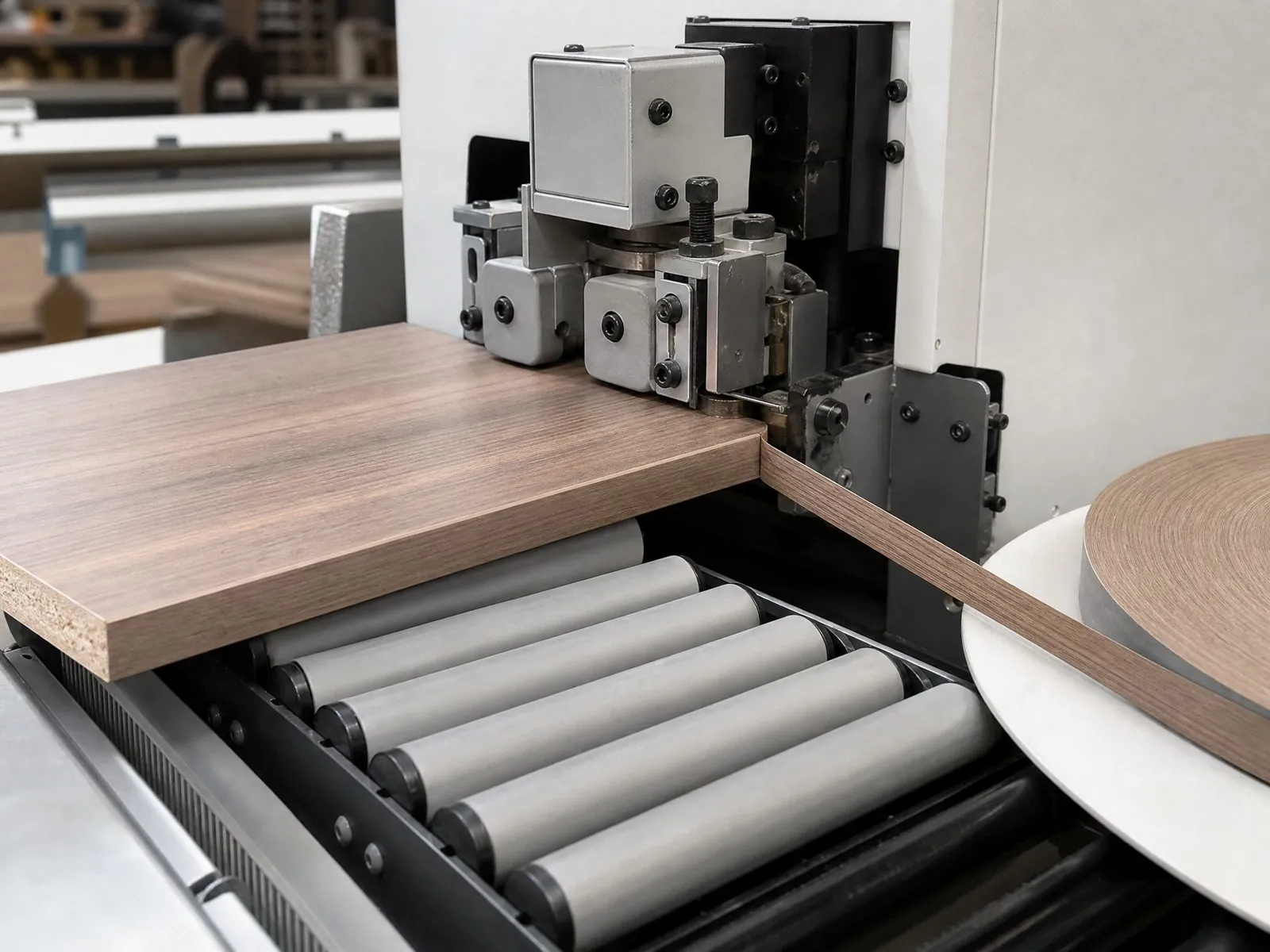
How PVC, ABS and laser zero-joint edge banding compare on appearance, moisture resistance, glue, thickness and inspection, and where each belongs in project cabinetry.
PVC, ABS or Laser Edging: Which Should You Specify?
For most project cabinetry, ABS edge banding applied with a good glue line is a reliable default; PVC is a lower-cost option widely used in many markets; and laser or hot-air edging (zero-joint edging) gives the cleanest look and the best moisture resistance at the joint, at a higher cost. "Laser" describes the bonding method, not the edge material: laser-ready edges are usually ABS or PP with a functional layer.
| Edge Type | Material and Bonding | Appearance | Moisture at Joint | Typical Use |
|---|---|---|---|---|
| PVC edge with hot-melt glue | Polyvinyl chloride strip, EVA or PUR glue | Good; thin visible glue line | Good with PUR glue, moderate with EVA | Budget and mid-range cabinetry |
| ABS edge with hot-melt glue | Acrylonitrile butadiene styrene, chlorine-free | Good; thin visible glue line | Good with PUR glue | Export projects, markets preferring chlorine-free materials |
| Laser or hot-air edge (zero joint) | Edge with a functional layer melted onto the board | Seamless; no glue line | Very good | Premium kitchens, high-gloss and light colors, wet areas |
| PP edge | Polypropylene strip | Similar to ABS | Depends on bonding | Markets with specific material preferences |
| Veneer or solid wood edge | Real wood strip or lipping | Matches veneer faces | Depends on finishing | Veneer furniture and joinery |
What Is the Difference Between PVC and ABS?
PVC and ABS look and perform similarly in daily use. The main differences are environmental profile, processing behavior and buyer preference in certain markets.
- Chlorine content: PVC contains chlorine; ABS does not. Some European buyers and green building programs prefer ABS for that reason.
- Processing: ABS can be slightly more brittle in cold conditions and needs careful trimming; PVC is flexible and forgiving.
- Color matching: both are available in solid colors, wood grains and high-gloss versions matched to board decors.
- Cost: PVC is often slightly cheaper; the difference is usually small compared with overall cabinet cost.
- Durability: both resist impact well when thick enough and properly bonded.
Choose ABS when the destination market, client or certification scheme asks for chlorine-free materials. Otherwise both are acceptable when the bonding is good.
How Does Laser or Zero-Joint Edging Work?
Zero-joint edging uses a special edge band with a pre-applied functional polymer layer. A laser, hot air or similar energy source melts that layer just before the edge is pressed onto the board, so the edge fuses to the panel without a separate glue line.
- Appearance: the joint is nearly invisible, which matters on white, light gray and high-gloss panels where a glue line shows.
- Moisture: with no glue line to absorb water or dirt, the joint resists moisture and stays clean.
- Heat: the bond is stable under normal kitchen heat.
- Cost: laser-ready edge bands and the machines cost more, so panels cost more.
Laser edging is valuable on visible door edges, sink cabinets and bathroom vanities. Many buyers use it only on doors and visible parts and use standard glued edges on interior carcass parts.
Which Glue Types Are Used With Conventional Edging?
When edges are glued, the glue type is as important as the edge material. Ask suppliers which glue they use on each part.
| Glue | Strength | Moisture and Heat Resistance | Note |
|---|---|---|---|
| EVA hot-melt | Good | Moderate; can soften with heat | Common, economical, glue line visible |
| PO (polyolefin) hot-melt | Good | Better than EVA | Thinner glue lines possible |
| PUR (polyurethane) hot-melt | Very good | High; cures with moisture | Preferred for kitchens and bathrooms |
For sink bases, vanities, laundry cabinets and outdoor or balcony units, PUR glue or laser edging is recommended. EVA is usually acceptable for dry areas such as wardrobes and living room furniture.
What Edge Thickness Should Be Used?
Edge thickness balances impact resistance with appearance. Thin edges are cheaper and look sharp; thick edges absorb knocks and can be radiused.
- Thin edges (around 0.4-1 mm as a general reference): internal shelves, back edges, hidden parts.
- Medium edges (around 1-2 mm): carcass front edges, standard doors.
- Thick edges (around 2-3 mm): high-impact areas, hotel and office furniture, edges that will be radiused.
These are typical industry ranges, not company standards. Confirm edge thickness per part on the shop drawings so it is consistent across the project.
How Do Edge Profiles Affect Durability?
The edge profile changes how the edge feels and how it resists damage. Specify it per part.
- Sharp square edge: modern look but chips more easily on impact.
- Small radius (around 1-2 mm): standard on many cabinets; softens the edge and reduces chipping.
- Larger radius: used on thick edges for hotel and office furniture.
- Chamfer: a small angled edge, often on handleless doors.
How Should Edge Color and Pattern Be Matched?
Edge color must match the board decor under different lighting. A poor match is the most common visual complaint in edge banding.
- Order edges from suppliers that match the specific board decor code.
- Approve a sample panel with board and edge together, not separately.
- For wood grains, check grain direction on the edge versus the face.
- For high-gloss boards, use high-gloss edges and check gloss level.
- Check the match under daylight and warm artificial light.
Contrast edges, such as black edges on white panels or wood edges on solid colors, can be a design choice. Specify them clearly on the drawing to avoid confusion.
Which Parts Should Be Edged and Which Can Stay Raw?
Edge every edge that is visible, touched or exposed to moisture. Leaving edges raw saves little and exposes the core to humidity.
- All visible front edges of carcasses, shelves and doors.
- All four edges of doors and drawer fronts.
- Back and bottom edges near sinks, dishwashers and floors.
- Edges around cut-outs for pipes, sockets and cables (sealed if not banded).
- Top edges of tall units visible from a staircase or mezzanine.
Hidden edges against walls can be left with a thin edge or sealer, depending on budget and moisture risk.
What Should Be Checked at Inspection?
Edge defects are easy to spot at the factory and expensive to fix on site. Include these checks in the inspection plan.
- Edges fully bonded, with no gaps, lifted corners or open joints.
- Glue line thin and even, with no squeeze-out.
- Edges flush-trimmed and radiused consistently, with no sharp burrs.
- Color and grain match approved samples.
- Corners neatly finished where two edges meet.
- No scorch marks on laser-edged panels.
How Does Edge Banding Affect Total Cost?
Edge banding is a small part of cabinet cost but a large part of perceived quality. Upgrading only visible door edges to laser edging or PUR glue usually adds little cost per cabinet while improving appearance and moisture resistance where it matters most.
When comparing quotations, ask each supplier to state edge material, thickness, glue type and bonding method per part. Two quotes with the same board can differ greatly in durability because of edging.
Why Does Edge Banding Fail, and How Can Buyers Prevent It?
Most edge banding failures come from the process, the board or the environment rather than from the edge material itself. A lifted edge is rarely solved by switching from PVC to ABS. It is solved by finding out why the bond failed, so ask for the cause before you accept a replacement batch or a change of specification.
| Symptom | Likely Cause | How to Prevent It |
|---|---|---|
| Edge peels away in long strips | Glue too cold, too little glue, or dusty panel edges | Ask for machine setting records and clean, freshly cut edges |
| Corners lift first | Poor corner trimming or repeated knocks in transit | Radius the corners and protect them in the carton |
| Swelling beside the edge | Water reaching the core through an open joint | Use a moisture-resistant bond and seal nearby cut-outs |
| Dark or dirty line at the joint | Thick glue line collecting dirt | Use PUR or zero-joint bonding on light-colored fronts |
| Edge shrinks back at panel ends | Tension or heat during application, or large temperature swings | Check a sample after exposure to site conditions |
| White marks on bent or trimmed edges | Stress in the edge material | Review trimming tools and the minimum bend radius |
Board quality matters as much as the glue. An edge bonds to the panel core, so a loose or porous core gives the glue less to hold, and the edge can pull away with core particles still attached to it. If failed edges come off carrying board material, the weak point is probably the core. If they come off clean, look first at the glue and the machine settings. This simple check on a failed sample tells you which conversation to have with your supplier.
Shipping and site conditions are the next risk. Cabinets may cross several climates and then wait on a damp site before anyone opens the cartons. A bond that looks perfect at the factory can weaken if panels stay wet or exposed to high heat for long periods.
- Store cartons indoors, off the floor and away from wet trades.
- Keep edge-banded parts out of direct sun near glazing during construction.
- Ask for moisture-barrier wrap on routes with long sea transit or humid destinations.
- Open a sample carton on arrival and check edges before the whole shipment is distributed.
Shaped parts need separate review. Curved tops, radiused shelf ends and tight internal corners may not run through an automated line, so they are often banded by hand or on a contour machine. Thicker edges also resist tight bends. Ask how each shaped part will be edged, and approve one finished part before batch production.
Finally, agree a site repair method in advance. Small lifted sections can often be re-bonded by a trained installer, but heat tools can mark gloss edges. Supply spare edge band in each decor, along with a short repair instruction, and specify when a door or panel should be replaced rather than repaired.
How Can Arcova Help With Edge Banding Choices?
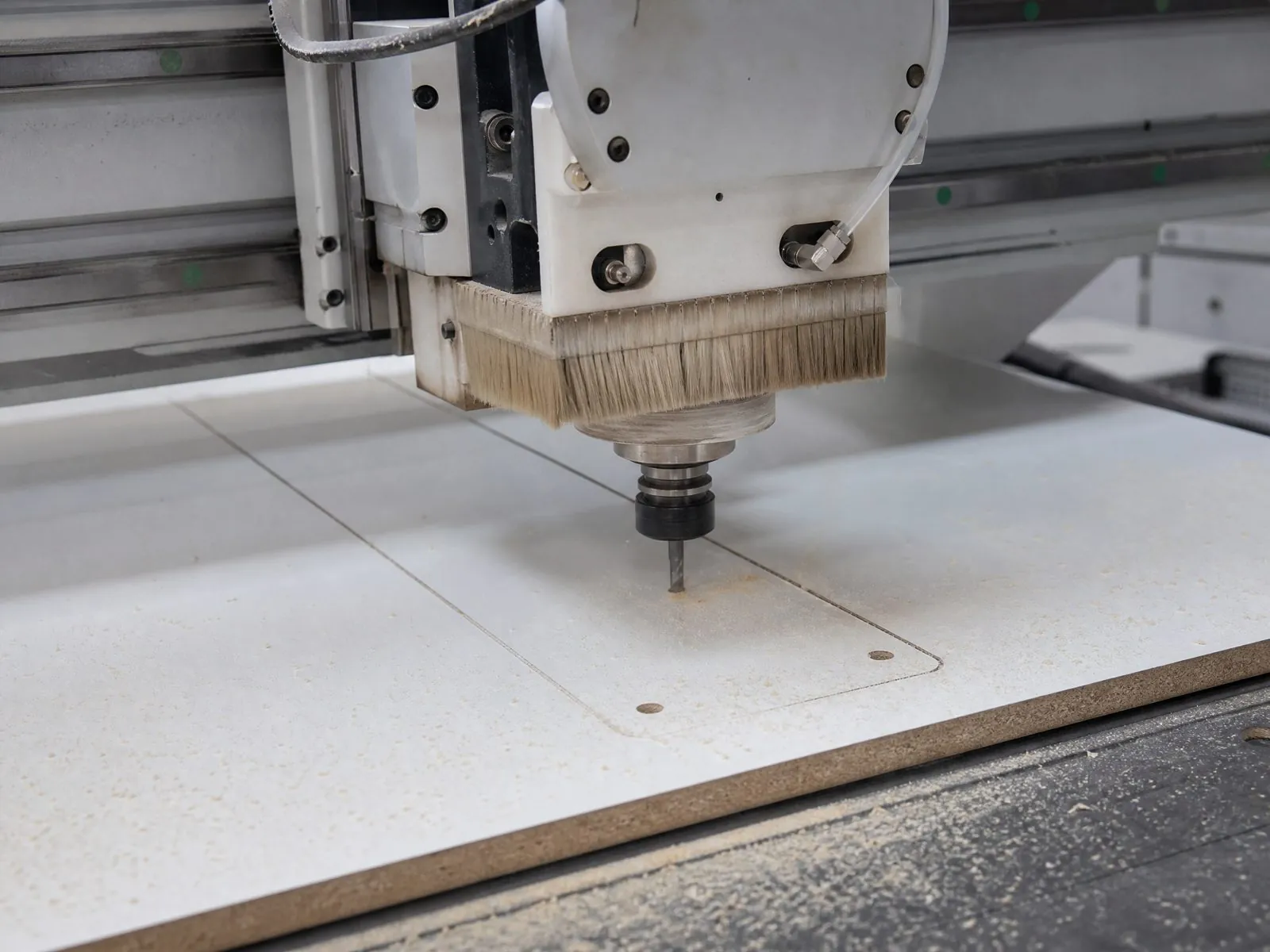
Arcova runs automated edge banding lines alongside CNC cutting and drilling lines in a 40,000 m² factory. We can specify edge material, thickness, profile and bonding per part, approve board-and-edge samples, and inspect edges in our photo-reported quality checks. Boards are available from EGGER, Kronospan and DARE, and certifications include ISO9001, BSCI and FSC. See our factory, quality process or contact our team.