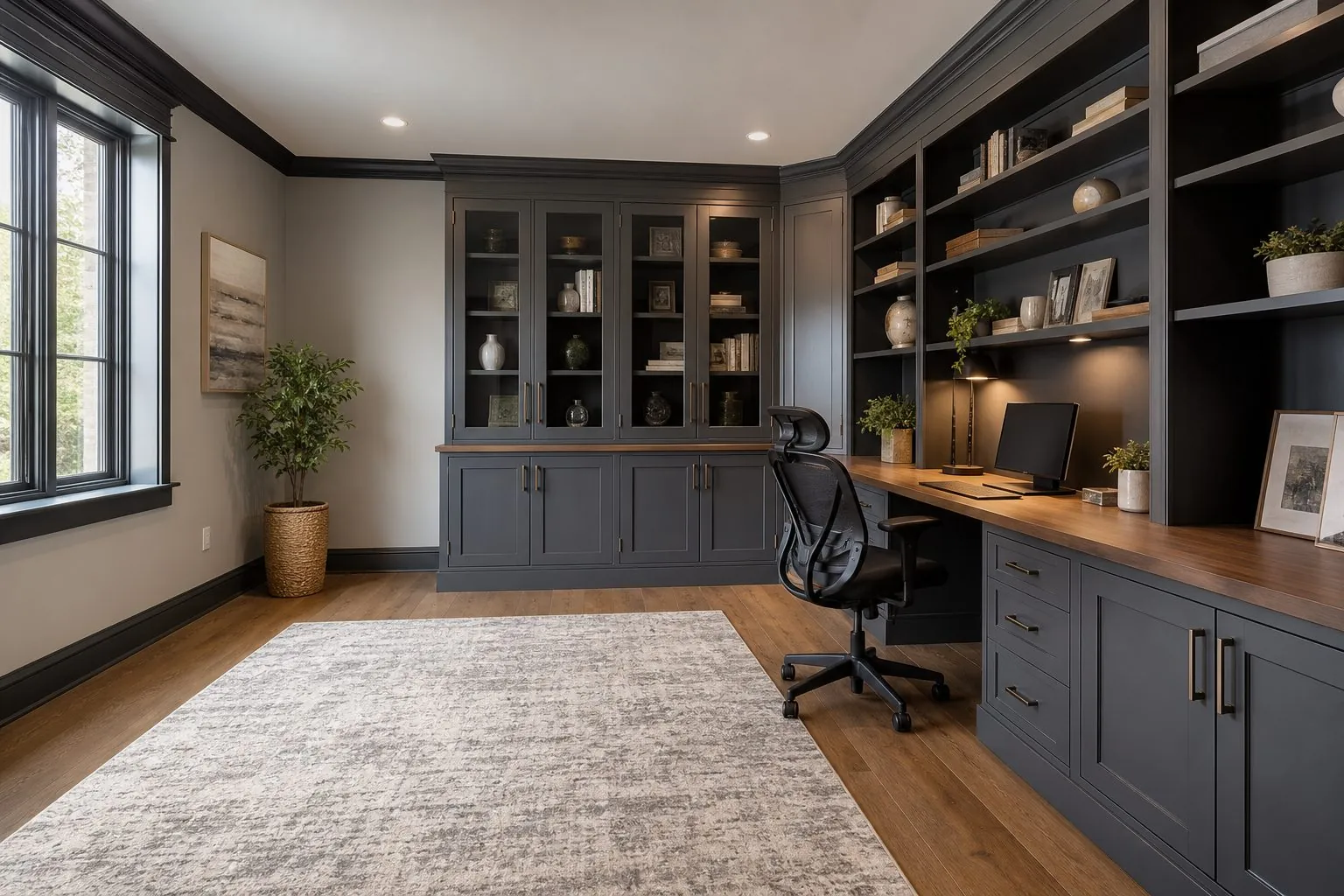
How to design study room bookcase walls that carry real book loads: shelf sag control, wall fixing, layouts, depths, desk integration, finishes and child safety.
What Makes a Study Room Bookcase Wall Work?
A successful study bookcase wall combines three things: shelves that do not sag under books, a layout that mixes open display with closed storage, and secure fixing to a wall that can carry the load. Appearance matters, but load planning comes first, because a filled bookcase is one of the heaviest pieces of joinery in a home or office.
Bookcase walls suit home studies, libraries, children's study rooms, executive offices and hotel lounges. They are less suitable on lightweight partitions that cannot take fixings, or in rooms where the wall must remain accessible for services. Before ordering, confirm the wall construction, ceiling height, what will be stored, and whether a desk, TV or window seat is integrated.
- Plan shelf spans from the weight of books, not from the look of empty shelves.
- Use closed base cabinets for files, printers and clutter.
- Keep the most-used books between waist and eye level.
- Fix the full wall securely and include anti-tip measures.

How Heavy Are Books, and Why Does It Matter?
Books are dense, and a full shelf can weigh far more than buyers expect. Hardcover books, reference volumes and binders are especially heavy. That weight acts on shelves, shelf supports, side panels and the wall fixings.
As a rough planning reference, a densely packed shelf of hardcover books can carry tens of kilograms per running meter; the real figure depends on book type and shelf depth. Rather than relying on general numbers, describe the expected contents to your manufacturer so they can choose shelf thickness, span and supports accordingly.
| Content Type | Relative Load | Design Response |
|---|---|---|
| Decorative objects, photos | Light | Standard shelves, longer spans acceptable |
| Paperbacks and novels | Medium | Moderate spans, standard shelf thickness |
| Hardcovers and art books | Heavy | Shorter spans, thicker or stiffened shelves |
| Binders, files, encyclopedias | Very heavy | Short spans, fixed shelves, strong supports |
How Do You Prevent Shelf Sag?
Shelf sag is controlled by span, shelf stiffness and support method. Reduce the span, increase stiffness or add support, and sag drops sharply. Doubling the span greatly increases deflection, so span is the most powerful lever.
- Shorten spans: use more vertical dividers on wide walls; many designers keep book shelves noticeably shorter than display shelves.
- Thicker shelves: a thicker shelf is much stiffer; specify thickness on the drawings for approval.
- Front lips and edging: a solid timber or doubled front edge stiffens the shelf and hides thickness changes.
- Hidden stiffeners: steel or aluminium profiles routed into the shelf underside for long spans.
- Back panel fixing: screwing shelves to a solid back panel adds support along the rear edge.
- Fixed shelves: fixed shelves connected to sides with dowels or connectors stiffen the whole unit.
Material matters too. Plywood and quality MDF behave differently from particle board under long-term load. Discuss the board choice with your manufacturer; boards can be sourced from EGGER, Kronospan or DARE.
How Should a Bookcase Wall Be Fixed to the Wall?
A bookcase wall must be fixed so it cannot tip forward, even when someone pulls on an upper shelf or a child climbs. Fixing method depends on the wall type.
| Wall Type | Typical Fixing Approach | Note |
|---|---|---|
| Concrete or solid masonry | Suitable anchors through hanging rails or carcass backs | Strongest and most reliable |
| Timber stud partition | Fix into studs or added blocking | Plan blocking before boarding |
| Metal stud partition | Fix into reinforced studs or backing plates | Coordinate with drywall contractor |
| Lightweight board without backing | Not recommended for heavy loads | Consider freestanding units fixed to floor |
Tall units should be fixed at the top as well as the middle. Floor-standing bookcases rest their weight on the floor, so leveling feet or a plinth must sit on a solid floor, and the wall fixings mainly resist tipping. Wall-hung floating shelves, by contrast, put the full load on the wall.
Uneven walls and floors are common, especially in older buildings. Shop drawings should allow scribe fillers at walls and ceiling and adjustable feet or a leveling plinth at the base, so the bookcase can stand plumb and level. A bookcase that leans slightly forward is both unsafe and visually obvious once shelves are filled, because books exaggerate any tilt. Fixing brackets should be positioned where the installer can reach them after the unit is in place, typically through the back rail behind the top shelf.
Which Layouts Suit a Study Room?
Most study bookcase walls combine closed base storage, open shelves above and an integrated desk or reading zone. The layout should reflect how the room is used.
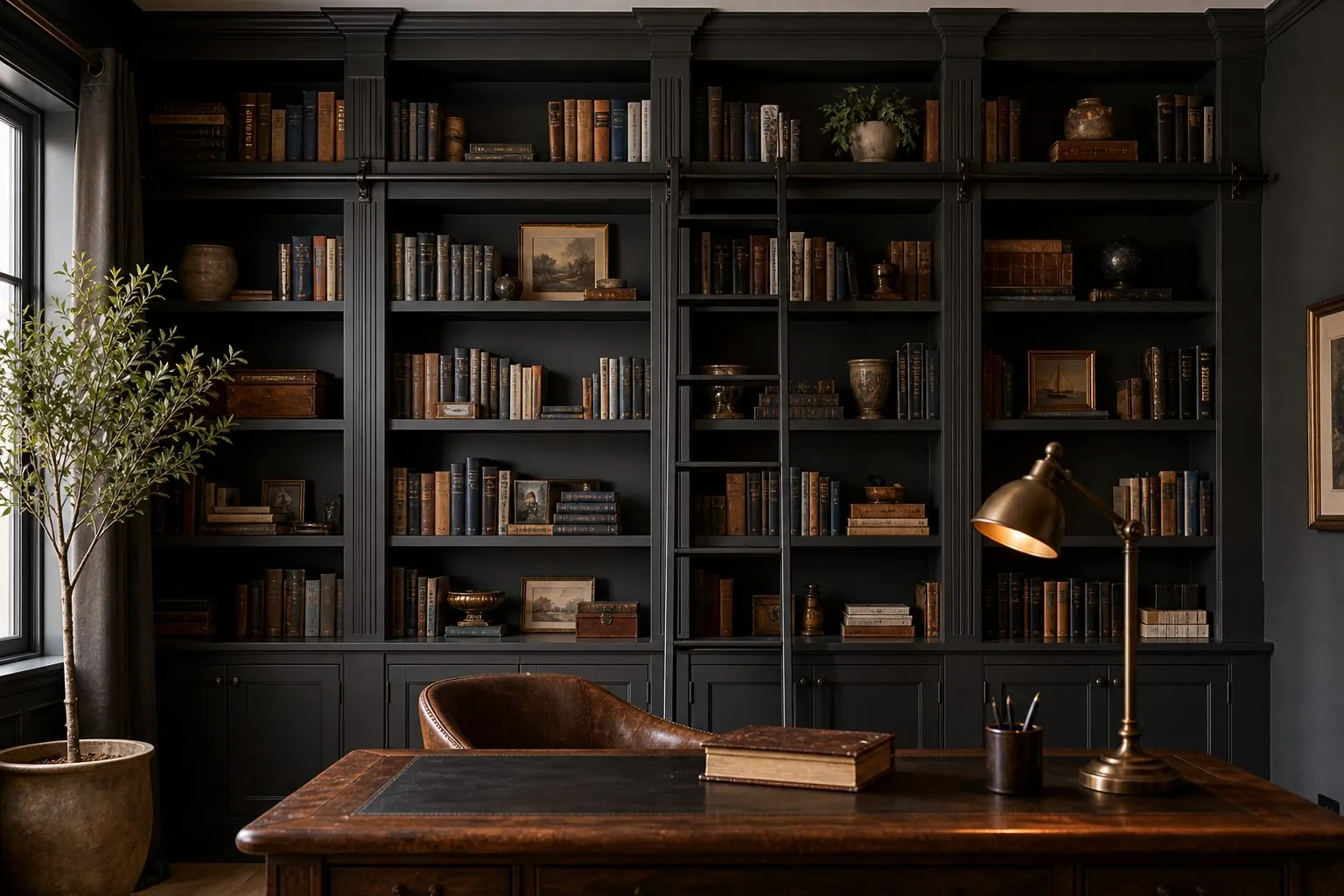
- Full library wall: floor-to-ceiling open shelves, sometimes with a rolling library ladder.
- Base cabinets and open shelves: doors or drawers below to hide files and equipment, open shelves above for books.
- Bookcase with integrated desk: a desk section in the middle, shelves around it and cable routes for computers.
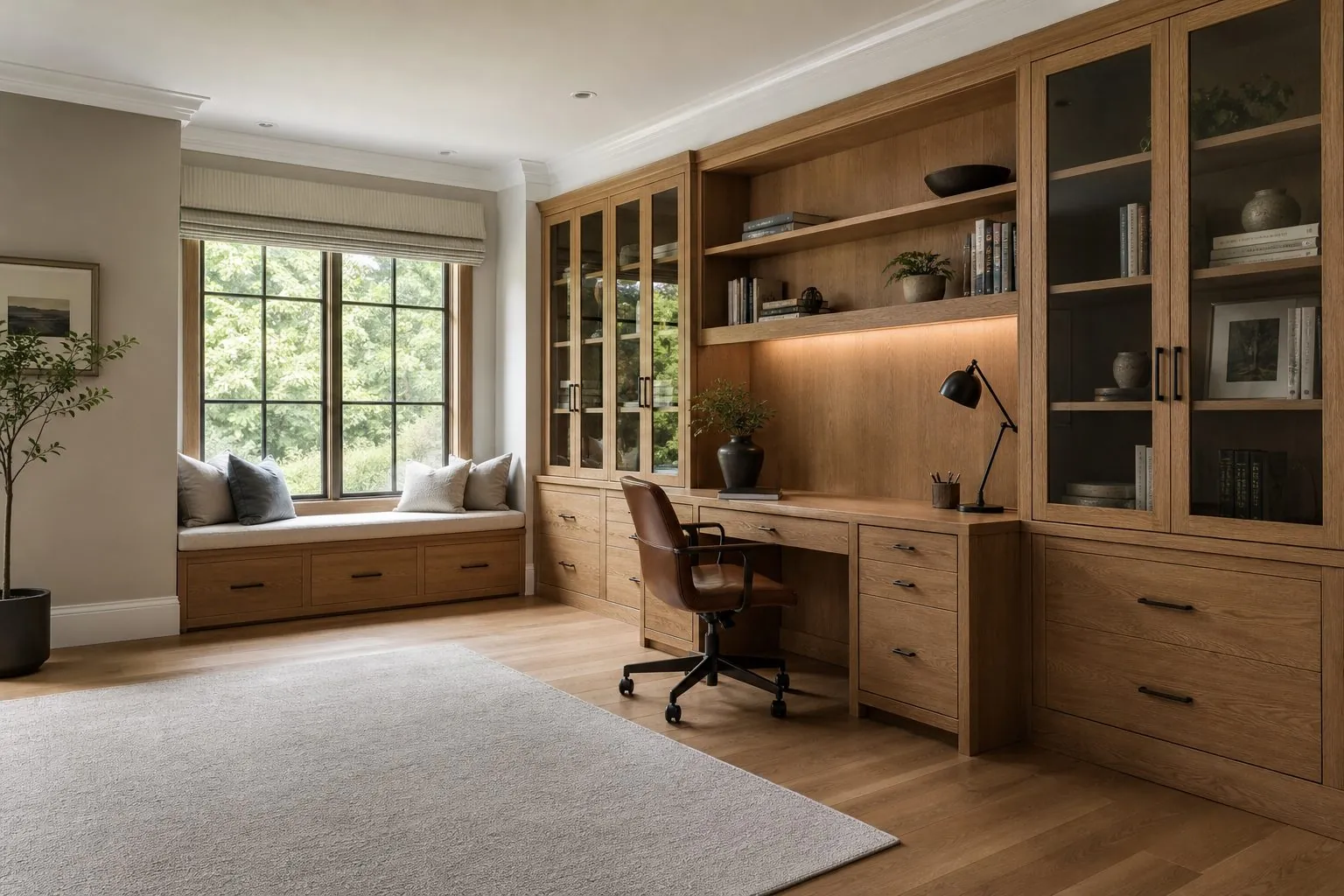
- Window-framing bookcase: shelves on both sides of a window with a window seat below.
- Bookcase with TV or media niche: for study-family rooms used for both work and relaxing.
Base cabinets are usually deeper than book shelves, giving a worktop ledge for printers and lamps. Book shelves can be shallower, since most books do not need full cabinet depth.
What Depth and Shelf Spacing Should You Use?
Choose depth by book size and shelf spacing by book height. Excess depth wastes space and lets books get pushed back; too little depth leaves large books overhanging.
- Many paperback and novel collections fit comfortably on relatively shallow shelves.
- Large art books, atlases and binders need deeper shelves; dedicate a few lower shelves to them.
- Adjustable shelf pins with regular spacing let owners adapt to their collection.
- Lower shelves are often taller to hold larger, heavier books near the floor for stability.
Any figures should be confirmed against the owner's real collection. For hotel lounges and offices, where contents are decorative or mixed, standard shelf spacing with adjustability is usually sufficient.
A practical approach for private studies is to ask the owner to measure their collection in running meters by category: paperbacks, hardcovers, oversized books and files. The manufacturer can then allocate shelf length per category, add an allowance for growth and set fixed shelves where heavy categories sit. This avoids the common outcome where a beautiful wall is too short for the collection, or where oversized books end up stacked flat because no shelf is tall or deep enough. In project apartments, where the owner is unknown, a mix of standard and taller shelves with adjustable pins covers most needs.
How Do You Integrate Desks, Lighting and Cables?
Integration turns a bookcase into a working study. Plan the desk, lighting and power on the same drawing as the shelves.
- Desk section: set the desk height for the user and leave knee clearance; add drawers or a pedestal on one side.
- Cable management: grommets in the desk top, cable channels behind panels and access to sockets.
- Task lighting: LED strips under the shelf above the desk light the work surface.
- Shelf lighting: vertical profiles or under-shelf strips add evening atmosphere; route cables inside uprights.
- Ventilation: closed compartments for printers, routers or computers need ventilation openings.
Mark driver locations, switches and socket heights on the drawings so the factory machines grooves and holes before finishing.
Rolling library ladders are a popular feature on tall bookcase walls. They run on a rail fixed across the upper part of the bookcase, so the rail position, the structural fixing behind it and the clearance at the base must be designed together. The ladder supplier's guidance on rail height and load should be followed, and the bookcase uprights reinforced where rail brackets attach.
Which Finishes Work Best for Study Bookcases?
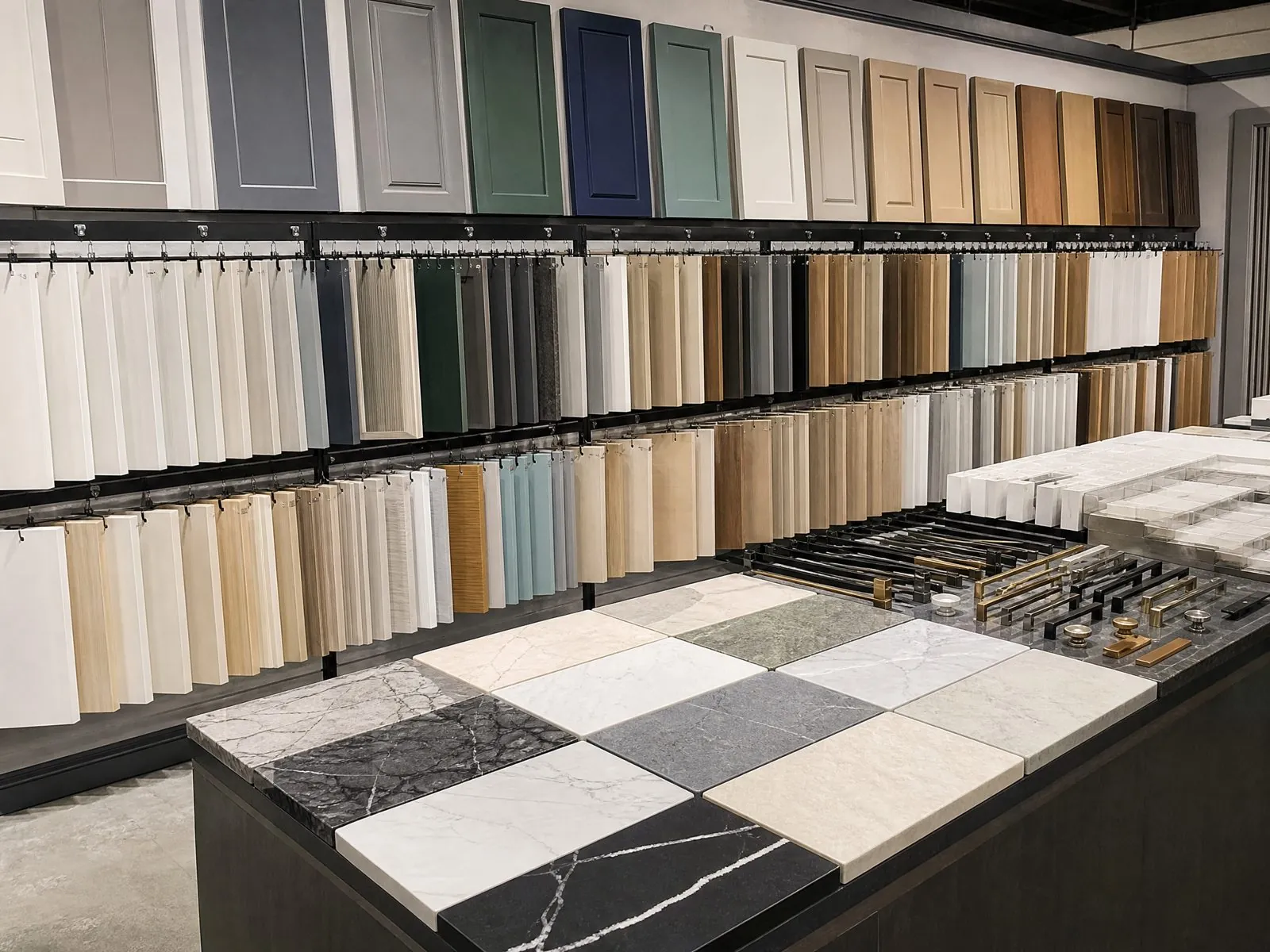
Choose the finish for durability on edges and shelf fronts, which take the most contact. Wood veneer gives a classic library feel and suits executive offices and villas. Lacquer offers custom colors, popular for painted library walls, but shelf edges can chip. Melamine and laminate are practical and economical for children's study rooms and project apartments.
| Finish | Best For | Watch Out For |
|---|---|---|
| Wood veneer | Libraries, executive studies | Natural color variation; approve samples |
| Lacquer | Painted library walls | Edge chipping on heavily used shelves |
| Melamine | Kids' rooms, apartments | Edge banding quality on visible edges |
| Laminate | Offices, high-use areas | Limited profiled details |
Because open shelving shows every edge, specify full edge banding or solid edging on all visible shelf fronts and uprights.
What Safety Points Matter in Children's Study Rooms?
In children's rooms, bookcases must resist tipping and climbing. Always fix units to the wall with anti-tip hardware, keep heavy items on lower shelves and avoid shelves that look like a ladder in front of windows.
- Round over exposed corners and edges at child height.
- Use soft-close hinges and runners to protect fingers.
- Avoid glass doors at low level unless safety glass is used.
- Check the destination market's rules for children's furniture.
Adjustable shelves and modular sections allow the bookcase to grow with the child, from toys and picture books to school files. Open low cubbies with fabric bins suit younger children.
How Can Arcova Help With Study Room Bookcase Walls?
Arcova manufactures bookcase walls as part of our study furniture and kids' room furniture ranges in a 40,000 m² factory with automated CNC cutting, edge banding and drilling lines. We prepare shop drawings showing shelf spans, stiffeners, fixing points and lighting routes, approve finish samples, and inspect production with photo reports before export packing labelled by unit and room.
Our factory holds ISO9001, BSCI and FSC certifications and provides 24-hour online technical support with installation guidance. Send your study room elevations for a bookcase layout and quotation.