How to specify upholstered headboards for hotels and homes, covering formats, fabrics, fire requirements, construction, electrical integration, installation and maintenance.
What Is a Wall-Mounted Upholstered Headboard?
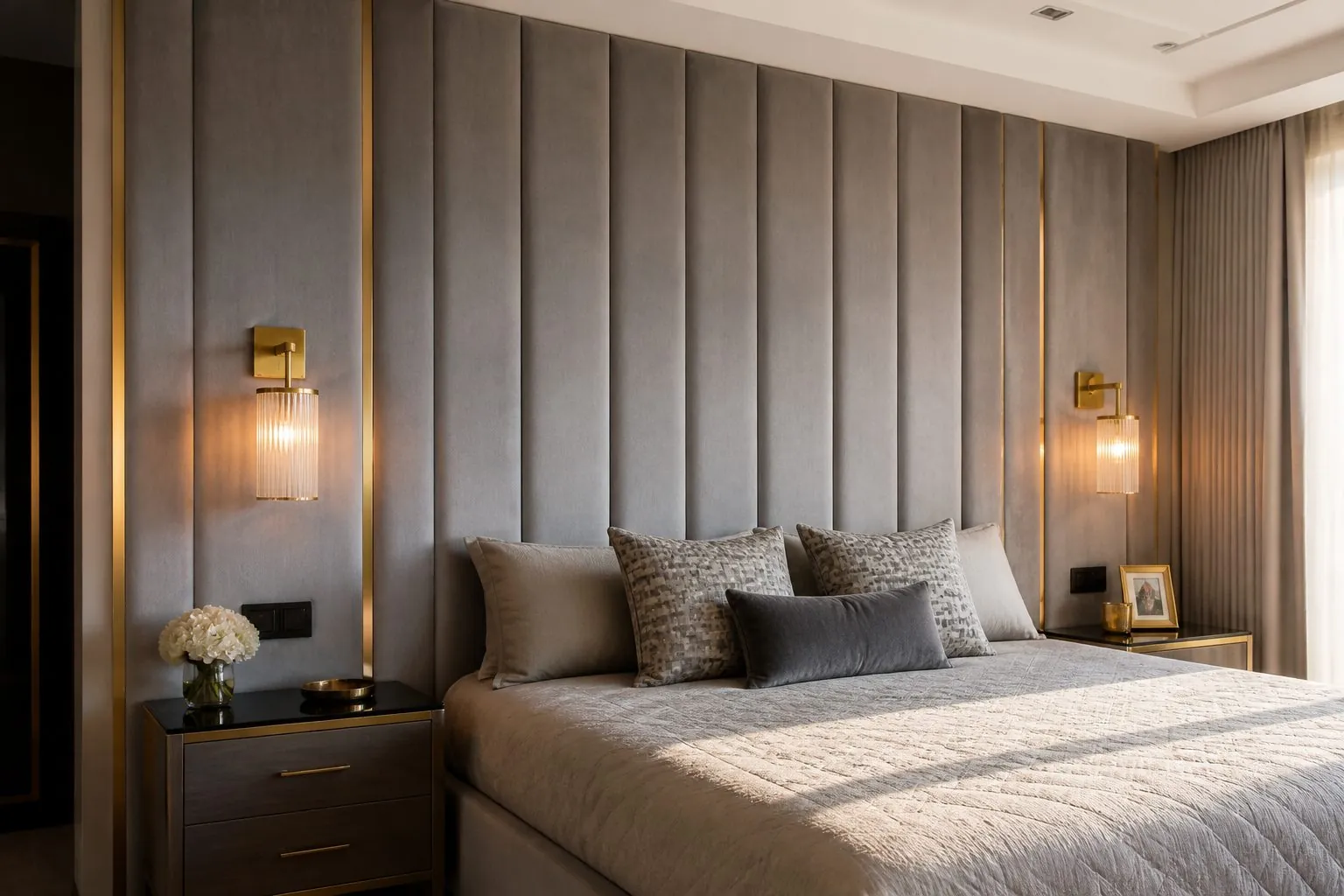
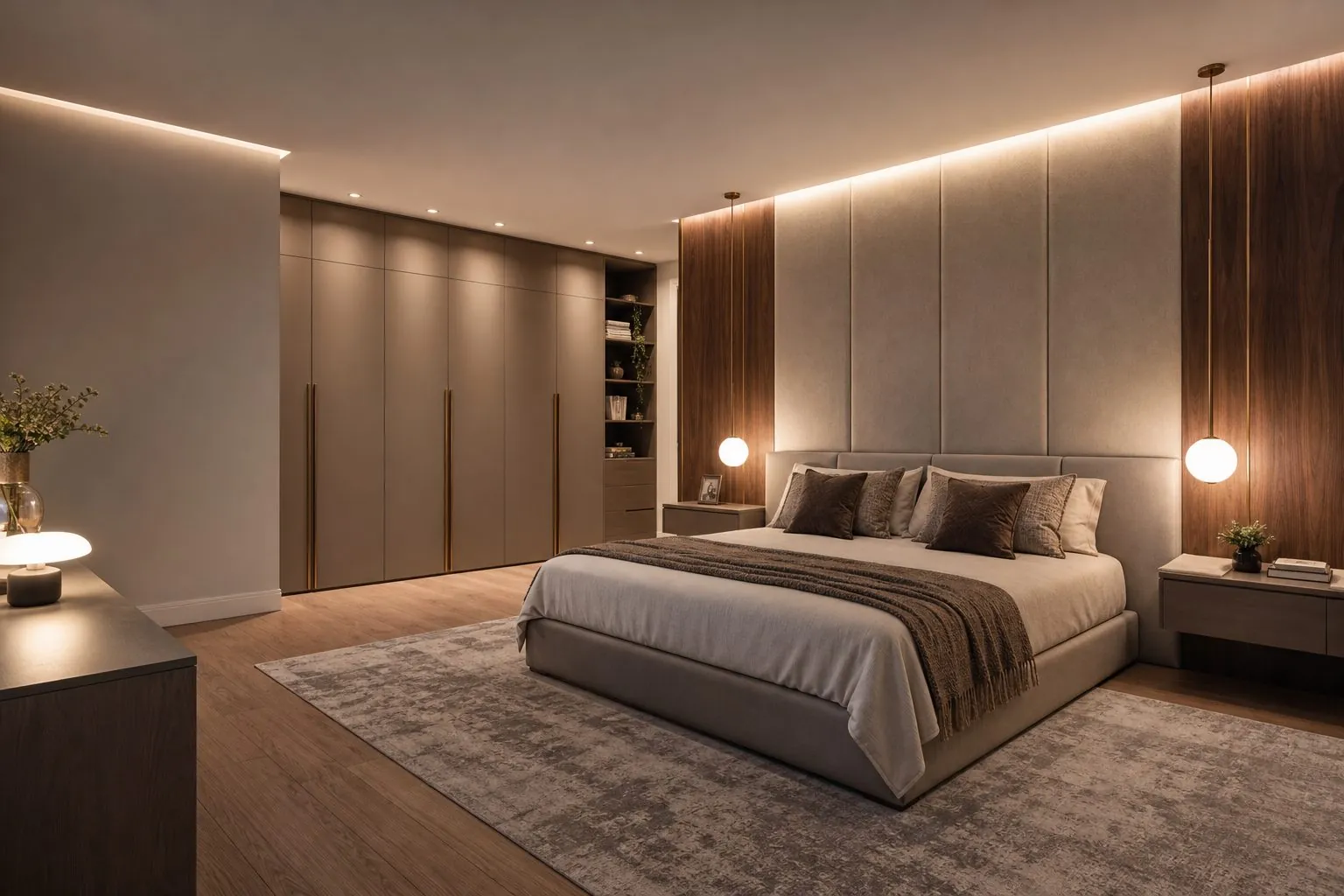
A wall-mounted upholstered headboard is a fabric- or leather-covered headboard fixed to the wall behind the bed, often running wider than the bed and sometimes up to the ceiling. It replaces a free-standing headboard, softens the room acoustically and becomes the main design feature of the bedroom.
For hotels, the panel also solves practical problems. It protects the wall from scuffs, hides cabling for reading lights and sockets, and can integrate bedside shelves. For homes, it creates a hotel-style look without the bulk of a large bed frame.
| Format | Typical Size Logic | Where It Fits |
|---|---|---|
| Bed-width panel | Matches bed width, mid-height | Standard hotel rooms, apartments |
| Wide panel with nightstands | Bed plus bedside zones | Hotel rooms, master bedrooms |
| Full-height panel | Floor or bed level to ceiling | Suites, villas, boutique hotels |
| Full-width headboard | Entire bed wall | Feature rooms, show flats |
| Modular tiles | Repeated upholstered modules | Flexible layouts, easy replacement |
Is a Wall-Mounted Headboard Better Than a Free-Standing One?
A wall-mounted headboard is usually better for hotels and built-in bedroom schemes, while a free-standing headboard suits homes where the bed may move. Wall-mounted headboards are cleaner, easier to housekeep and harder to damage, but they fix the bed position.
- Housekeeping: beds can be pulled out for cleaning without moving a heavy headboard.
- Durability: fixed panels do not knock against the wall or loosen over time.
- Integration: lights, switches, USB points and shelves can be built in.
- Flexibility: free-standing headboards allow changing the room layout later.
- Installation: wall-mounted headboards need prepared walls and accurate setting out.
For homes, choose a wall-mounted headboard if the bed position is fixed by window and door locations. For hotels, the wall-mounted headboard is almost always the more practical option.
Which Fabrics and Materials Work Best?
Choose fabric for durability, cleaning and fire performance first, then color and texture. Hotel panels face guests leaning back, room service trays, makeup, hair oil and frequent cleaning, so appearance alone is not a good selection criterion.
| Covering | Look and Feel | Strengths | Considerations |
|---|---|---|---|
| Contract fabric | Woven textures, wide colors | Durable, hotel-grade options | Check abrasion and fire documentation |
| Performance velvet | Rich, soft | Premium feel | Shows pressure marks; brush maintenance |
| Faux leather | Smooth, wipeable | Easy to clean | Can feel cold; check quality grade |
| Genuine leather | Natural, premium | Ages well | Higher cost, needs care |
| Fabric with stain treatment | Varied | Easier maintenance | Treatment may affect feel |
Ask the fabric supplier for abrasion, light fastness and fire test reports where required. Arcova does not publish its own fabric ratings; required values are confirmed at quotation against the project specification.
What Fire and Safety Requirements Apply?
Hotels and public buildings usually need upholstered headboards to meet local fire regulations, and the requirement applies to the full assembly, not just the fabric. Confirm the standard early, because it affects the core board, foam, fabric and adhesive.
- Identify the fire regulation for wall linings and upholstery in the destination country.
- Check whether the hotel brand standard adds stricter requirements.
- Select core boards, foam and fabric with suitable documentation.
- Confirm whether a full assembly test is needed.
- Keep certificates for handover and inspections.
Homes usually have fewer formal rules, but choosing flame-retardant foam and avoiding panels close to heaters or candles is still sensible.
How Are Headboard Panels Constructed?
A good headboard panel has a stable core board, a foam layer chosen for comfort and shape, and fabric stretched and fixed evenly at the back. Construction quality shows in straight edges, consistent tension and corners without wrinkles.
- Core: MDF, plywood or fire-rated board, machined for fixings and cut-outs.
- Foam: density and thickness set the softness and profile; firmer foam keeps shape longer.
- Wadding: optional layer for a rounded, softer edge.
- Fabric fixing: stapled and glued at the back with even tension.
- Detailing: piping, channels, tufting or panel grooves, sewn or formed into the foam.
Panel and foam thickness should be agreed on drawings for each project. Arcova confirms these values per specification; they are confirmed at quotation rather than fixed standards.
How Should Lighting, Sockets and Nightstands Be Integrated?
Plan electrical items with the panel design, not after it. Moving a reading light or socket after production usually means a new panel. Freeze switch and socket positions on electrical drawings before panels are cut.
| Integration | Planning Point |
|---|---|
| Reading lights | Height above mattress and beam angle |
| Sockets and USB | Reach from bed and local plug standard |
| Master switch | Consistent position across room types |
| LED strip | Driver location and maintenance access |
| Floating nightstands | Structural fixing behind the panel |
Upholstered panels often sit next to wooden side panels or nightstands. See our hotel furniture range for coordinated headboard and casegoods packages.
How Are Upholstered Headboards Installed?
Most wall-mounted headboards hang on concealed cleats or metal rails fixed to the wall, which keeps them tight to the wall and allows removal for maintenance. The wall must be flat, strong enough and ready before installation.
- Confirm wall construction and add blocking in lightweight partitions.
- Mark rail or cleat positions from shop drawings and room setting-out.
- Fix rails level; any error shows in long panel joints.
- Connect electrical items before hanging panels.
- Hang panels from center outward and check joints and alignment.
- Protect upholstery until final cleaning and handover.
Panels are labelled by room and position so installers can work quickly on large hotel floors.
How Do You Maintain and Replace Upholstered Panels?
Design headboards for replacement from the start. Upholstery wears faster than wooden joinery, and hotels often refresh fabric during renovation cycles without changing the rest of the room.
- Use removable panels on cleats so a single panel can be taken down.
- Keep spare panels or fabric from the same batch for repairs.
- Vacuum regularly and spot-clean following the fabric supplier's guidance.
- Avoid oily hair products contact zones by choosing darker colors or wipeable lower sections.
- Record fabric codes and panel references in the maintenance file.
For homes, removable panels make it easier to change the room style later.
Plan the refresh cycle at design stage. If the operator expects to reupholster panels during a soft renovation, specify a core and fixing system that allows panels to be removed, recovered off site and rehung without damaging the wall. Recording the original foam specification also helps the upholsterer match the profile, so refreshed panels look the same as the untouched ones in other rooms.
How Do You Size and Design a Headboard Panel?
Size the panel from the bed, the nightstands and the ceiling, then choose the pattern. A panel that is slightly too narrow makes a king bed look squeezed, while a panel that stops at an awkward height cuts the wall in a way guests notice immediately.
Start with the mattress width and add the bedside zones if nightstands, lights or sockets will sit within the panel. Then decide the top line. Many hotels align the panel top with a door head, a window head or a ceiling reveal so the room reads as one composition. Full-height panels hide uneven walls and make low rooms feel taller, but they use more material and need more careful joint planning.
| Design Choice | Effect in the Room | Planning Note |
|---|---|---|
| Vertical channels | Adds height, modern look | Joint positions must align with bed center |
| Horizontal panels | Widens narrow rooms | Long joints show any wall unevenness |
| Grid or tiles | Tailored, boutique style | More joints; easier to replace single modules |
| Plain stretched panel | Calm, minimal | Fabric tension must be very even |
| Tufted or buttoned | Classic, residential feel | Buttons can collect dust; check cleaning routine |
Keep the bottom edge of the panel safely above the mattress top, or set it behind the bed base so the mattress does not rub fabric. For room types with twin beds that may be converted to a king, design the panel width and electrical points to work for both layouts. This avoids a second set of panels when the operator changes room configuration.
Color and pattern should also consider housekeeping. Light fabrics show head marks at pillow height first. Many hotels choose a mid-tone fabric or add a wipeable band at pillow level to keep panels looking fresh between deep cleans.
How Should Hotels Plan Headboard Panels Across Many Rooms?
Plan headboard panels by room type, not room by room. Grouping rooms into a small number of panel types reduces drawing work, simplifies production and makes spare parts easier to manage over the life of the hotel.
- List all room types with bed sizes and quantities.
- Define one panel layout per room type, including mirrored versions for handed rooms.
- Freeze electrical positions per room type on shop drawings.
- Approve fabric and finish samples, then build a mock-up room.
- Record mock-up comments and update drawings before mass production.
- Plan packing and labels by floor and room number to match the installation sequence.
Ordering a small quantity of spare panels per type, from the same fabric batch, is cheaper than reordering later when batch color may differ. Keep panel references in the hotel maintenance system so the operations team can request exact replacements.
How Can Arcova Help With Upholstered Headboards?
Arcova makes upholstered headboards as part of complete bedroom and hotel joinery packages. We deepen drawings, prepare 3D views, approve fabric and finish samples and can build mock-up rooms for hotel approval.
Production takes place in the Arcova Contract Manufacturing Base, a 40,000 m² factory with 12 production lines and monthly capacity of 40 × 40HQ containers. Certifications include ISO9001, BSCI and FSC.
- Headboards with integrated lighting cut-outs, shelves and nightstands
- Inspection with photo reports
- Export packing labelled by room
- Installation guidance and 24-hour online technical support
Explore bedroom furniture or send your room drawings for a project review.