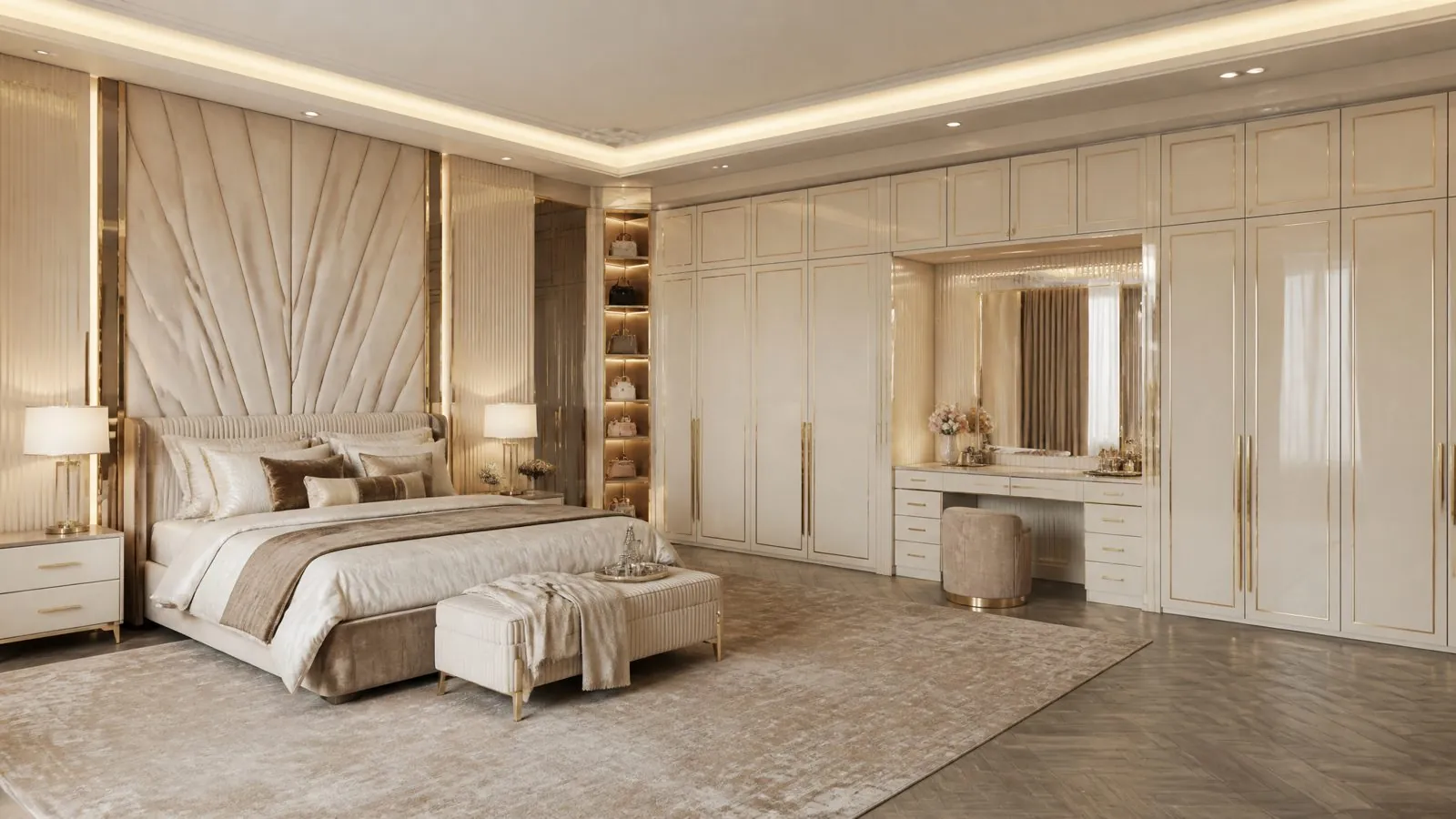
A practical buyer guide to sourcing custom bedroom furniture for hotels and residential projects: scope, drawings, materials, hardware, samples, packing and quality checks.
What Should Buyers Decide Before Sourcing Custom Bedroom Furniture?
Decide the scope, the budget level per room and the delivery format before you contact any factory. Most delays in bedroom furniture sourcing come from unclear scope, not from production. When a buyer sends a floor plan without saying which items are included, the factory has to guess, and every guess becomes a revision later.
For a hotel, apartment or residential project, a bedroom package usually includes some or all of these items:
- Bed frame or headboard panel, sometimes with integrated bedside shelves
- Bedside tables, floating or freestanding
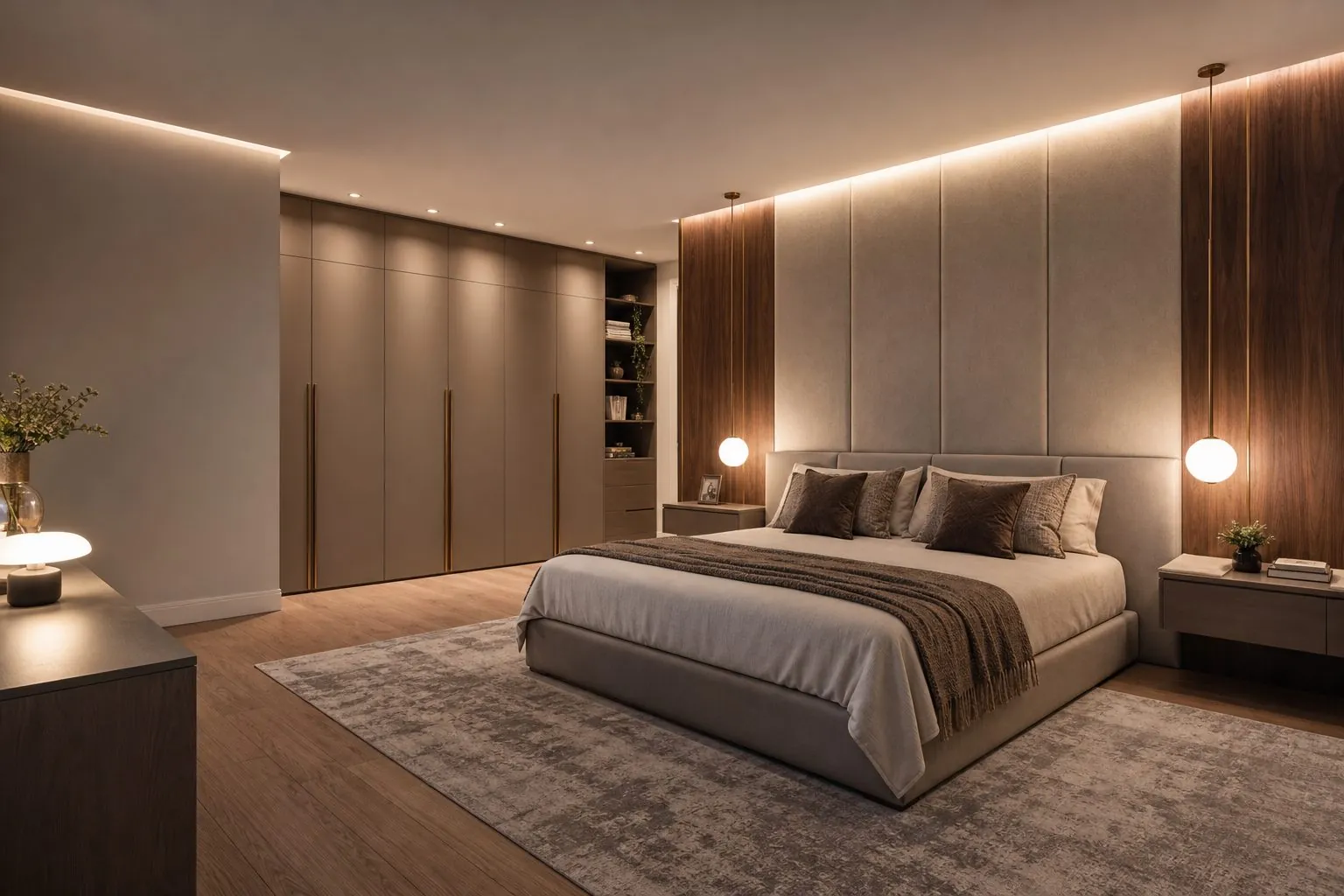
- Built-In Wardrobes or Walk-In Wardrobe Systems
- Dressing table, desk or vanity unit with mirror
- Chest of drawers, TV panel or luggage bench
- Upholstered headboard behind the bed and decorative trims
Write a simple item list per room type, with quantity, and mark which items are loose furniture and which are fixed joinery. Fixed items need site dimensions and installation planning; loose items need packing and assembly planning. Mixing the two without clear labels is one of the most common reasons quotations are not comparable between suppliers.
The second decision is the budget level. A bedroom in a rental apartment, a mid-scale hotel and a luxury villa can share the same layout but need very different finishes and hardware. Telling the factory your target market early lets it propose realistic materials instead of quoting the most expensive option or the cheapest one.
Which Bedroom Items Should Be Custom and Which Can Be Standard?
Make custom the items that must fit the room or match the design language, and keep standard the items that do not. This rule controls cost without weakening the design. Wardrobes, headboard walls and fitted desks usually need custom sizes because they meet walls, ceilings and windows. Bedside tables, chests and stools can often be standard modules repeated across many rooms.
| Item | Usually Custom | Usually Standard | Buyer Note |
|---|---|---|---|
| Built-In Wardrobes | Width, height, internal layout | Door module widths, hardware | Confirm ceiling height on site |
| Headboard wall | Overall width, panel joints, lighting | Panel profile, upholstery fabric | Coordinate with sockets and switches |
| Bedside table | Finish to match headboard | Size and drawer layout | Floating types need wall backing |
| Bed frame | Height, slat design, storage | Mattress size standards | Follow the local mattress size system |
| Desk or dressing table | Length to fit alcove | Drawer modules | Check cable routing for lamps and chargers |
| Chest of drawers | Finish only | Carcass and drawer sizes | Good candidate for repeat modules |
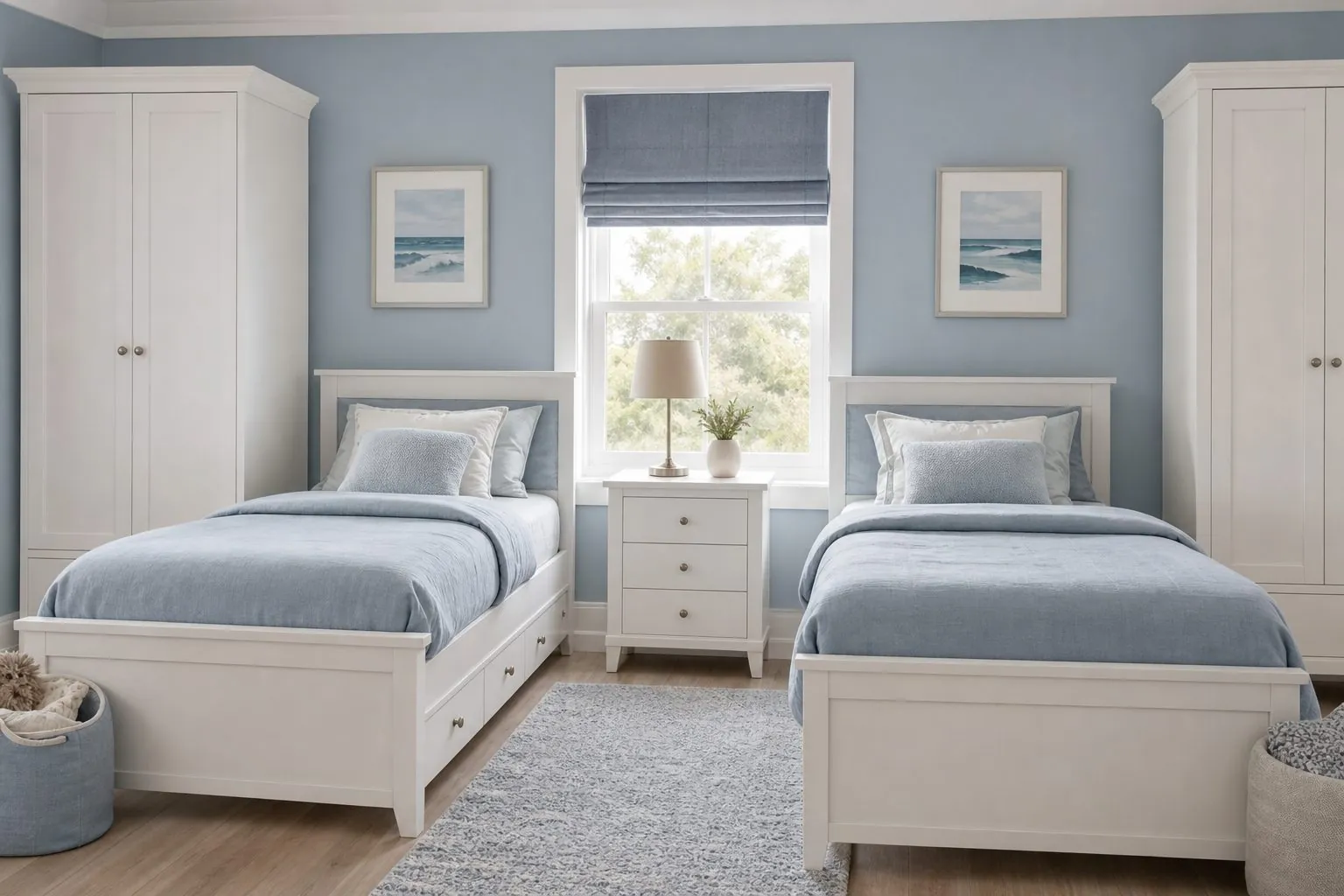
Mattress size deserves special attention for export projects. Bed sizes differ between the US, UK, EU, Australia and many Asian markets, and the names do not always match the dimensions. Always state the actual mattress dimensions in millimeters or inches on the drawing, not only the name such as "queen" or "king".
What Drawings and Information Does a Factory Need for an Accurate Quote?
Send floor plans, elevations, a finish schedule and a hardware expectation, and you will get a quote that can be compared line by line. Without elevations, a factory can only estimate. Without a finish schedule, it will choose a default finish that may not match your design.
- Floor plans per room type with wall lengths, door swings, windows and sockets.
- Elevations of every joinery wall, including heights and visible joints.
- Finish schedule listing board, color code or sample reference for each surface.
- Hardware level, for example budget, mid-range or premium, or named brands.
- Quantities per room type and total number of rooms or units.
- Destination market so the factory can check emission and safety documents.
- Delivery format, assembled, flat-packed or knock-down, and how cartons should be labelled.
If you only have concept images, that is still a useful starting point. A capable supplier can provide drawing deepening and 3D design to turn concept boards into shop drawings. Just make sure the scope of that design work, and who approves each revision, is agreed in writing before work starts.
Which Materials Work Best for Bedroom Furniture in Project Use?
For most project bedrooms, melamine-faced board carcasses with a durable door or panel finish offer the best balance of cost, stability and easy maintenance. Bedrooms are generally dry, low-impact spaces compared with kitchens and bathrooms, so you can spend more on visible surfaces and less on structural upgrades.
| Material or Finish | Strengths | Limitations | Typical Use |
|---|---|---|---|
| Melamine-faced board | Stable, economical, many wood grains | Flat surfaces only, limited edge profiles | Wardrobe carcasses, rental apartments |
| PET or high-pressure laminate | Uniform color, good scratch resistance | Color range set by supplier | Modern apartments, mid-scale hotels |
| Lacquered MDF | Any color, matte to gloss, shaped edges | Higher cost, needs careful packing | Premium residences, show units |
| Wood veneer | Natural grain, warm feel | Grain and tone vary by batch | Villas, boutique hotels |
| Upholstered panels | Soft, acoustic, comfortable to lean on | Fabric must meet fire rules in hotels | Headboards, bed walls |
Two points matter for project buyers. First, ask about board origin and emission documents. Recognized board suppliers such as EGGER, Kronospan and DARE are often specified, and markets like the US require CARB-compliant composite wood. Second, approve physical finish samples, not screen colors. Wood grains and fabric shades vary under different light, and a signed reference sample protects both sides during mass production.
How Should Hardware Be Specified for Bedroom Furniture?
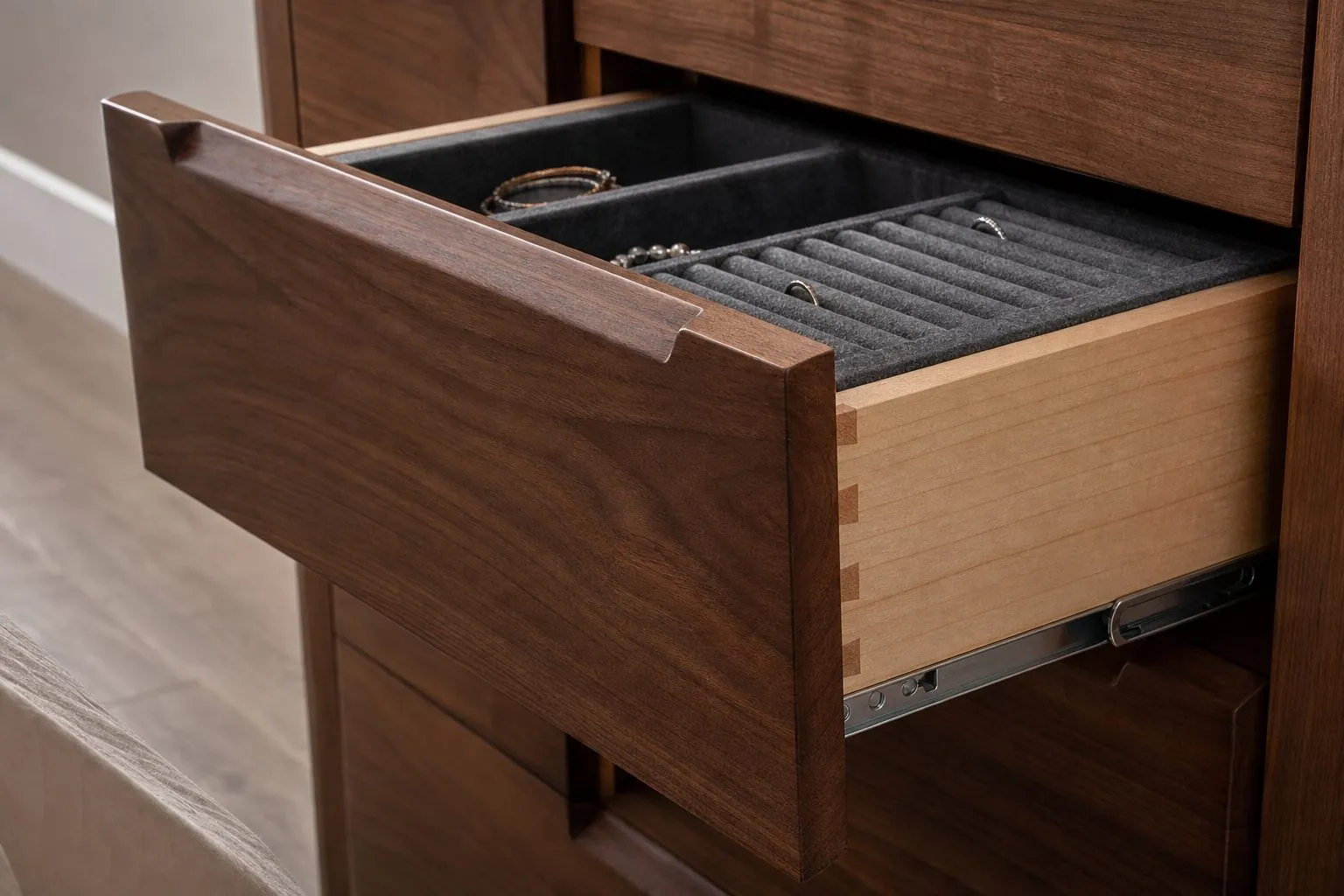
Specify hardware by function and expected usage, then choose a brand level that matches the budget. Hinges, drawer slides and wardrobe fittings are the parts guests and residents touch every day, and they cause more complaints than finishes do.
- Hinges for wardrobe doors: soft-close is now expected in most mid-range and premium projects.
- Drawer runners: full-extension runners are easier to use; check the load rating against the intended contents.
- Sliding door systems: useful in narrow rooms where swing doors block circulation; ask for the track type and how doors are adjusted after installation.
- Wardrobe fittings: hanging rails, pull-down rails, trouser racks and LED strips should be listed on the drawing.
- Handles: decide between handleless, profile, knob or bar handles early, because it changes door design.
Hardware brands such as Blum, Hettich, Häfele, Salice, DTC and Hutlon cover different budget levels. A practical approach for large projects is to choose a reliable mid-range brand for high-use items like hinges and runners, and keep decorative handles flexible. Whatever you choose, list brand and model on the approved drawing, so substitutions cannot happen quietly during production.
How Do You Compare Quotations from Different Bedroom Furniture Suppliers?
Compare quotations only after you make sure each supplier quoted the same scope, the same materials and the same hardware. A low price often means a different specification, not a more efficient factory.
Build a comparison sheet with these columns for every item:
- Carcass board type and origin
- Door or panel finish and edge treatment
- Hardware brand and model
- Included accessories, lighting and mirrors
- Packing method and labelling
- Samples, mock-up and inspection included or extra
- Payment terms and shipping terms
Ask each supplier to state assumptions in writing. Lines such as "back panel thickness", "edge banding on hidden edges" or "LED driver included" often explain price gaps. Where a supplier cannot confirm a value yet, it is better to see "to be confirmed" on the quote than a number that changes later.
Should I ask for unit prices or room package prices?
Ask for both. A room package price is easy to budget, while unit prices let you adjust quantities, remove items or swap finishes without asking for a completely new quotation.
Why Are Samples and Mock-Up Rooms Worth the Time?
Samples and a mock-up room are the cheapest way to find problems before they are repeated hundreds of times. A wrong drawer height or a fabric that marks easily costs little to correct on one room and a lot to correct on a full hotel tower.
A typical approval sequence looks like this:
- Finish samples: board colors, veneer, lacquer and fabric swatches, signed by the buyer.
- Hardware samples: hinges, runners and handles tested by hand.
- Single item sample: for example one bedside table or one wardrobe module.
- Mock-up room: full room installed at the factory or on site, reviewed by the design team and operator.
- Approval record: comments, photos and the final signed version kept by both sides.
During the mock-up, test daily use, not only appearance. Open every drawer fully, hang clothes on the rails, plug in a phone at the bedside, check that the headboard light does not glare, and look at how easily surfaces can be cleaned. Housekeeping teams in hotels often give the most useful comments.
How Should Bedroom Furniture Be Packed and Labelled for Projects?
Pack by room or unit, label every carton clearly and include an installation guide, and site work will move much faster. Bedroom packages contain many similar panels, and installers lose hours when cartons are labelled only by item code.
- Label cartons with project name, building, floor, unit or room number and item description.
- Provide a packing list per container that matches the carton labels.
- Protect corners, lacquer and veneer faces with suitable protection, not only film.
- Pack hardware with the item it belongs to, or in clearly labelled boxes per room.
- Keep spare parts such as hinges, handles and touch-up materials in a separate labelled box.
Choose between flat-packed and assembled delivery based on site conditions. Flat-packed or knock-down furniture uses container space better and survives transport well, but needs more site labor. Assembled pieces save site time but take more space and need stronger packing. Many projects combine both: wardrobes and headboard walls in panels, small bedside tables assembled.
What Quality Checks Should Happen Before Shipment?
Agree on an inspection checklist before production and receive a photo report before the goods leave the factory. Quality problems are much easier to fix in the factory than on a construction site in another country.
A practical pre-shipment checklist for bedroom furniture covers:
- Dimensions of key items against approved shop drawings
- Color and finish against the signed reference samples
- Edge banding quality, chips and exposed raw board
- Hardware function: hinges, soft-close, runners and locks
- Lighting and wiring, if LED strips or reading lights are included
- Carton labels, packing list and protection of finished faces
Also check documents. Depending on the market, you may need certificates for boards, fabric fire performance or a factory audit report. Ask which certificates the factory holds and which are product-specific, and receive copies before shipment so customs or the client do not delay acceptance.
How Can Arcova Help With Custom Bedroom Furniture Sourcing?
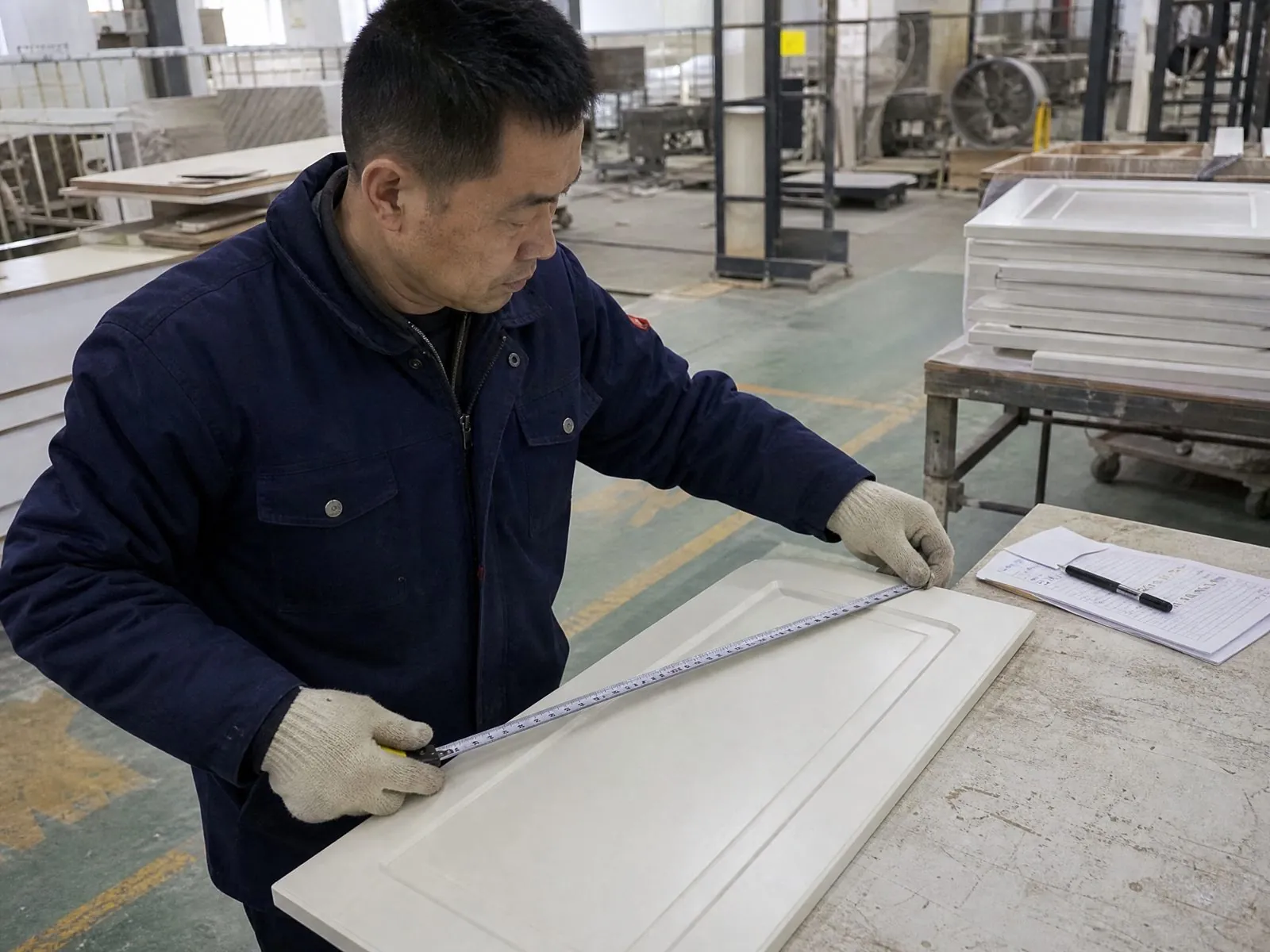
Arcova supports bedroom furniture projects from drawings to delivery, with one factory team handling joinery and loose furniture. Arcova Contract has more than 12 years of manufacturing experience, a 40,000 m² production base and 12 production lines, including automated CNC cutting, edge banding and drilling lines.
- Drawing deepening, shop drawings and 3D design for each room type
- Finish sample approval and mock-up rooms before mass production
- Hardware options from Blum, Hettich, Häfele, Salice, DTC and Hutlon to suit the budget
- Boards from suppliers such as EGGER, Kronospan and DARE
- Certifications including ISO9001, BSCI and FSC
- Inspection with photo reports and export packing labelled by unit or room
- Installation guidance and 24-hour online technical support
With a monthly capacity of 40 × 40HQ containers, the factory can plan large hotel and residential bedroom packages alongside OEM and private label orders. MOQ and lead time depend on the scope and are confirmed per project. To start, see our custom bedroom furniture range or send your drawings for a detailed quotation.