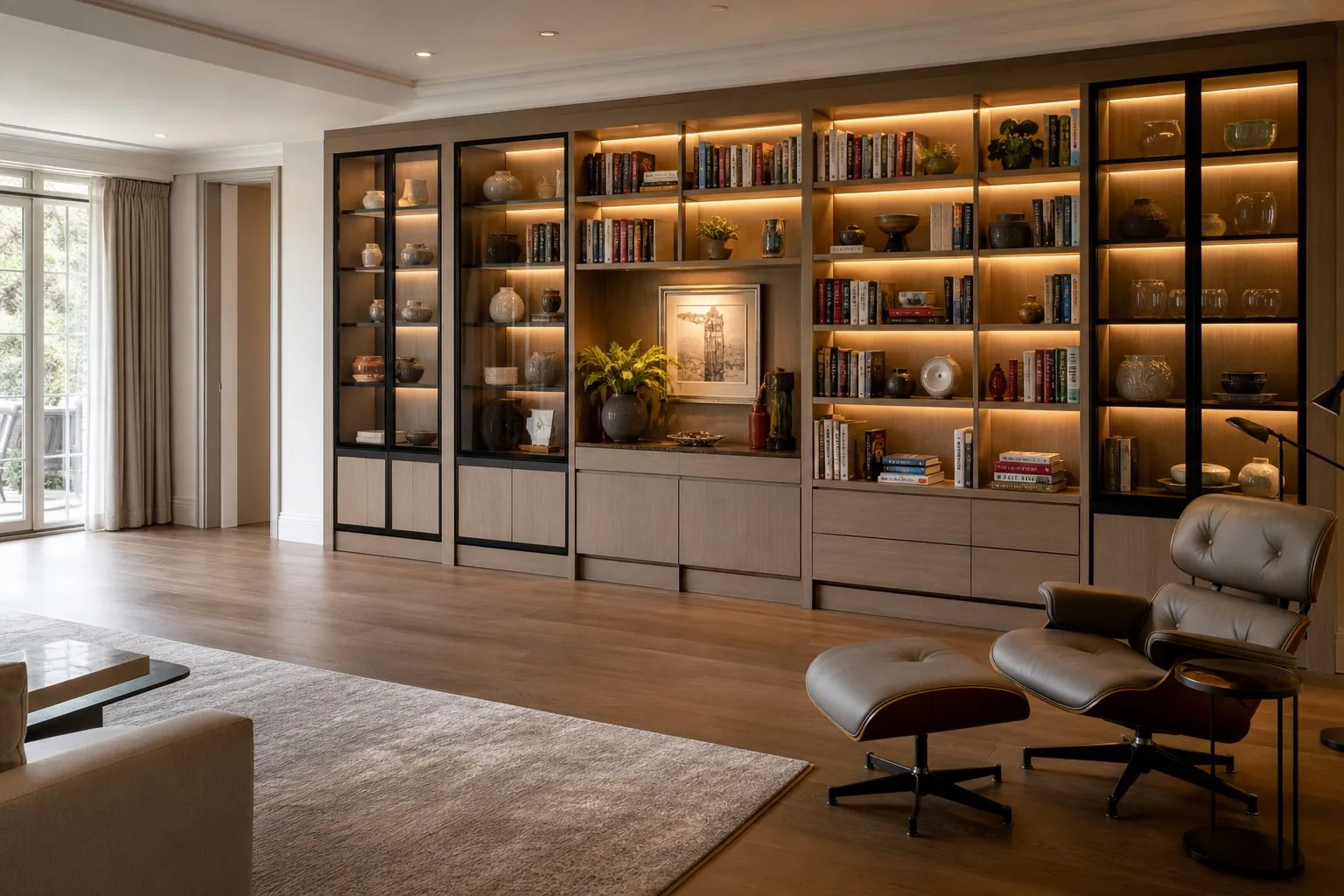
How shelf span, material, thickness and support method affect built-in bookcase sagging, and what to confirm on drawings before ordering custom bookcase walls.
What makes a built-in bookcase perform well over time?
A built-in bookcase performs well when shelf span, shelf material and support method are matched to the actual load. Most sagging shelves are not caused by poor-quality boards but by spans that are too long for the weight of books placed on them.
Books are heavier than most people expect. A shelf full of hardcovers, art books or files carries far more weight than a shelf of decorative objects. Designers often draw long, elegant shelves on renders; without engineering, those shelves bow within months.
Four decisions control long-term performance:
- Shelf span: the clear distance between supports.
- Shelf material and thickness: how stiff the shelf is.
- Support method: pins, fixed joints, hidden brackets or back fixing.
- Installation: fixing to the wall and leveling on uneven floors.
Finish, color and lighting create the look, but these four decisions determine whether the bookcase still looks right after years of use.
How long can a bookcase shelf span before it sags?
Keep shelf spans moderate for loaded book shelves. Many designers treat roughly 600–900 mm as a practical span range for shelves carrying books, with shorter spans for thinner or weaker boards and heavier loads. These are general industry references, not an Arcova specification, and the right span depends on material, thickness and load.
Sag increases sharply with span. Doubling the span does not just double the sag; it increases it many times. That is why a small reduction in span, or an extra upright, often solves a problem more effectively than switching to a more expensive board.
| Use of shelf | Typical load character | Span approach |
|---|---|---|
| Display objects and decor | Light and spread out | Longer spans possible; check visual sag |
| Paperback fiction | Moderate, evenly distributed | Moderate spans in common board |
| Hardcovers and reference books | Heavy, dense | Shorter spans or stiffer shelves |
| Art books, files, records | Very heavy, concentrated | Short spans, reinforced or fixed shelves |
| Media equipment | Point loads, sometimes heavy | Fixed shelves with support below |
When a design calls for a long uninterrupted span, solutions include steel reinforcement inside the shelf, a thicker or laminated shelf, a front rail that stiffens the edge, or fixing the back edge to the wall or back panel. Each adds cost, so balance appearance against budget.
Which shelf materials are best for bookcases?
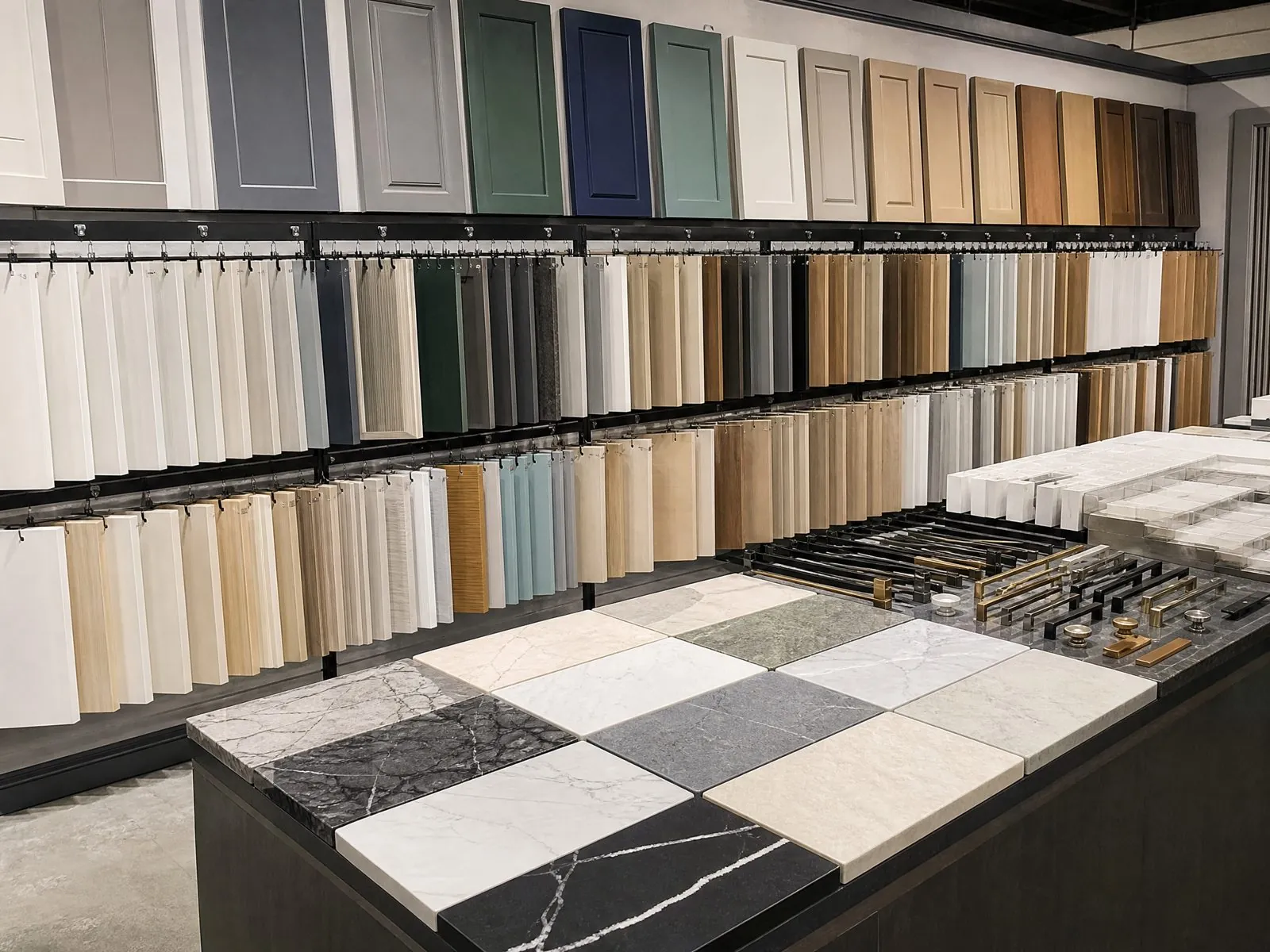
Plywood and solid wood are the stiffest common choices; MDF and particleboard are economical and stable but need shorter spans or extra thickness for heavy books. The best material depends on load, finish and budget.
| Material | Strengths | Limitations | Typical finishes |
|---|---|---|---|
| Melamine-faced particleboard | Economical, consistent, wide color range | Lower stiffness; edges need good banding | Melamine wood grains and solid colors |
| MDF | Smooth, paints well, stable | Heavy and can sag under long-term load | Paint, lacquer, veneer |
| Plywood | Stiffer for its weight, holds screws well | Higher cost; edges need banding or lipping | Veneer, laminate, paint |
| Solid wood | Very stiff, durable edges, repairable | Moves with humidity; higher cost | Oil, stain, lacquer |
| Veneered panel with solid lipping | Wood look with stiff front edge | More production steps | Matched to veneer joinery |
Board suppliers such as EGGER, Kronospan and DARE offer different densities and grades, which affect stiffness. Shelf thickness for your project is confirmed at quotation on the drawings once spans and loads are known.
Why the front edge matters
A solid wood lipping or a deeper front edge stiffens a shelf considerably and hides the board core. It also makes thin-looking shelves possible without sagging, which suits modern designs that want a slim profile.
Adjustable or fixed shelves: which should you choose?
Use a mix. Fixed shelves at intervals stiffen the whole bookcase and carry heavy loads well; adjustable shelves between them give flexibility for different book heights.
- Fixed shelves are joined to the uprights with dowels, connectors or housings, which helps hold the bookcase square.
- Adjustable shelves sit on pins in drilled hole lines, allowing height changes but carrying less load at the same span.
- Metal shelf supports are stronger than plastic pins and suit heavier loads.
- Hidden shelf-pin systems keep the hole lines less visible in veneer or painted finishes.
- Floating shelves use concealed rods into the wall or back panel and need solid fixing to perform.
For tall bookcase walls, at least one fixed shelf at mid-height is common practice because it braces the uprights and reduces racking.
What depth and height should a built-in bookcase have?
Depth should follow what will be stored. Most book collections fit comfortably in a shallow bookcase, while deeper units suit mixed storage, media and lower cabinets. Height usually runs to the ceiling for a built-in look, with fillers to scribe to uneven ceilings.
| Zone | Typical depth reference | Typical use |
|---|---|---|
| Upper book shelves | Around 250–350 mm | Paperbacks and standard hardcovers |
| Mid-height shelves | Around 300–400 mm | Larger books, display objects |
| Lower cabinets or drawers | Around 400–600 mm | Files, toys, media, closed storage |
| Window seat or desk integration | Per design | Seating or work surface |
These depths are general references only. A stepped design with deeper lower cabinets and shallower open shelves above is popular in living rooms and libraries, because it adds closed storage and a surface for objects while keeping the shelves above light.
Shelf spacing should suit typical book heights, with one or two taller sections for oversized books. Adjustable shelves solve most spacing questions.
How should built-in bookcases be fixed and installed?
Every tall bookcase must be fixed to the wall. Anchoring prevents tipping, holds the units square and reduces stress on shelves and joints. Wall construction must be suitable for the fixings used.
- Check walls and floors for level and plumb before installation.
- Level base units or plinths first, using adjustable feet or shims.
- Fix units to solid masonry, concrete or studs with blocking; add blocking in lightweight walls beforehand.
- Join adjacent units so the run acts as one structure.
- Scribe fillers to walls and ceilings for a built-in finish.
- Install shelves, doors and lighting last, then adjust.
Uneven floors are the most common cause of doors that do not close evenly and shelves that look sloped. Time spent leveling the base saves time adjusting everything above it.
How do lighting and integration change the design?
Lighting and integrated features turn a bookcase into a room feature, but each one affects structure and must be planned before production.
- LED profiles in shelf fronts or uprights need grooves and cable channels machined into panels.
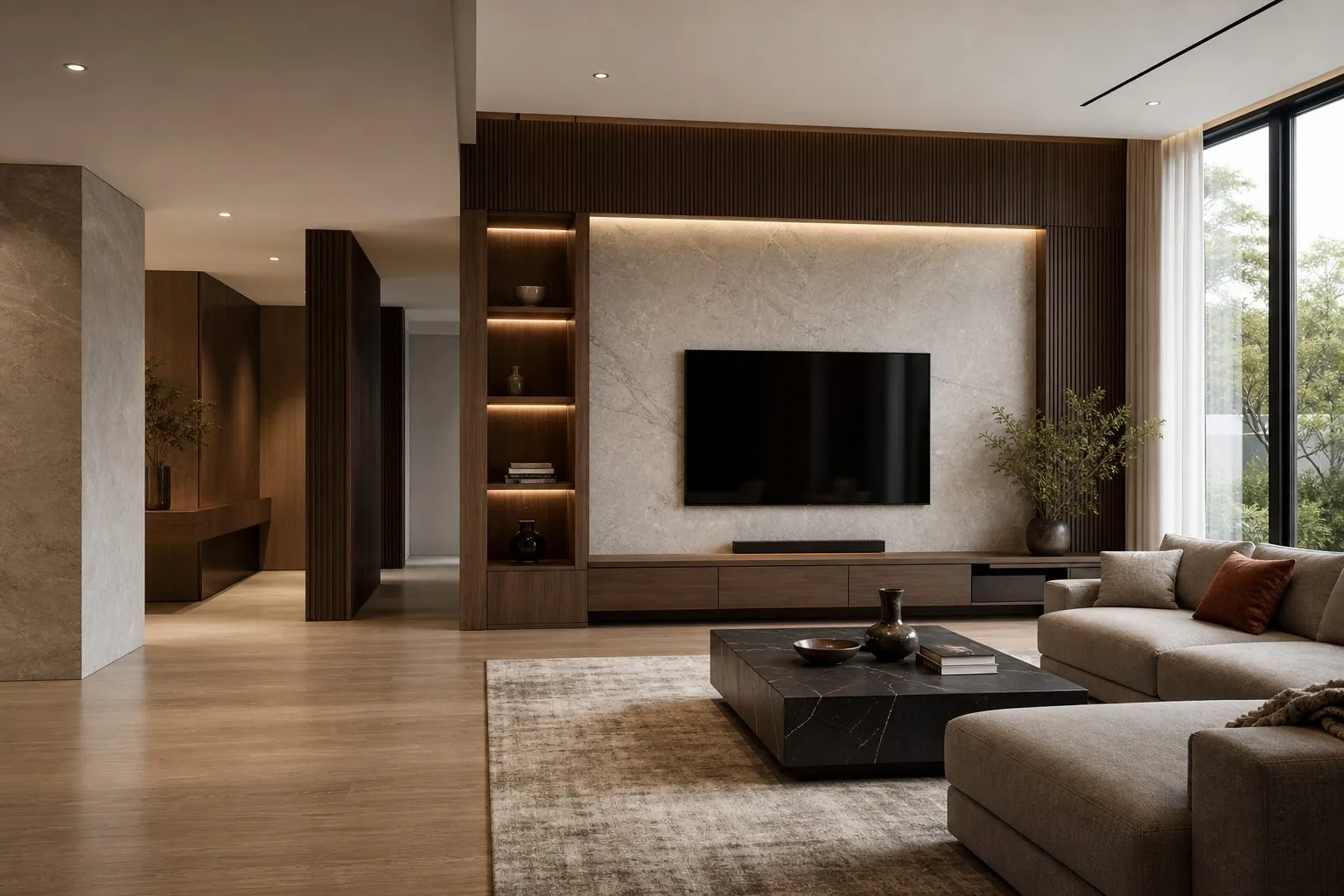
- Integrated TV niches need cable routes, ventilation and correct bracket fixing into the wall.
- Desks within bookcases need a stiffer worktop and knee space without uprights.
- Window seats need lift-up lids or drawers and comfortable seat depth.
- Library ladders need a rail fixed to strong uprights and enough floor clearance.
Lighting also adds heat and cables near books, so use low-voltage LEDs and accessible drivers. A licensed electrician must make the mains connection.

What should buyers confirm before ordering a built-in bookcase?
Confirm the load, spans, materials and site conditions before drawings are finalized. These decisions are hard to change once panels are cut.
- Measured wall width and ceiling height at several points.
- What will be stored on each section: books, files, display or media.
- Shelf span, material, thickness and support type for each section.
- Fixed and adjustable shelf positions.
- Wall construction and fixing method.
- Lighting, sockets and data positions.
- Finish samples for veneer, paint or melamine.
For projects with many identical rooms, a mock-up unit is useful to check shelf stiffness and finish before mass production. For libraries and offices, shelf load expectations should be stated clearly in the brief.
Which finishes and edges work best on bookcases?
Choose finishes for wear as well as looks. Bookcase shelves are scraped constantly by books sliding in and out, so the shelf surface and front edge take more abuse than the sides or back panel.
| Finish | Wear on shelves | Appearance | Repair |
|---|---|---|---|
| Melamine | Good scratch resistance, easy to clean | Consistent wood grains and colors | Hard to repair; replace shelf |
| Painted MDF | Can scuff where books slide | Smooth, any color | Touch-up possible; may show |
| Lacquered veneer | Moderate; matte lacquers hide wear better | Natural wood character | Spot repair by a finisher |
| Oiled solid wood | Shows wear but ages naturally | Warm, natural | Easy to re-oil |
| HPL laminate | High wear resistance | Wide range of decors | Hard to repair; very durable |
Painted bookcases are popular in living rooms and libraries, but paint on shelf surfaces can stick to book covers if items are placed before the finish fully cures. Allow curing time and advise owners accordingly. Some projects use a tougher finish on shelf tops and paint only on visible frames.
Edge details
- Thin ABS or melamine edge banding suits economical melamine shelves.
- Solid wood lipping protects veneer shelves and adds stiffness.
- Painted MDF edges should be well sealed to avoid chipping.
- Rounded or eased front edges reduce chipping and feel better in family homes and children's rooms.
Back panels also matter. Thin back panels are economical, but a thicker back fixed to the wall adds rigidity and allows shelves to be supported along their rear edge, which helps long spans. Back panel thickness is confirmed for each design.
In damp or coastal climates, choose moisture-resistant boards and keep bookcases slightly away from external walls to allow air circulation. Books and boards both suffer if condensation forms behind the unit.
How can Arcova help with built-in bookcases?
Arcova produces built-in bookcases, library walls and storage walls for living rooms, studies and home offices and commercial interiors. Shelf spans, materials and supports are reviewed on shop drawings before production.
- Drawing deepening, shop drawings and 3D design.
- Boards from EGGER, Kronospan and DARE, chosen to suit load and finish.
- CNC cutting, edge banding and drilling on automated lines.
- Finish sample approval, mock-ups and inspection with photo reports.
- Export packing labelled by unit or room, with installation guidance.
Arcova has 12+ years of manufacturing experience and holds ISO9001, BSCI and FSC certifications. Shelf load values, thicknesses and lead times are confirmed for each order. Send your elevations to start a bookcase project.