How to choose kitchen cabinet hinges, drawer slides and lift systems by door type, load and project use, and what to confirm on drawings before production.
Which kitchen cabinet hardware matters most for long-term performance?
Hinges, drawer slides and lift systems decide how a kitchen feels and how long it keeps working, more than the door finish does. A kitchen with a premium lacquer front and weak hinges will sag, slam and need service calls within a few years. A modest melamine kitchen with well-chosen, correctly adjusted hardware can stay smooth for a long time.
For project buyers, hardware is also where cost, lead time and after-sales risk concentrate. Every door and drawer opens thousands of times a year, and a single hardware decision is multiplied across hundreds of apartments or hotel rooms. Getting the specification right at drawing stage is far cheaper than replacing parts after handover.
The three hardware groups to specify carefully are:
- Hinges for doors, including opening angle, overlay type and soft-close damping
- Drawer slides or runners, including extension type, load class and closing action
- Lift systems for wall cabinet flaps, including stay type and force range
Handles, legs, shelf supports and connectors matter too, but they rarely cause the same level of complaints when they are average quality.
How do concealed hinges work, and which type should you choose?
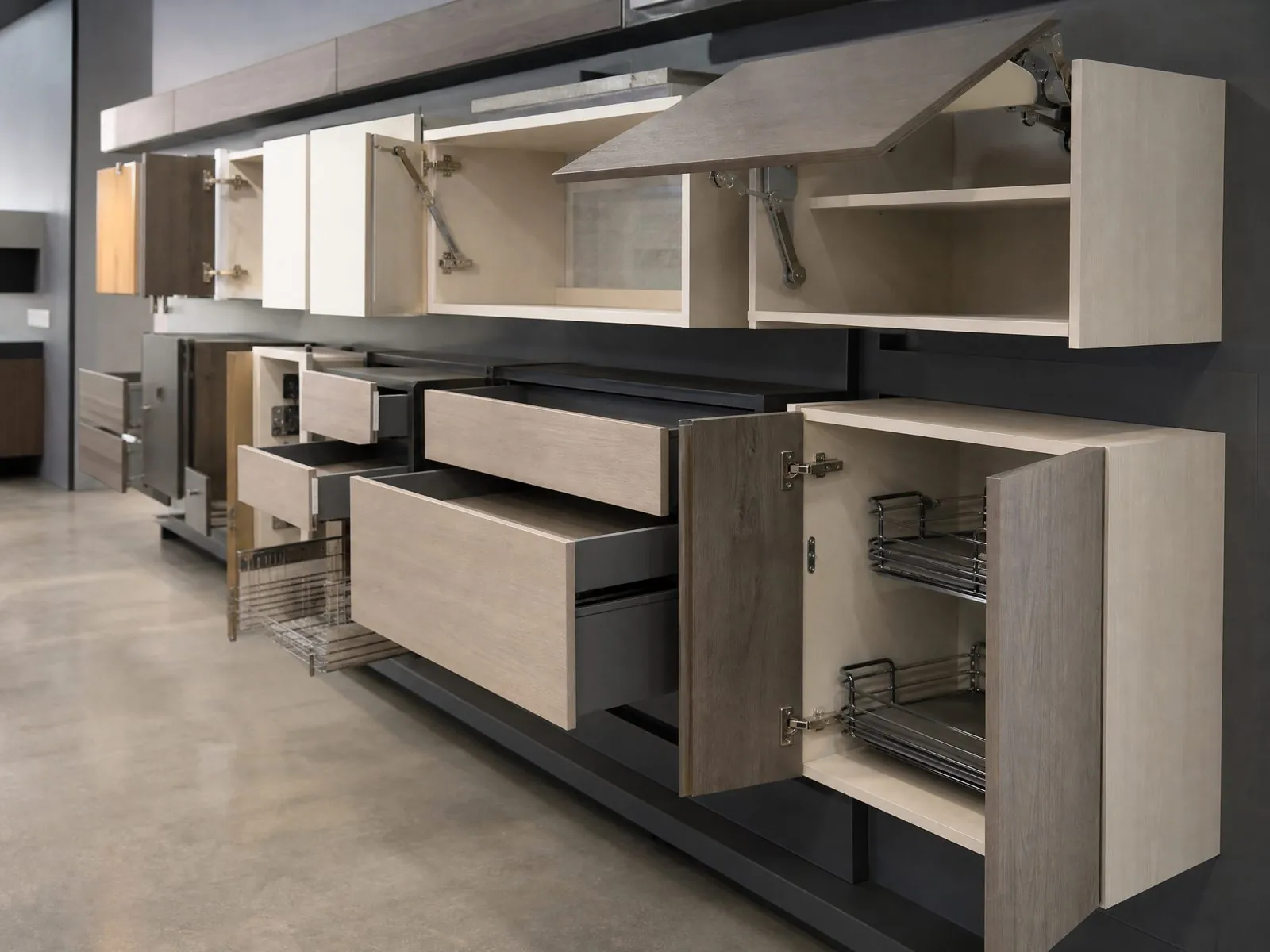
For most modern kitchens, a clip-on concealed hinge with integrated soft-close is the right default. It allows doors to be removed without tools, adjusted in three directions and closed quietly. Other hinge types are used for specific geometry problems, not as general upgrades.
A concealed hinge has a cup set into a bored hole in the back of the door and an arm that clips onto a mounting plate on the cabinet side. Adjustment screws move the door sideways, up and down, and in and out, which lets installers create even gaps across a run of doors.
Overlay types
- Full overlay: the door covers the cabinet side panel fully; common on end cabinets and frameless kitchens.
- Half overlay: two doors share one central side panel; used where cabinets join with a single divider.
- Inset: the door sits inside the cabinet opening, flush with the front edge; used in some classic and Shaker designs and needs very precise carcass work.
Special hinge types
| Hinge type | Typical use | What to check |
|---|---|---|
| Standard opening angle (around 100–110°) | Most base and wall doors | Clearance from walls and adjacent doors |
| Wide angle (up to about 155–170°) | Doors with internal pull-outs that must clear the opening | Door may project further into the room |
| Zero-protrusion hinge | Doors in front of interior drawers | Slightly different drilling pattern |
| Corner and bi-fold hinges | L-shaped corner cabinets | Correct pairing with the corner door design |
| Thick-door or glass-door hinges | Heavy fronts, framed glass or mirrored doors | Hinge model rated for door type |
| Push-open (no handle) hinges | Handleless kitchens | Use a separate push latch or hinge without damping conflict |
Angles above are general industry references, not an Arcova standard. The exact angle depends on the hinge model chosen.
How many hinges per door?
Hinge count depends on door height, width and weight. Tall pantry doors, glass doors and doors with heavy veneer or stone inserts need more hinges than a standard base door. Hardware makers publish charts for this, and buyers should ask that the shop drawings show hinge count per door. Too few hinges is a common cause of tall doors twisting.
What should buyers know about soft-close damping?
Soft-close is now expected in most kitchen markets, but how it is achieved affects durability and service. Integrated soft-close inside the hinge or slide is cleaner and more reliable than add-on dampers fitted to the cabinet.
- Integrated dampers are adjusted with the hinge and rarely go missing.
- Add-on bumpers or clip dampers are cheaper but can be knocked loose and are easy to forget during installation.
- Heavy doors may need damping adjusted or switched off on some hinges so the door still closes fully.
- Push-open systems and soft-close dampers must be compatible; otherwise the door may not latch.
In hotels and rental apartments, ask how damping is serviced. Being able to replace a damper without removing the whole hinge saves maintenance time.
Which drawer slides suit which drawers?
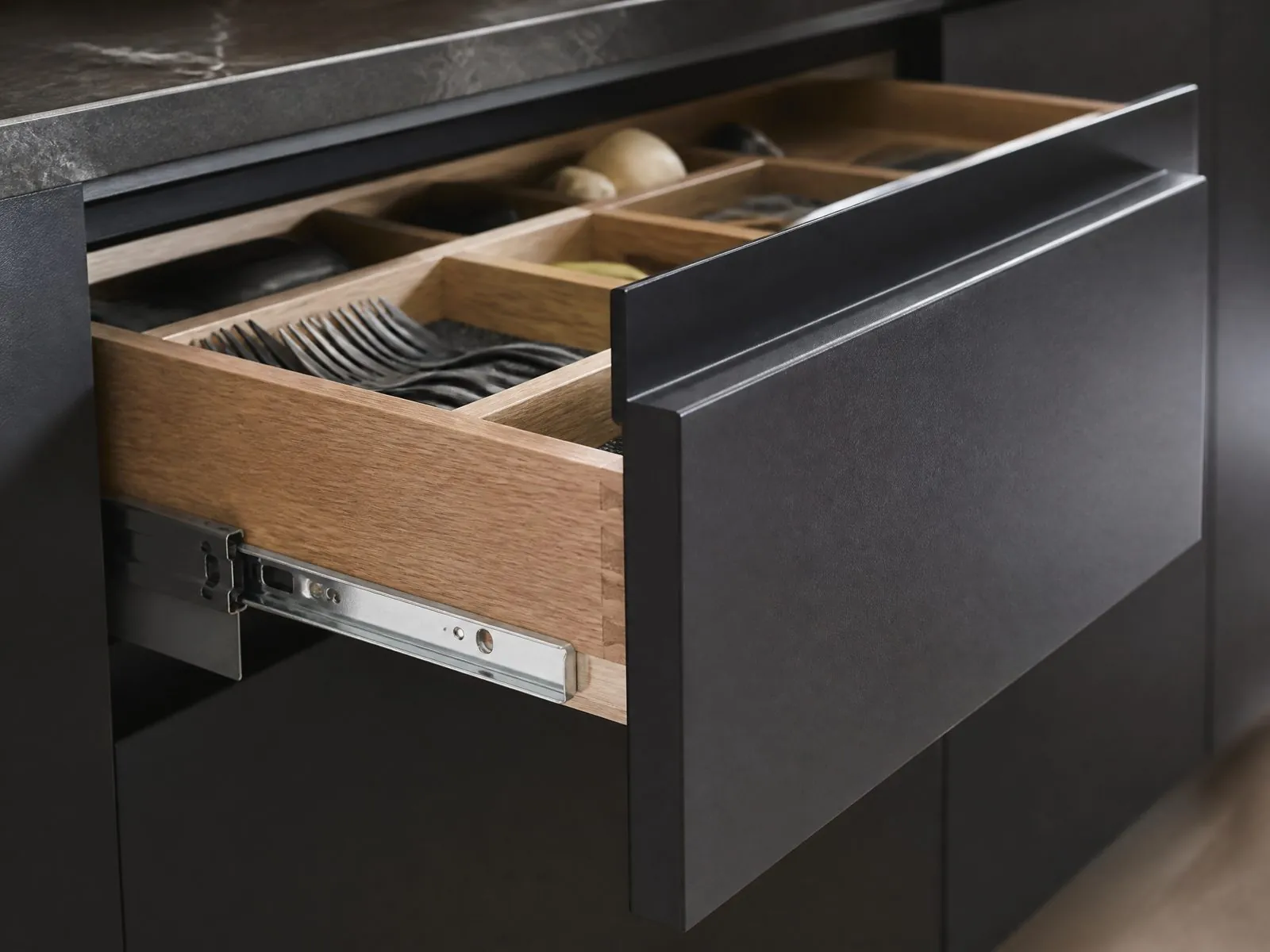
Full-extension, soft-close slides are the best choice for most working drawers because they give access to the back of the drawer and close quietly. Partial-extension and roller slides make sense only for low-budget or light-use drawers where cost is the main concern.
| Slide type | Extension | Typical application | Notes |
|---|---|---|---|
| Roller (epoxy) slides | Usually about three-quarter | Budget furniture, light drawers | Lower cost, less smooth, limited load |
| Ball-bearing side-mounted slides | Full extension available | General kitchen and utility drawers | Visible on drawer sides; durable and economical |
| Concealed undermount slides | Partial or full | Wood or melamine drawer boxes in quality kitchens | Hidden under drawer, cleaner look, usually soft-close |
| Metal drawer systems (box sides) | Full extension | Pan drawers, inner drawers, cutlery drawers | Complete side profile system; easy to assemble and adjust |
| Heavy-duty slides | Full extension | Wide pan drawers, pantry pull-outs | Check load class for contents |
Load classes
Slides are sold in load classes. Wide pan drawers holding cast-iron cookware or a full set of plates need a higher load class than a cutlery drawer. Specific load values must come from the hardware supplier for the exact model; buyers should ask that drawings note the load class for each drawer type rather than assume one slide fits all.
Drawer box construction
- Melamine or plywood boxes on undermount slides suit traditional and premium designs.
- Metal side systems give consistent quality and fast assembly in volume production.
- Inner drawers behind a door need slides that clear the hinges, so pair them with suitable hinge types.
- Drawer bottoms for heavy loads should be thicker or reinforced; thickness for your project is confirmed at quotation on drawings.
How do lift systems for wall cabinets compare?
Lift systems replace hinged doors on wall cabinets with flaps that open upward, keeping the door out of the user's head space. Choose the lift type based on door size, cabinet height and ceiling clearance, then size the mechanism to the actual front weight.
| Lift type | How it opens | Best for | Watch out for |
|---|---|---|---|
| Stay lift (lift-up) | Flap swings up and stays at any height | Small to medium wall units | Needs clearance above the cabinet |
| Up-and-over (parallel lift) | Front lifts and moves over the cabinet top | Wide units close to the ceiling | More complex installation |
| Bi-fold lift | Two-part front folds as it rises | Tall wall units with limited ceiling space | Two front panels must be aligned well |
| Swing-up lift | Front swings up and back | Units where the front should clear head height | Larger arc of movement |
| Gas strut / piston stay | Simple strut holds the flap open | Budget projects and light fronts | Fixed force; may weaken over time |
Most branded lift systems use a force setting chosen from the cabinet height and front weight, often with fine adjustment. If the force is wrong, a flap either drifts down or springs up too sharply. Glass, mirror or stone-effect fronts add weight and often need a stronger mechanism.
For tall users and accessibility, consider electric servo-drive options on premium projects, and check that the open front is still reachable to close.
How do you match hardware quality to budget and project type?
Match hardware to how often the kitchen is used and who maintains it, not only to the purchase budget. Rental, hotel and serviced apartment kitchens are used hard and maintained by staff, so reliable mid-range or premium hardware usually pays back through fewer service calls.
- Premium residential and show units: branded concealed hinges, undermount or metal drawer systems, branded lift systems throughout.
- Volume apartment projects: branded or quality mid-range hinges and full-extension slides; lift systems only where needed.
- Rental and student housing: robust, easy-to-replace hardware with standard drilling patterns.
- Importer retail ranges: hardware selected to match the price point and the target market's expectations.
At Arcova, hardware from Blum, Hettich, Häfele, Salice, DTC and Hutlon is available by budget, so buyers can mix brands strategically, for example premium slides on heavy pan drawers and economical hinges on light wall doors.
Avoid mixing several hinge brands within one kitchen. Different brands use different mounting plates and adjustment logic, which complicates installation and spare parts.
What should be confirmed on drawings before production?
Hardware problems are cheapest to fix on paper. A good shop drawing package states every hardware item per cabinet, so the buyer can approve it before parts are ordered and boards are drilled.
- Hinge brand, model, opening angle and overlay type for each door type.
- Number of hinges per door, especially for tall, glass and heavy doors.
- Drawer slide type, extension, load class and soft-close or push-open action.
- Lift system type and force setting based on front weight and cabinet height.
- Handle type and drilling positions, or the handleless profile system.
- Clearances where doors meet walls, appliances, ceilings and other doors.
- Spare hardware quantities for large projects.
Ask for a sample cabinet or mock-up for large orders. Opening a real door and drawer reveals problems that are hard to see on paper, such as a hinge angle that clashes with a pull-out.
How should hardware be installed and adjusted on site?
Most hardware complaints after handover come from installation, not from the hardware itself. Carcasses must be level and square before doors and drawers are adjusted; otherwise no amount of hinge adjustment produces even gaps.
- Level base cabinets and fix wall cabinets securely before hanging doors.
- Adjust hinges in sequence: side-to-side, then height, then depth.
- Check that soft-close engages on every door and drawer.
- Set lift system force so the flap stays open at all positions.
- Re-check adjustment after worktops and appliances are installed, because their weight can shift cabinets slightly.
For overseas projects, factory pre-drilling and pre-fitting of hinge cups and slide parts saves site time. Labelled parts and clear guidance help local installers who may not know the specific hardware brand.
How can Arcova help with kitchen cabinet hardware?
Arcova builds custom kitchen cabinets with hardware selected to your budget and project type from Blum, Hettich, Häfele, Salice, DTC and Hutlon. Hinge cups and drilling patterns are machined on automated CNC and drilling lines, which keeps positions consistent across large orders.
- Shop drawings list hardware per cabinet for your approval.
- Finish sample approval and mock-ups before mass production.
- Inspection with photo reports before shipping.
- Export packing labelled by unit or room, with installation guidance.
- 24-hour online technical support for installers.
The factory holds ISO9001, BSCI and FSC certifications, with 12+ years of manufacturing experience. Hardware load ratings, warranties and lead times are confirmed for each order. To discuss a hardware specification, send your drawings or learn more about our quality control process.