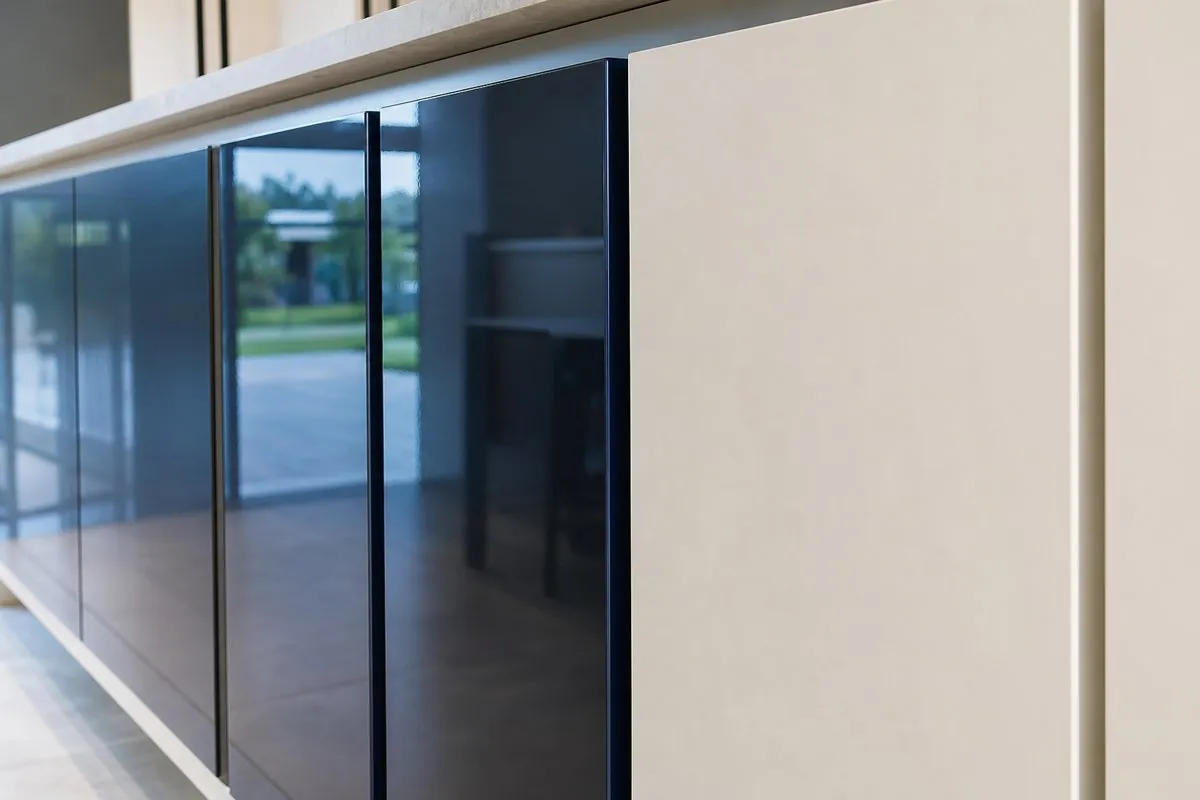
A buyer's comparison of lacquer, melamine and PET cabinet doors covering durability, design freedom, cost drivers, project fit, sample approval and shipping protection.
What Is the Short Answer: Lacquer, Melamine or PET?
Choose melamine for cost-controlled, high-volume projects, PET for a modern matte or gloss look with better consistency than paint, and lacquer for premium projects that need custom colors, profiled doors or a hand-finished appearance. All three are surface finishes applied over an engineered core, usually MDF or particle board, so the core and edge treatment matter as much as the face.
For most apartment developers, melamine or PET covers the kitchen budget well. For villas, show units and boutique hotels, lacquer is often worth the extra cost and care. The right choice depends on budget, door style, color, durability expectations and how the doors will be shipped and installed.
| Factor | Melamine | PET | Lacquer |
|---|---|---|---|
| Relative cost | Lowest | Medium | Highest |
| Typical core | Particle board or MDF | MDF or particle board | MDF |
| Color range | Supplier decor collections | Supplier film collections | Almost any color code |
| Door profiles | Flat slab only | Flat slab, limited edge profiles | Slab, Shaker, fluted, routed |
| Batch consistency | Very high | Very high | Good, needs sample control |
| Repairability | Limited | Limited | Can be touched up |
| Best for | Rental and volume projects | Modern apartments | Villas, premium projects |
How Is Each Door Finish Made?
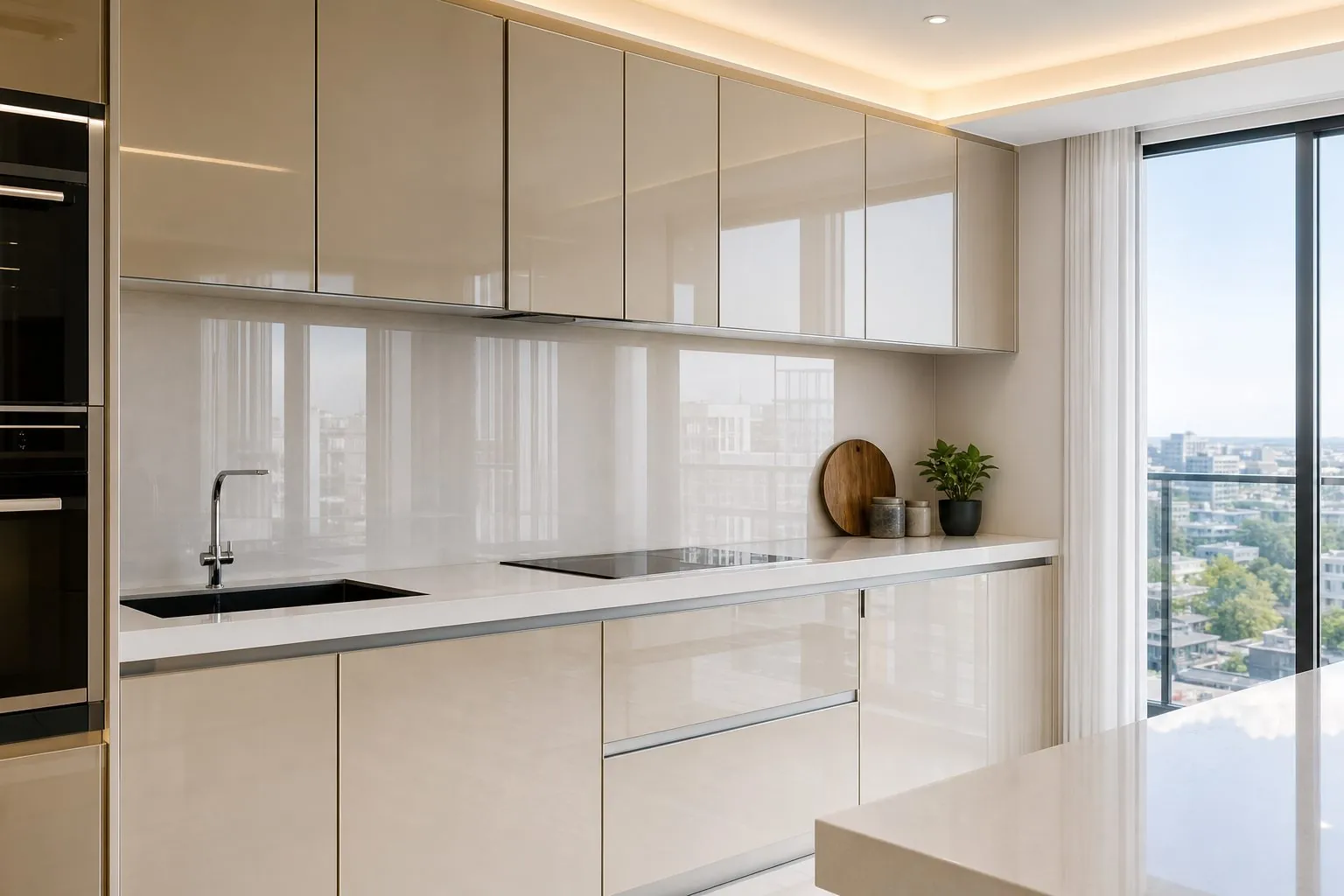
The manufacturing process explains most of the differences in look, cost and durability. Melamine and PET are factory-made surfaces bonded to board, while lacquer is sprayed and cured on each door.
Melamine
Melamine-faced board is decor paper impregnated with resin and pressed onto particle board or MDF under heat and pressure at the board mill. Cabinet factories cut the panels and apply edge banding. Because the surface comes from the board supplier, such as EGGER, Kronospan or DARE, color and texture are highly consistent between batches.
PET
PET is a polyester film laminated onto MDF or board, either flat or wrapped on edges with matching banding. Super-matte PET with a soft-touch surface and high-gloss PET are common. The film is made in controlled rolls, so it is consistent and smooth, without the orange peel that can appear on sprayed finishes.
Lacquer
Lacquer doors are machined from MDF, sanded, primed and sprayed in several coats, with sanding between coats, then cured. The result can be matte, satin or high gloss, in almost any color code. Because it is a coating, it wraps edges and profiles seamlessly, which is why lacquer is used for Shaker and fluted doors.
Which Finish Is Most Durable in Daily Kitchen Use?
Melamine and PET usually resist daily wear better than lacquer, while lacquer is easier to repair. Durability should be split into several kinds of damage, because each finish behaves differently.
| Damage Type | Melamine | PET | Lacquer |
|---|---|---|---|
| Surface scratches | Good resistance, especially textured decors | Good on matte; gloss shows fine marks | Moderate; gloss shows marks most |
| Impact chips | Edges can chip if hit | Edges can chip if hit | Can chip at corners |
| Moisture at edges | Depends on edge banding and core | Depends on edge banding and core | Sealed all round when well sprayed |
| Heat near ovens | Needs heat protection | Film can lift with excess heat | Can discolor with excess heat |
| Fingerprints | Low on textured decors | Low on super-matte, higher on gloss | Visible on gloss |
The weak point for melamine and PET is usually the edge banding. Good edge banding, applied on automated machines with a suitable adhesive, seals the core and reduces water entry near sinks and dishwashers. For lacquer, the weak point is impact at corners and door edges.
- Specify heat shields or deflector strips beside ovens for any finish.
- Use moisture-resistant cores in sink and dishwasher zones.
- Choose textured or matte surfaces in rental properties to hide wear.
How Do the Finishes Compare on Appearance and Design Freedom?
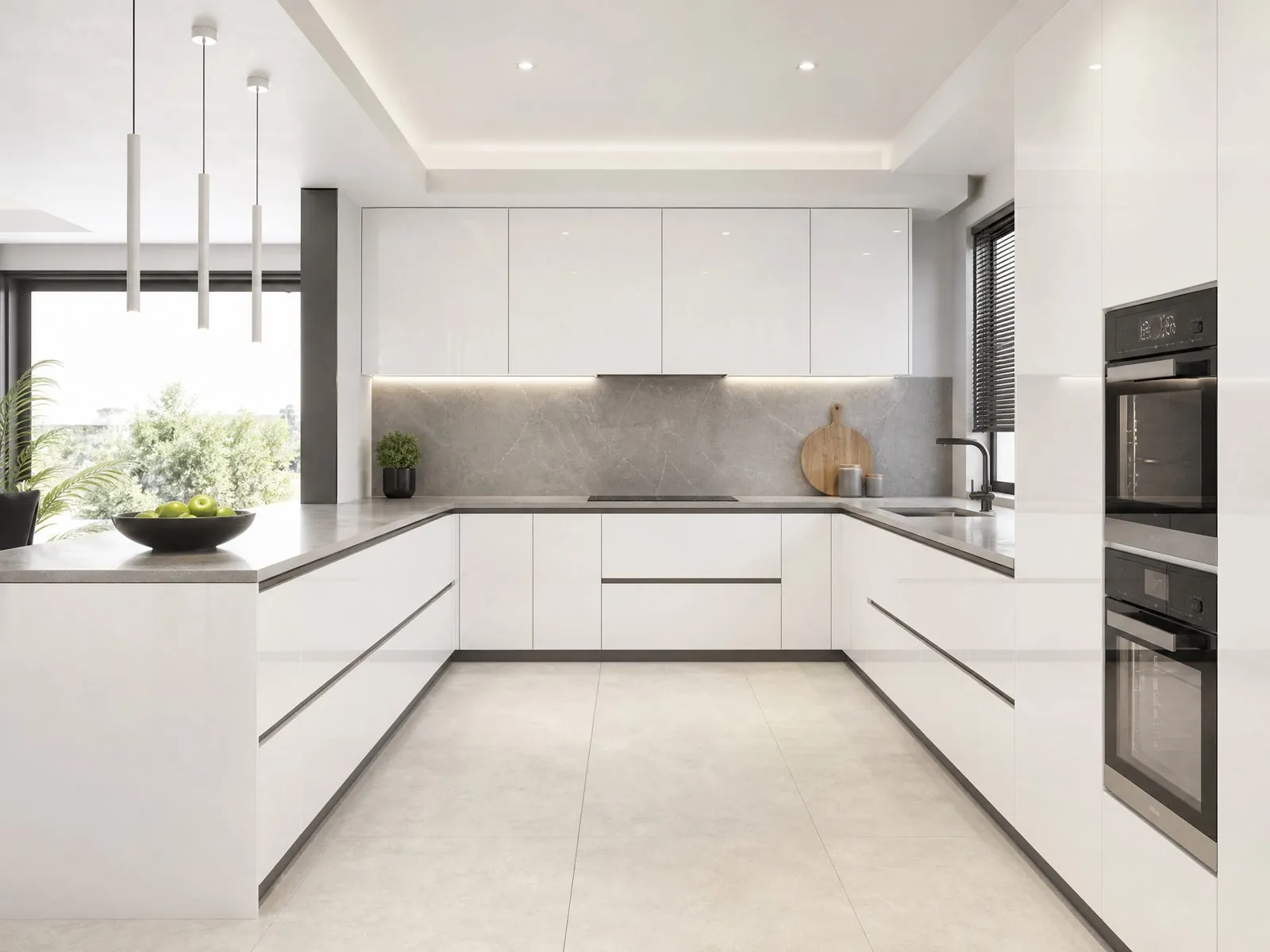
Lacquer gives the most design freedom, PET gives the cleanest modern flat look, and melamine gives the most realistic wood grains at low cost. Each suits different design intents.
- Melamine: wide range of wood grains, stones and solid colors, often with synchronized textures that follow the grain. Limited to flat slab doors.
- PET: strong in solid colors, especially super-matte and high-gloss; some wood-grain films exist. Flat doors with slim edges suit handleless kitchens.
- Lacquer: any color, any sheen level, and any profile that can be machined in MDF, including Shaker frames, fluted fronts, J-pull grooves and curved panels.
If the design calls for a specific brand color, a profiled door or matching paint on cabinetry and doors, lacquer is often the only option. If the design is flat and minimal, PET often delivers it with better consistency.
How Does Cost Compare, and What Drives It?
Melamine is generally the most economical, PET sits in the middle and lacquer is the most expensive. We do not publish fixed prices because cost depends on many project variables, but the main cost drivers are predictable.
- Labor: lacquer needs multiple spray, sand and cure cycles; melamine needs only cutting and edging.
- Yield and rework: sprayed finishes have more defects to rework than pressed surfaces.
- Sheen: high gloss costs more than matte in both PET and lacquer, because surface defects are more visible.
- Door style: profiled and Shaker doors add machining and finishing time.
- Packing: lacquer and gloss doors need more protective packing.
A common budget strategy is to use melamine for carcasses and interiors on all projects and spend the finish budget on door fronts only.
Which Finish Suits Each Type of Project?
Match the finish to the project's budget, user profile and maintenance expectations rather than to a showroom sample.
| Project Type | Recommended Finish | Reason |
|---|---|---|
| Rental apartments and student housing | Melamine | Low cost, hard-wearing, easy replacement |
| Mid-range apartments for sale | Melamine or PET | Modern look within developer budget |
| Handleless modern kitchens | PET super-matte or gloss | Clean flat fronts, consistent color |
| Shaker and classic kitchens | Lacquer | Profiles need sprayed finish |
| Villas and show units | Lacquer or veneer | Custom colors and premium feel |
| Hotel pantries and serviced apartments | Melamine or PET | Durability and easy maintenance |
Mixed specifications are common. For example, PET lower cabinets with lacquer feature tall units, or melamine wood-grain islands with PET solid-color perimeter cabinets.
What Should You Check When Approving Door Samples?
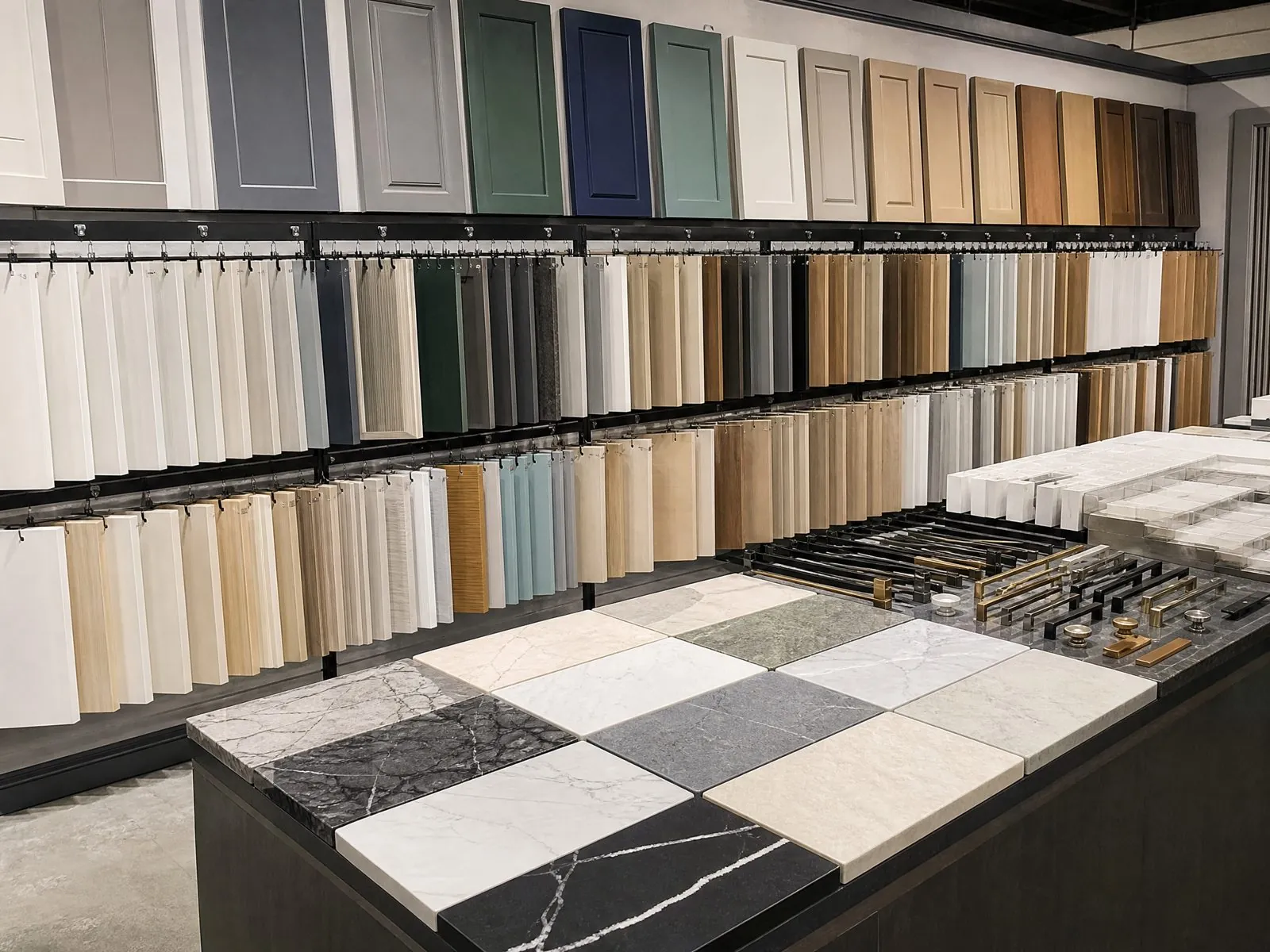
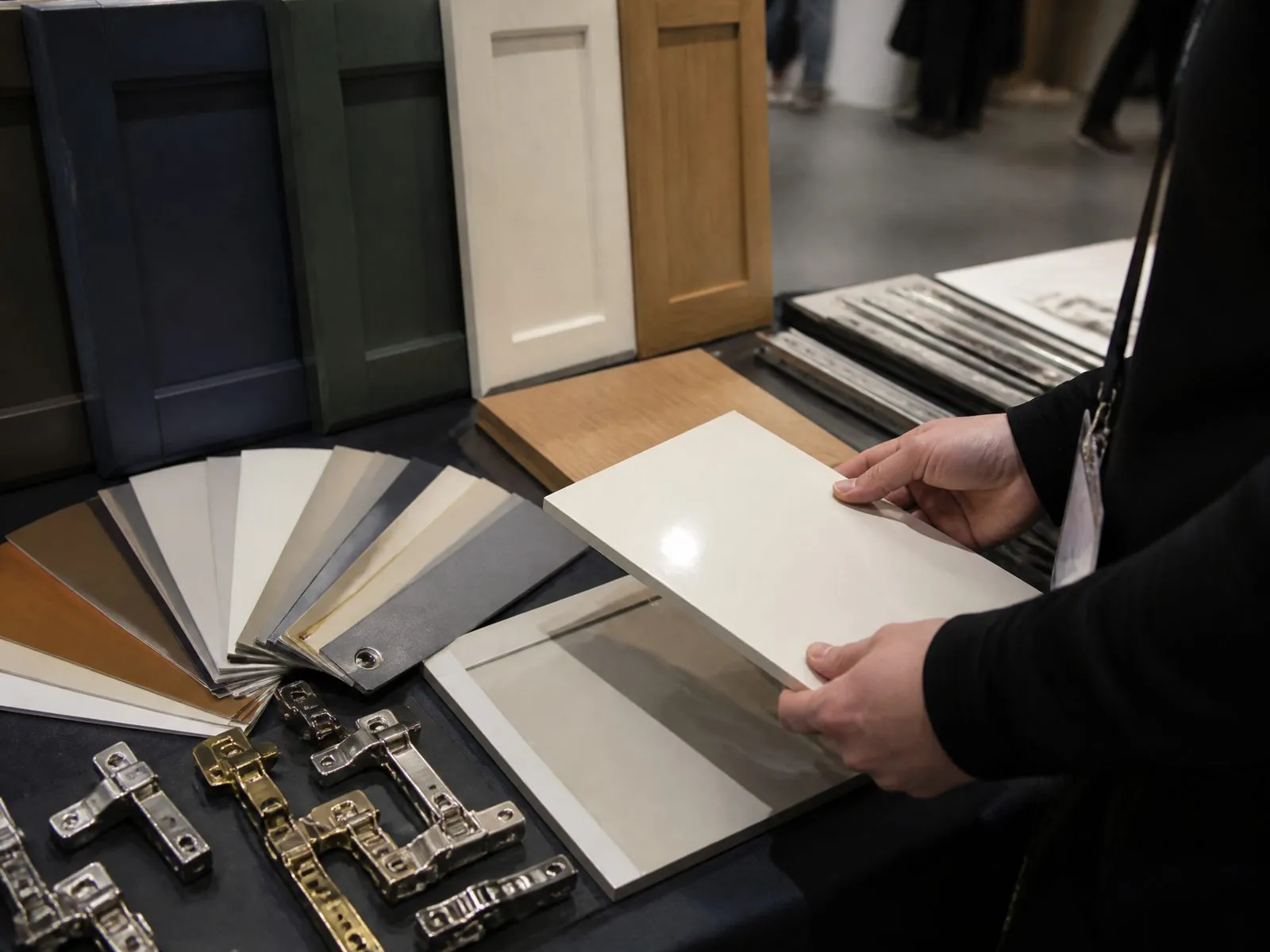
Approve finishes on physical samples under realistic light, not on screen images. Colors and gloss levels change significantly between photos, daylight and kitchen lighting.
- Request full-size or large door samples, including edges and a corner.
- Check the edge banding color match on melamine and PET.
- For lacquer, confirm color code, gloss level and the agreed method of measuring it.
- For gloss finishes, look at the surface at an angle under a strong light to check smoothness.
- Keep a signed reference sample at both your office and the factory.
- For multi-batch projects, ask how batch-to-batch color will be controlled.
How Do Shipping and Installation Differ by Finish?
Lacquer and high-gloss doors need the most protection in transit and on site. Melamine is the most forgiving. Plan packing and site handling according to the finish.
- Gloss PET and lacquer doors are usually shipped with protective film on the face, which should stay on until installation is complete.
- Doors should be packed face to face with foam or separators to prevent rubbing.
- Edges and corners need protectors, especially on lacquer doors.
- Store cartons flat and dry on site, away from direct sun and wet trades.
- Order a small quantity of spare doors or touch-up kits for lacquer projects.
Installers should adjust hinges after installation to keep gaps even. Even gaps are particularly visible on gloss handleless fronts.
How Do Core Board and Edge Banding Change the Result?
The face finish gets the attention, but the core board and edges decide how a door performs over years. A good finish on a weak core or a poorly banded edge will fail first at the sink, the dishwasher and the oven tower.
Core choices
- Particle board: economical and stable for melamine carcasses and flat doors; screw holding is lower than MDF, so hinge positions should be drilled accurately.
- MDF: fine, uniform core that machines cleanly; required for lacquer and preferred for PET doors with routed handles or profiles.
- Moisture-resistant grades: available in both particle board and MDF; recommended for sink bases, dishwasher end panels and bathroom-adjacent cabinets.
- Plywood: used in some markets for carcasses where buyers prefer it; less common as a lacquer door core because the surface grain can telegraph through paint.
Edge treatment
Melamine and PET doors rely on edge banding. ABS or PVC banding applied on automated edge banders gives a clean, consistent edge. Some lines use laser or zero-joint edging, which reduces the visible glue line and improves moisture resistance; ask whether this is available for your order and how it affects cost. For PET, edge banding is matched to the film color and gloss, and high-gloss edges are polished after application.
Lacquer has no separate banding: the coating wraps the edge. This is why lacquer doors look seamless, but it also means edges need the same number of coats and sanding as the face. Ask the factory to show an edge cross-section on the sample so you can see the coating build.
| Edge Detail | Melamine | PET | Lacquer |
|---|---|---|---|
| Edge method | ABS or PVC banding | Color-matched banding or wrapped film | Sprayed with the face |
| Visible joint | Fine glue line | Fine glue line, polished on gloss | None |
| Typical weak point | Water at poorly sealed edges | Heat or water at edges | Impact at corners |
How Can Arcova Help You Choose the Right Door Finish?
Arcova produces melamine, PET and lacquer cabinet doors in our 40,000 m² Arcova Contract Manufacturing Base, with automated CNC cutting, edge banding and drilling lines. We can source boards from EGGER, Kronospan or DARE and pair them with Blum, Hettich, Häfele, Salice, DTC or Hutlon hardware according to your budget.
For each project we prepare finish samples for approval, build mock-ups where required, and inspect production with photo reports before export packing labelled by unit and room. Our factory holds ISO9001, BSCI and FSC certifications, and our team offers 24-hour online technical support. Explore our kitchen cabinets, read about our quality control, or send your kitchen drawings for a finish recommendation and quotation.