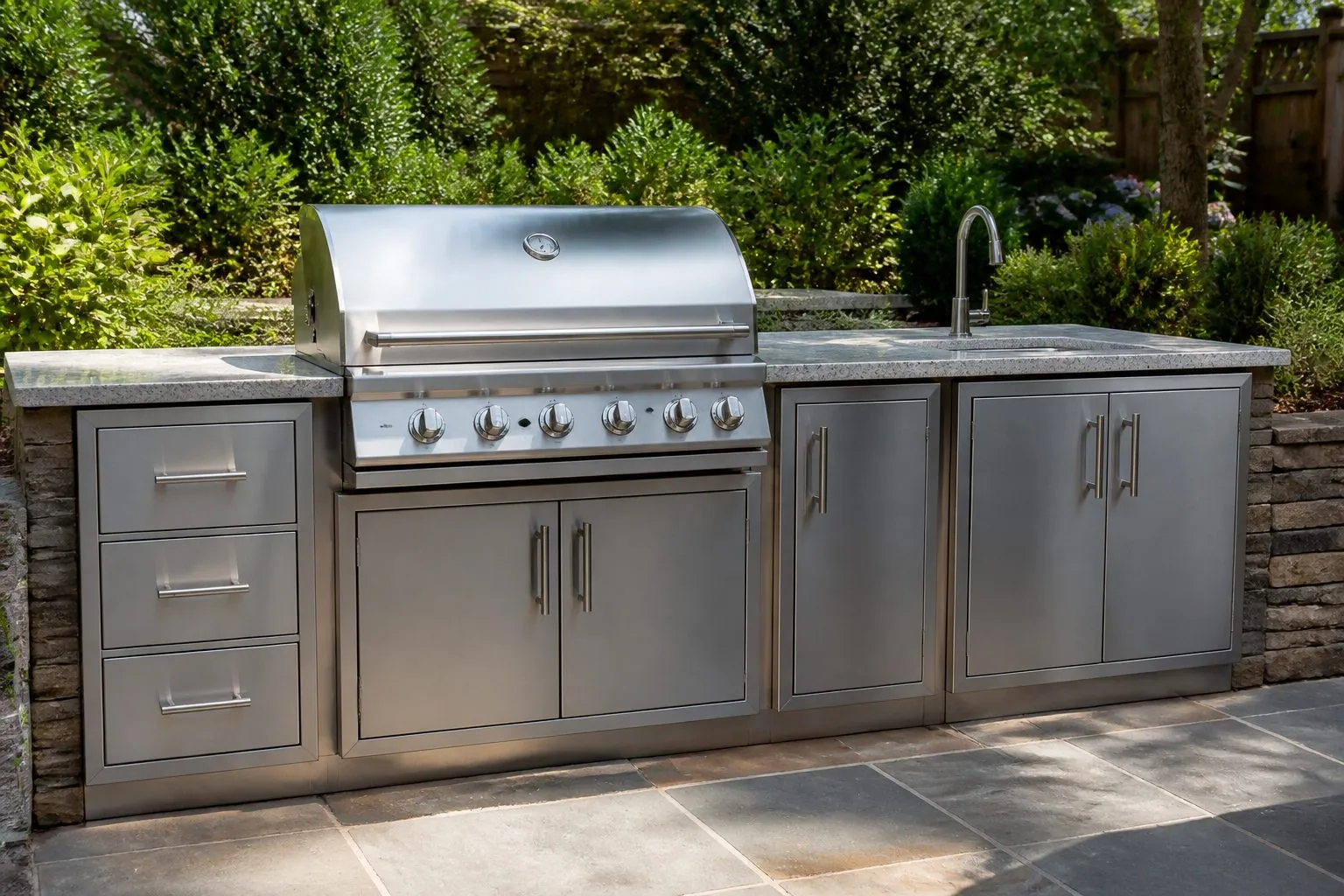
Stainless steel vs HDPE outdoor kitchen cabinets: steel grades, marine board properties, heat clearances, worktops, hardware, maintenance, ordering checks and installation.
Is Stainless Steel or HDPE Better for Outdoor Kitchen Cabinets?
Stainless steel is the better choice for professional-looking outdoor kitchens near grills and heat sources, while HDPE (high-density polyethylene) marine board is the better choice for colored finishes, coastal and pool areas, and projects that want a furniture look without corrosion risk. Many outdoor kitchens combine both: stainless steel around the grill and HDPE for storage cabinets.
Outdoor cabinets face sun, rain, temperature changes, salt air, pool chemicals and insects. Materials that work indoors, such as standard MDF or particleboard, fail quickly outside. The choice between stainless steel and HDPE depends on climate, heat exposure, appearance and budget.
| Factor | Stainless Steel | HDPE Marine Board |
|---|---|---|
| Water resistance | Excellent | Excellent, does not absorb water |
| Heat near grill | Good, non-combustible | Needs clearance or heat shield |
| Corrosion | Depends on grade; lower grades can rust near salt | Does not corrode |
| UV exposure | Not affected; surface can get hot | UV-stabilized grades needed to avoid fading |
| Colors and style | Metallic, sometimes powder coated | Wide range of solid colors and textures |
| Cleaning | Shows fingerprints and water marks | Easy to wipe, hides marks |
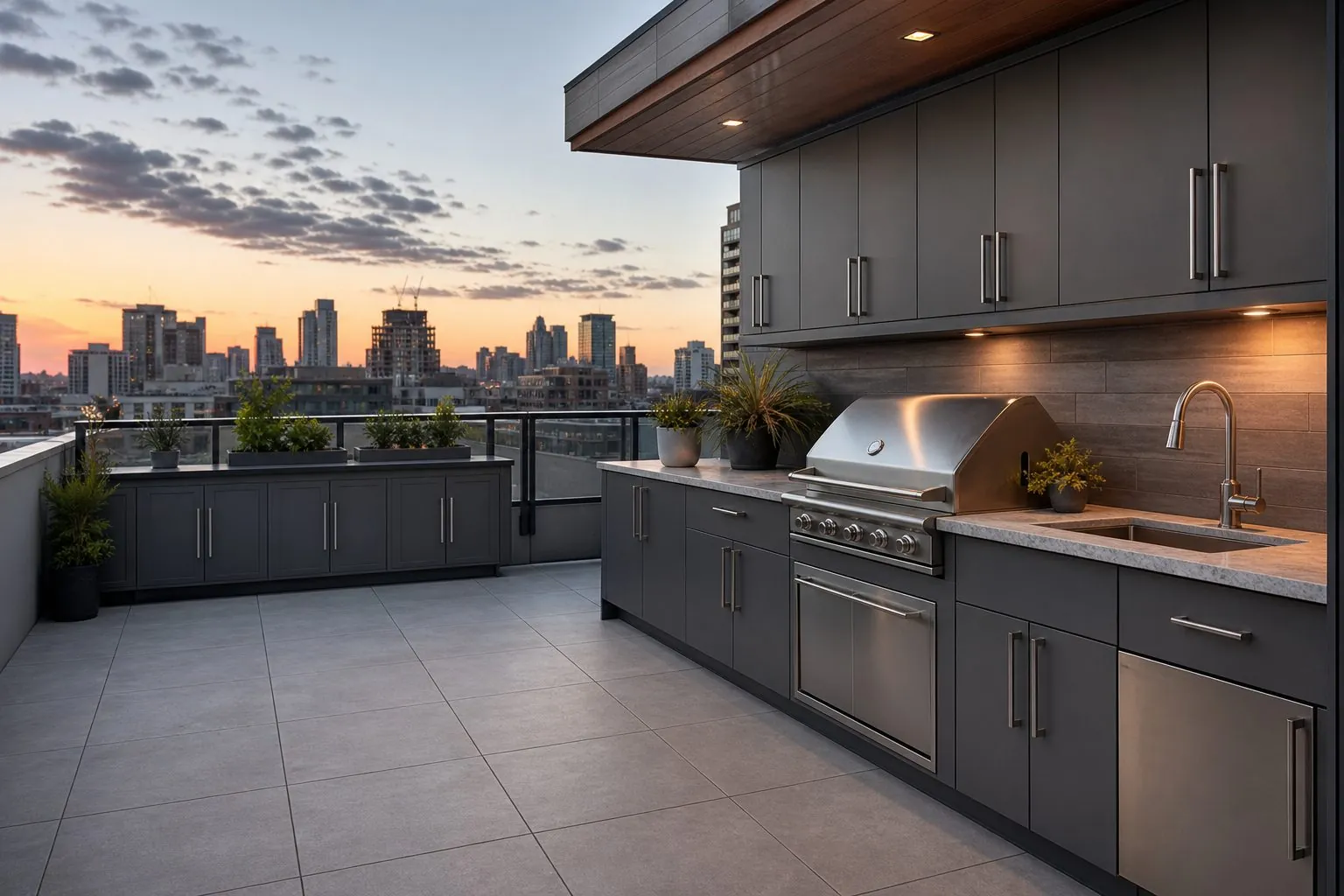
A practical rule is to start from the location. Fully exposed coastal terraces push the choice toward 316 stainless steel or HDPE. Covered patios in dry climates allow 304 stainless steel or HDPE with fewer restrictions. Rooftop kitchens in hotels add wind, strong sun and weight limits, which may favor lighter HDPE cabinets with stainless steel only around the grill.
Which Stainless Steel Grades Suit Outdoor Use?
Use grade 304 stainless steel for most outdoor kitchens and grade 316 for coastal, poolside and high-humidity locations. Lower grades such as 201 are cheaper but more likely to show rust spots outdoors.
- 201: lower nickel content; suitable mainly for dry, covered indoor areas.
- 304: common choice for outdoor kitchens in normal climates.
- 316: added molybdenum improves resistance to salt and chlorides; recommended near the sea and pools.
Finish matters too. Brushed finishes hide scratches better than mirror polish. Welded joints should be cleaned and passivated so they do not become rust points. Ask for material certificates when grade matters to the project. Sheet thickness is confirmed per design.
Stainless cabinets can also be powder coated in colors, which combines steel's heat resistance with a more decorative look. The coating must be rated for outdoor use, and any scratches through the coating should be touched up to protect the steel and the appearance.
Stainless steel surfaces can become very hot in direct sun. Handles and worktops in sunny locations should be considered with this in mind, especially for hotels and resorts where children may touch them.
What Is HDPE Marine Board and Why Is It Used Outdoors?
HDPE marine board is a solid polyethylene sheet developed for boats and outdoor furniture. It does not absorb water, rot, swell or corrode, and it can be machined like wood using CNC routers.
- Solid through the thickness, so scratches do not expose a different core.
- Colored throughout, with matte or textured surfaces.
- Resistant to many pool chemicals and cleaning agents.
- UV-stabilized grades resist fading in sun.
- Can be machined into doors with grooves, handles and profiles.
HDPE expands and contracts with temperature more than steel or wood. Cabinet designs must allow for this movement with suitable fixings and gaps. It is also combustible, so it needs clearance or heat shielding around grills, side burners and pizza ovens.
Thickness and color affect stability. Thicker sheets resist warping better, and darker colors absorb more heat in sun, increasing movement. Light and mid-tone colors are often recommended for fully exposed locations. Sheet thickness is confirmed per design and supplier.
HDPE cabinets look closer to indoor kitchen joinery than steel, which makes them popular for villas, resorts and residential terraces where the outdoor kitchen should feel like part of the house.
How Should Cabinets Be Designed Around Grills and Heat?
Grills and burners need non-combustible surroundings, ventilation and service access. The grill manufacturer's installation instructions should always decide the clearances and whether an insulated jacket is required.
- Use stainless steel or insulated jackets around built-in grills.
- Keep HDPE doors and panels at safe distances from heat sources.
- Provide ventilation openings for gas grills to prevent gas build-up.
- Allow access to gas valves and connections.
- Plan a heat-resistant worktop near the grill.
Send the grill, side burner and fridge models before shop drawings are prepared. Built-in appliances have specific cut-out, ventilation and clearance requirements that vary by brand.
Fridges and ice makers also need ventilation. Outdoor-rated appliances usually specify front or side vent requirements. If these are blocked by cabinet doors or panels, appliances overheat and fail early, especially in hot climates.
Which Worktops Pair Well With Outdoor Cabinets?
Outdoor worktops must resist UV, heat, frost and stains. Sintered stone and granite are common choices. Quartz is usually not recommended in direct sun because UV can fade the resin over time.
| Worktop | Outdoor Suitability | Notes |
|---|---|---|
| Sintered stone | Very good | UV and heat resistant; brittle edges |
| Granite | Very good | Seal regularly; heavy |
| Stainless steel | Good | Gets hot in sun; shows marks |
| Concrete | Good with sealing | Heavy; can crack without reinforcement |
| Quartz | Limited | UV may cause fading in direct sun |
Worktops should overhang cabinets slightly to throw rain clear of doors, and joints should be sealed with outdoor-rated sealant.
Weight matters for rooftops and balconies. Stone worktops and stainless steel cabinets add significant load, so the structural engineer should confirm floor capacity. HDPE cabinets with a thinner sintered stone top are a lighter combination for these locations.
Sinks outdoors need drainage and, in cold climates, a way to drain water lines before frost. Stainless steel sinks with outdoor-rated taps are standard. Include the sink and tap models in the drawings so cut-outs and cabinet access are correct, and check that the drain connects to a suitable outlet rather than running onto the paving.
Which Hardware and Fixings Work Outdoors?
Use stainless steel or other corrosion-resistant hardware for all outdoor cabinets. Standard indoor hinges and runners rust quickly and fail.
- Stainless steel hinges, ideally 304 or 316 to match the location.
- Stainless or coated drawer runners rated for outdoor use.
- Stainless screws and fixings to avoid rust streaks.
- Adjustable plastic or stainless feet to keep cabinets off wet floors.
- Magnetic or mechanical catches suited to wind exposure.
Avoid mixing metals where possible, since contact between dissimilar metals can cause corrosion in damp conditions.
Locks may be needed for cabinets in hotels and public areas to prevent misuse or theft of equipment. Choose stainless or weather-rated locks and keep keys under management control.
How Do Costs and Maintenance Compare?
Costs depend on material grade, design complexity and quantities, so compare quotations on the same drawings. In general, 316 stainless steel costs more than 304, and HDPE costs vary by thickness and color. Maintenance needs are low for both but different in nature.
- Stainless steel: clean regularly with mild cleaners to remove salt and dirt; wipe water marks; avoid chlorine-based cleaners.
- HDPE: wash with soapy water; check fixings for movement; replace hinges if worn.
- Both: cover the kitchen in winter in cold climates; drain water from appliances.
For hotels and resorts, maintenance teams prefer materials that tolerate frequent cleaning and do not need refinishing.
Lifecycle cost matters more than purchase price outdoors. A cheaper cabinet that rusts, swells or fades within a few seasons will cost more over time than a properly specified one. When comparing quotations, check material grades, hardware type and fixings, not just the headline price.
Mixing materials for value
- Stainless steel grill surround and doors near heat.
- HDPE storage cabinets and drawers in the rest of the run.
- Sintered stone worktop across both for a single, continuous surface.
What Should Buyers Confirm Before Ordering?
Confirm site conditions and appliance details first, since they drive material and design decisions.
- Location: coastal, poolside, covered or fully exposed.
- Climate: sun exposure, frost, heavy rain.
- Appliance models and gas or electric supply.
- Material choice per zone: stainless near heat, HDPE for storage.
- Worktop material and edge details.
- Color and finish samples under daylight.
- Drainage and slope of the floor.
- Quantity and delivery schedule for multi-unit projects.
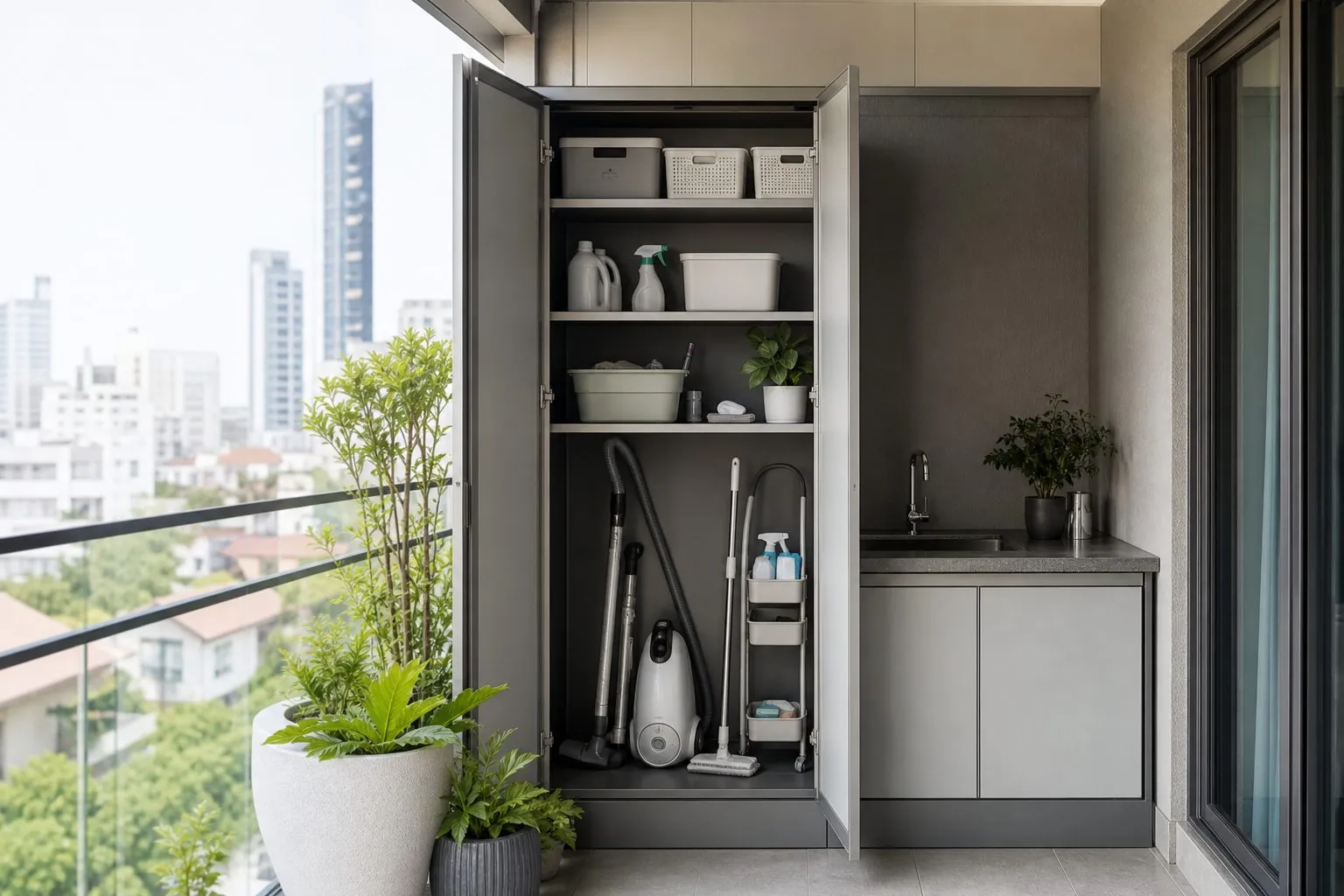
See our laundry and balcony cabinets for related outdoor and balcony storage options.
For multi-unit residential projects with balcony kitchens, also check building rules on gas use, weight limits and fire separation. Some buildings allow only electric grills on balconies, which changes the cabinet design and heat clearances.
How Are Outdoor Cabinets Installed?
Install outdoor cabinets on a level, well-drained base, leaving space for expansion and ventilation.
- Check that the base slab is level and drains away from the cabinets.
- Set cabinets on adjustable feet and level them.
- Join cabinets with stainless fixings, allowing for HDPE movement.
- Install appliances following manufacturer instructions.
- Fit worktops and seal joints with outdoor-rated sealant.
- Test doors, drawers, gas and electrical connections.
Gas and electrical connections must be made by licensed local installers.
After installation, give the owner or operator a care guide covering cleaning products, winter protection and the reference codes for replacement doors, hinges and runners. For hotels and resorts, a short maintenance schedule helps keep the kitchen looking new.
Outdoor sockets need weatherproof covers and the protection devices required by local electrical rules.
How Can Arcova Help With Outdoor Kitchen Cabinets?
Arcova coordinates outdoor kitchen cabinets with appliance models, worktops and site conditions in shop drawings, approves material and color samples, and inspects production with photo reports. Export packing is labelled by unit. We hold ISO9001, BSCI and FSC certifications and provide 24-hour online technical support. Learn more about our kitchen cabinets, factory and quality control, or send your outdoor kitchen layout.