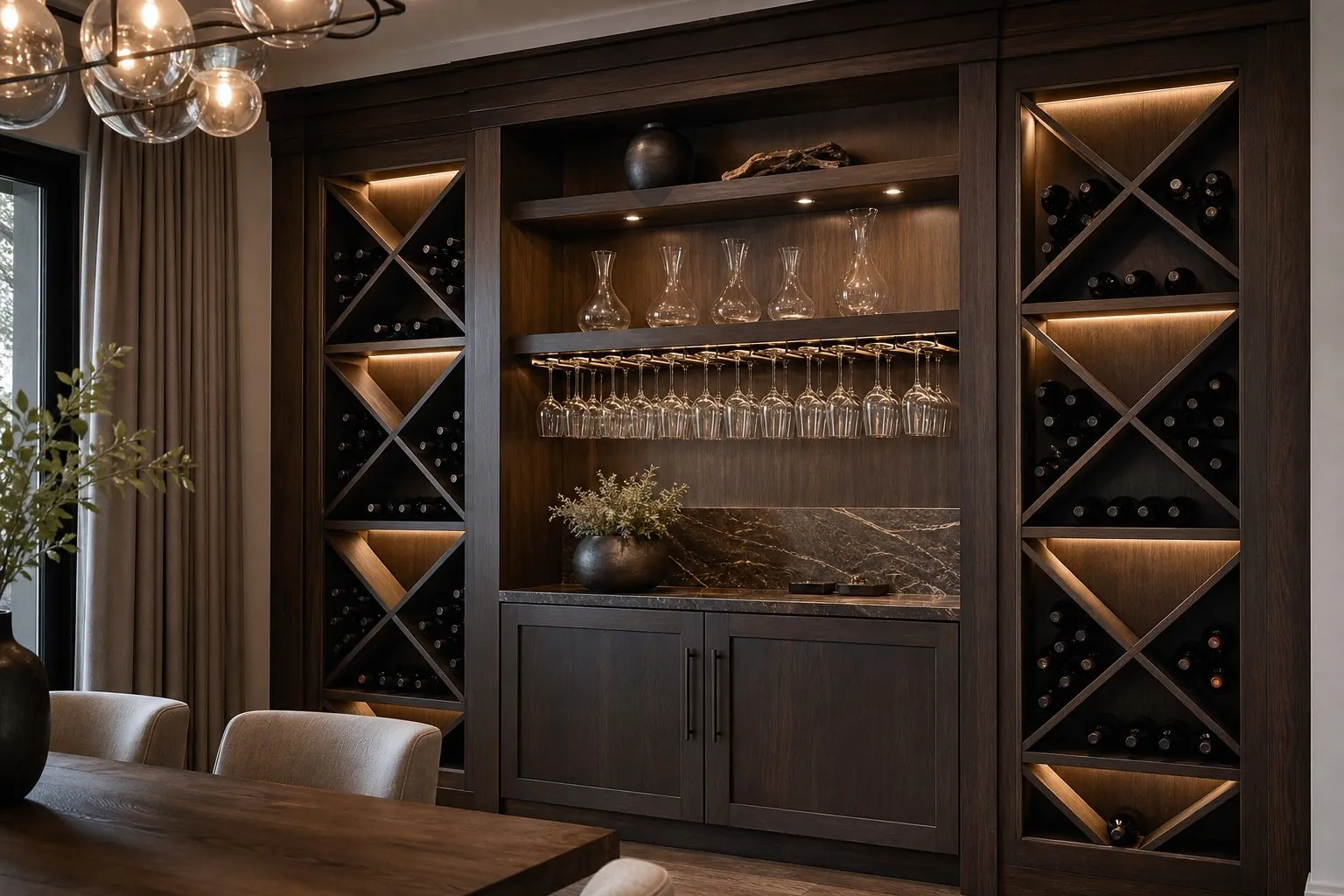
How to plan a built-in wine cabinet: display versus climate storage, bottle racks, glass choices, cooler integration, lighting, materials and what to confirm before ordering.
What Should a Built-In Wine Cabinet Actually Do?
A built-in wine cabinet should store bottles safely, display them attractively and, if long-term aging is needed, house a climate-controlled appliance. Joinery alone does not control temperature or humidity, so decide first whether the cabinet is for display and short-term storage or for serious aging.
Many buyers expect a wooden cabinet with glass doors to protect wine like a cellar. In reality, a cabinet at room temperature is fine for bottles consumed within months, but heat, light and temperature swings will affect wine kept for years. The design should match the real use.
- Display cabinet: racks, lighting and glass doors at room temperature.
- Cabinet with integrated cooler: joinery frames one or more wine coolers.
- Cabinet with climate unit: an insulated enclosure cooled by a dedicated system, designed with a cooling specialist.
Each option has different requirements for insulation, ventilation, power and drainage, so the choice shapes everything that follows.
Which Type of Wine Cabinet Suits Your Space?
Choose by bottle count, available space, budget and whether long-term aging matters. Display cabinets suit dining rooms and bars; integrated coolers suit kitchens and villas; climate-controlled enclosures suit collectors, restaurants and hotels.
| Type | Climate control | Best for | Main consideration |
|---|---|---|---|
| Open or glass display cabinet | None | Dining rooms, home bars | Keep away from heat sources and sunlight |
| Cabinet with built-in cooler | From appliance | Kitchens, villa bars | Cut-out and ventilation per model |
| Full-height wine wall with coolers | From appliances | Penthouses, clubhouses | Multiple appliances and power points |
| Insulated glass enclosure | Dedicated cooling system | Restaurants, collectors, hotels | Requires refrigeration specialist |
For projects such as hotel lounges or restaurants, the joinery manufacturer usually builds the cabinet, racks and doors, while a refrigeration specialist supplies and commissions the cooling system. Agree this split of responsibility early.
How Should Bottle Racks Be Designed?
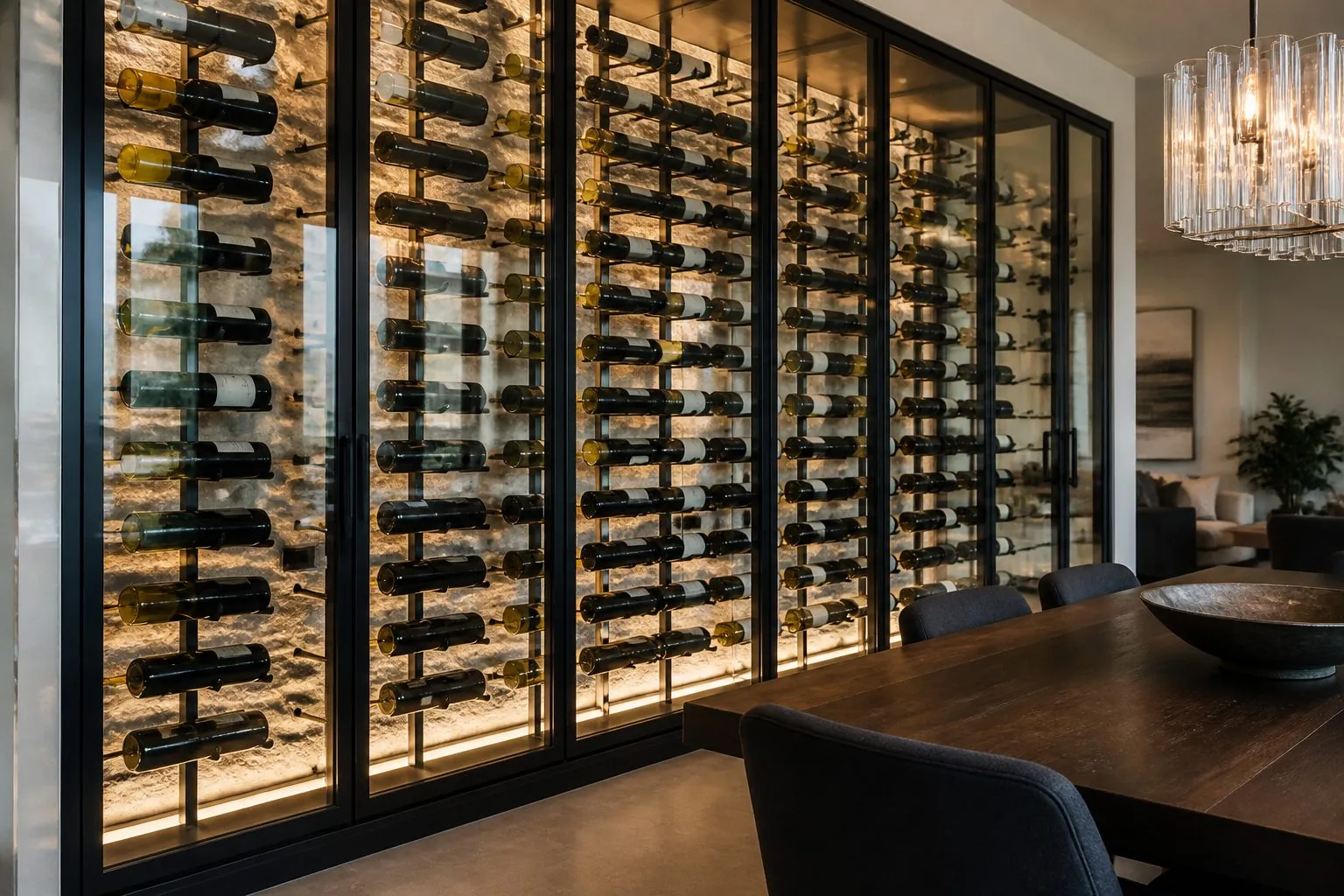
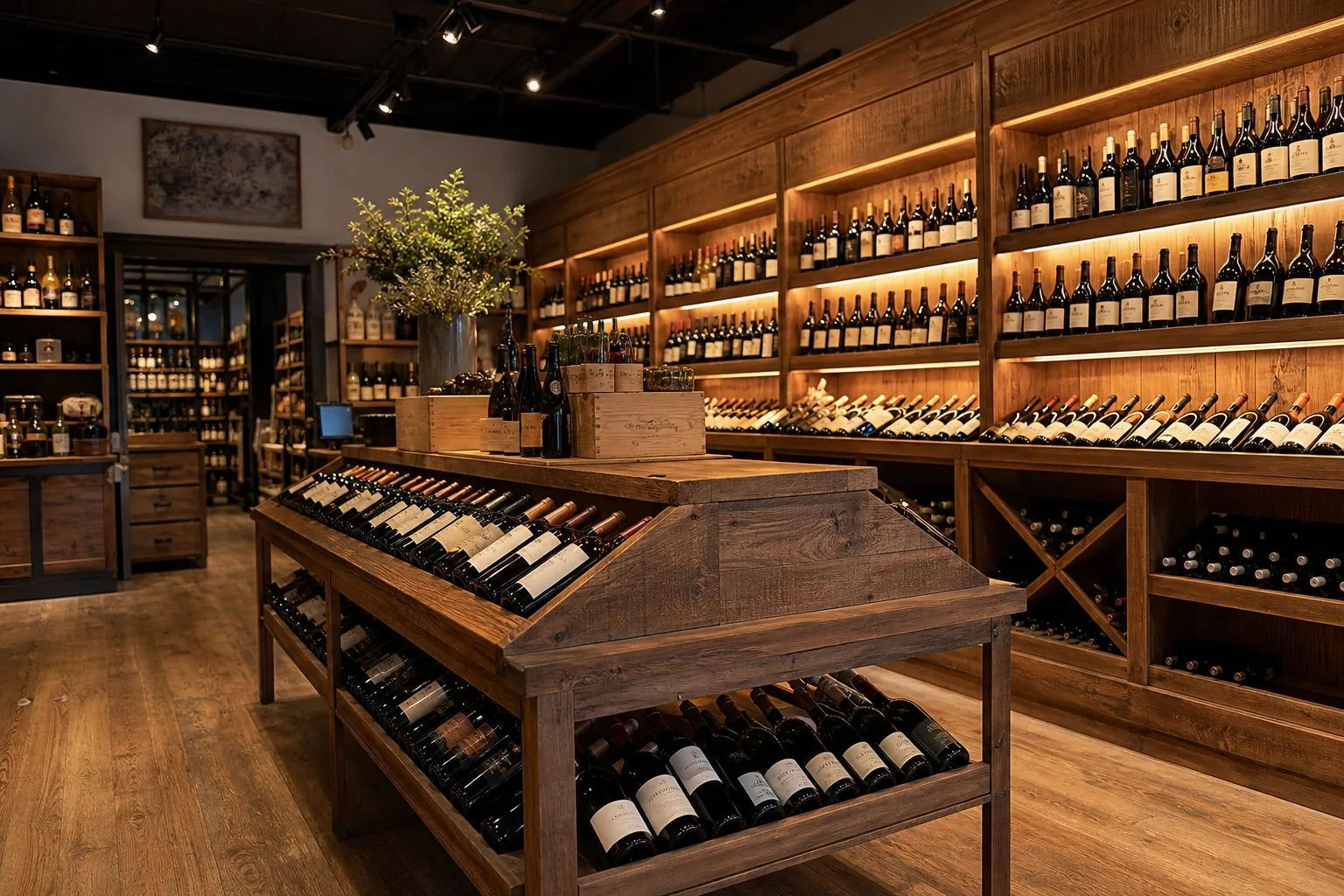
Store bottles horizontally for long-term storage so corks stay moist, and use angled display racks for bottles meant to be seen and sold or served soon. Rack spacing must suit the bottle shapes in the collection.
- Horizontal individual racks: each bottle has its own slot; easy to find and remove.
- Diamond or X cubbies: store more bottles per area; less easy to pick individual bottles.
- Angled display shelves: show labels; best for a few featured bottles.
- Pull-out racks: bring rows forward in deep cabinets.
- Case storage: base sections for wooden cases or boxes.
Standard 750 ml Bordeaux bottles fit most racks, but champagne, Burgundy and magnum bottles are wider. Plan a share of larger slots or adjustable shelves. Bottles are heavy, so rack spans and fixings must be designed for the load; capacity and load figures are confirmed per design.
Which Glass Should You Use on a Wine Cabinet?
Use tempered safety glass at minimum, and choose UV-filtering or tinted glass where bottles are exposed to daylight. For cooled cabinets, insulated double or triple glazing is needed to limit condensation and energy loss.
| Glass option | Benefit | Limitation |
|---|---|---|
| Clear tempered | Best display, safety glass | No UV protection |
| Tinted or bronze | Reduces light, warm look | Bottles less visible when unlit |
| UV-filtering laminated | Protects wine from light damage | Higher cost |
| Insulated glazing unit | Needed for cooled enclosures | Heavier; needs stronger hinges |
| Low-iron glass | Very clear, true color | Higher cost; no added protection |
Heavy glass doors require hinges or pivot hardware rated for their weight. Framed glass doors, using wood or metal frames, protect glass edges and are easier to fit with seals. Frameless glass looks lighter but needs precise hardware.
How Do You Integrate a Wine Cooler Correctly?
Follow the cooler manufacturer's installation manual exactly. Built-in and under-counter coolers have specific cut-out sizes and ventilation paths, and enclosing a freestanding cooler without airflow can cause overheating and early failure.
- Select the cooler model before cabinet drawings are finalized.
- Check whether it vents from the front base, sides or rear.
- Design cut-outs and ventilation grilles to the manual.
- Plan a dedicated socket in an accessible position.
- Leave service access so the cooler can be removed for repair.
- Match cabinet fronts and trims to the cooler door line.
When several coolers sit side by side, check the required gaps between them. Some models allow zero-clearance installation; others need spacing. Send manuals with your drawings so the factory can make cut-outs by CNC rather than leaving them for site work.
What Climate Conditions Matter for Wine?
Stable temperature, moderate humidity, darkness and low vibration matter most for wine storage. A cabinet without a climate unit can only help with darkness and vibration; temperature and humidity depend on the room or an appliance.
- Temperature: long-term storage is commonly kept cool and stable; daily swings are more harmful than a slightly warm but steady room.
- Humidity: moderate humidity helps corks; very dry air can dry corks, very damp air can damage labels and joinery.
- Light: UV light can affect wine, so limit direct sunlight and use LED lighting.
- Vibration: avoid placing cabinets against appliances or machinery.
In insulated enclosures, humidity also affects the cabinet itself. Choose stable materials such as plywood, veneered panels or suitable solid woods, and seal finishes. A refrigeration specialist should advise on condensation control, insulation and drainage.
Which Materials and Finishes Work Best?
Use dimensionally stable materials and durable finishes, especially in cooled or humid enclosures. Plywood, veneered MDF and kiln-dried solid woods are common, with metal racks and frames for modern designs.
- Plywood or veneered panels for carcasses because they are stable and strong.
- Solid wood racks in species with low odor and good stability.
- Metal rod or peg systems for modern, floating-bottle displays.
- Low-emission finishes to avoid odors in enclosed spaces.
- Stone or quartz counters on serving areas to resist spills.
Strong-smelling woods or finishes are best avoided in enclosed wine storage. Ask for finish samples and certifications such as CARB or FSC where projects require them.
How Should LED Lighting Be Used?
Use LED lighting with warm color temperature, keep it a short distance from bottles and control it with switches or sensors so it is not on all the time. LEDs produce far less heat than halogen, making them the standard for wine displays.
- Place LED strips in shelf fronts or vertical profiles to light labels.
- Use diffusers to avoid visible dots and glare on glass.
- Locate drivers outside cooled enclosures, with access for replacement.
- Choose dimmable systems for restaurants and lounges.
- Confirm electrical certification needs for the destination market.
What Should You Confirm Before Ordering?
Confirm purpose, capacity, appliances, glass, lighting and responsibility for cooling before drawings are approved. This avoids the most common problems: wrong cut-outs, poor ventilation and racks that do not fit the collection.
- Storage purpose: display, cooler integration or climate enclosure.
- Bottle count and mix of sizes.
- Cooler or cooling system models and manuals.
- Glass type, safety and UV protection.
- Lighting type, control and color temperature.
- Locks for hotels, restaurants and homes with children.
- Floor and wall capacity for full-height wine walls.
- Site measurements and access routes for large sections.
How Many Bottles Should a Built-In Wine Cabinet Hold?
Size the cabinet for the collection the owner will realistically hold in two to three years, plus some spare space. A cabinet sized only for today's bottles fills up quickly. One sized for an imagined cellar wastes wall space and budget.
Start by counting the bottles the owner keeps now, then split them into wine for long aging and wine for drinking soon. Bottles kept for aging belong in a temperature-controlled cooler or a cool, dark zone. Bottles for near-term drinking can sit in open racks or display niches, where they look good and are easy to reach.
| Storage Zone | Typical Use | Planning Note |
|---|---|---|
| Wine cooler | Long aging, white and sparkling wine | Capacity set by the appliance model |
| Closed racks | Medium-term storage | Keep away from heat and direct sun |
| Open display racks | Near-term drinking, feature bottles | Good light, but not for long storage |
| Magnum and case storage | Large formats and unopened cases | Needs taller, deeper bays |
Bottle shapes vary. Burgundy and Champagne bottles are wider than Bordeaux bottles, so racks with a fixed pitch may not fit every bottle. Ask for a mix of rack sizes, or for adjustable cradles in some bays.
How Do You Plan a Wine Cabinet for Hotels and Restaurants?
A commercial wine cabinet has to work for staff first and for display second. Staff need to find, pull and restock bottles quickly during service. Guests see the cabinet as part of the interior.
- Security: fit lockable doors or glazed fronts with locks wherever guests can reach the cabinet.
- Labelling: add numbered bins or rack labels that match the wine list, for fast picking.
- Service access: leave access panels for cooler maintenance that can be opened without emptying the racks.
- Durability: choose hard-wearing finishes on edges and handles that staff touch many times a shift.
- Lighting control: use low-heat LEDs and put them on a dimmer or timer, so bottles do not sit lit all day.
Before production, confirm the stock levels, the restocking routine and the cooler models with the operations team.
How Can Arcova Help With Built-In Wine Cabinets?
Arcova builds built-in wine cabinets, home bars and dining joinery as part of whole-house custom cabinetry projects. With 12+ years of manufacturing, a 40,000 m² factory and 12 production lines, we produce racks, cabinets and doors to shop drawings.
- Drawing deepening and 3D design with cooler cut-outs to appliance manuals.
- Finish sample approval and mock-ups for hospitality projects.
- Inspection with photo reports and export packing labelled by unit or room.
- Installation guidance and 24-hour online technical support.
- Certifications: ISO9001, BSCI and FSC.
See our dining and entryway cabinets or send your plans. Cooling systems are coordinated with specialists; capacity, MOQ and lead time are confirmed per project.