Flat-pack saves container space, while pre-assembled saves site labor. Compare freight, damage risk, installation and quality control to choose the right export cabinet format.
Should You Ship Export Cabinets Flat-Pack or Pre-Assembled?
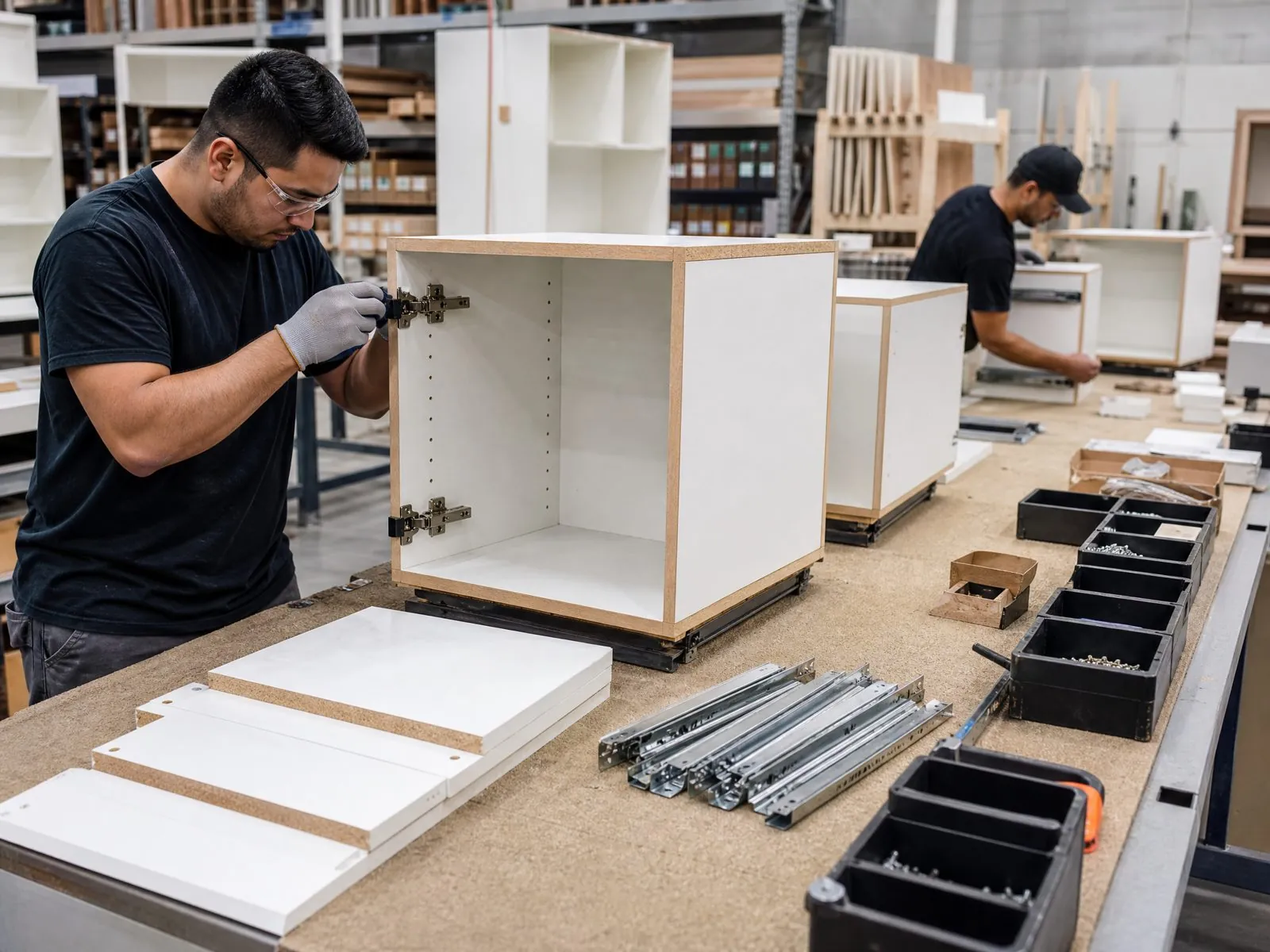
For most export projects, flat-pack is the better default, because it reduces container volume and protects finished panels when packed well. Pre-assembled cabinets make sense when site labor is expensive or unskilled, when quantity is small, or when construction quality depends on factory gluing and squaring. Many buyers end up with a hybrid: flat-pack carcasses with doors and special units handled separately.
The right answer depends on total installed cost, not freight alone. Compare the options on this basis:
| Factor | Flat-Pack | Pre-Assembled |
|---|---|---|
| Container use | High density, far more units per container | Low density, because each cabinet ships mostly air |
| Freight cost per unit | Lower | Higher |
| Site labor | Needs assembly time and a trained crew | Faster to set and fix |
| Corner and racking damage | Lower, with good panel packing | Higher, as boxes can rack if dropped |
| Squareness and joint quality | Depends on site assembly | Controlled at the factory |
| Access to upper floors | Easy in lifts and stairs | Large units can be difficult to move |
| Replacement parts | A single panel can be replaced | Often needs a whole unit or site repair |
How Much Container Space Does Flat-Pack Actually Save?
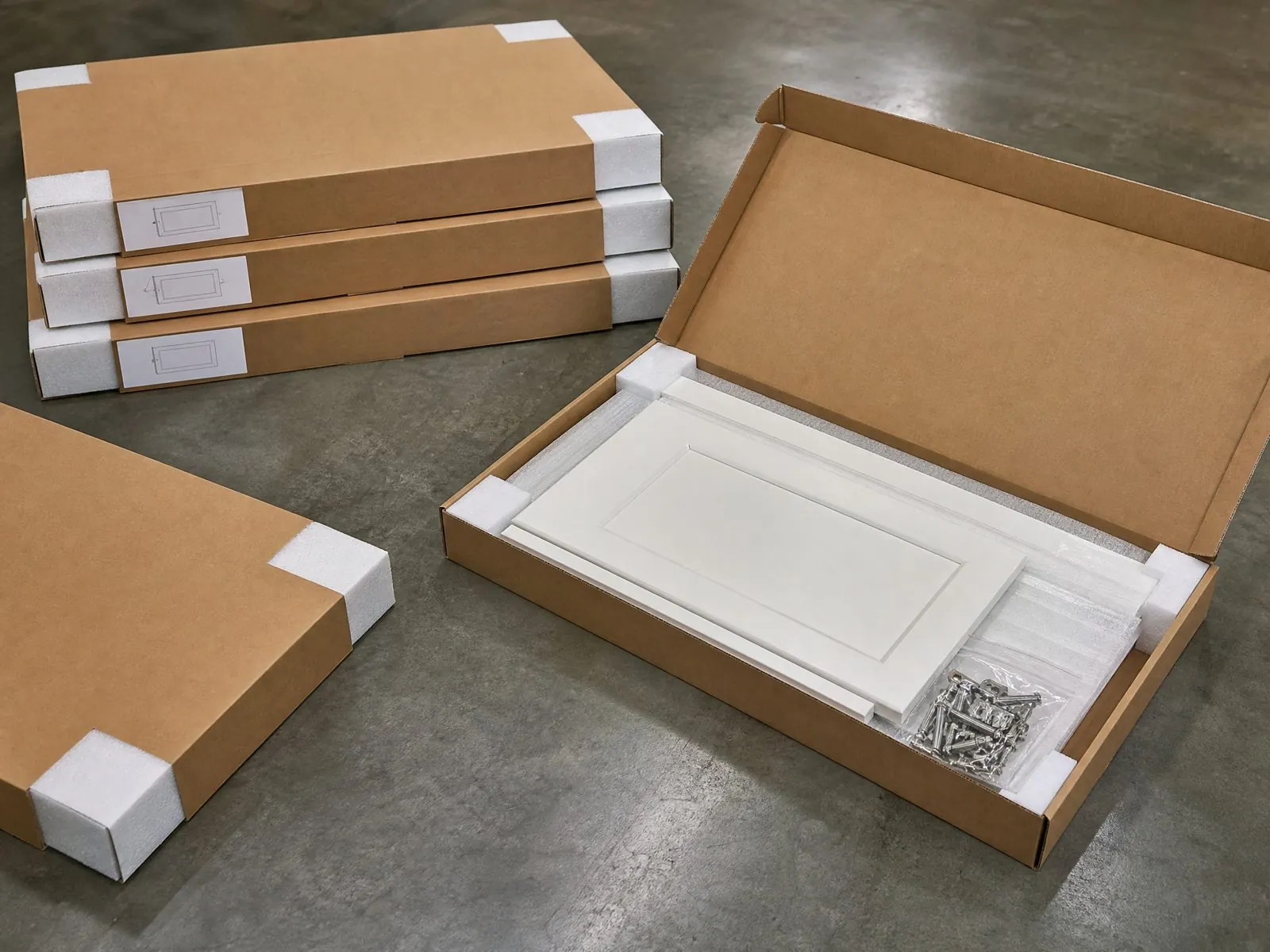
Flat-pack usually saves the majority of a cabinet's shipping volume, because it removes the empty space inside each box. The exact saving depends on the cabinet mix, so ask for a loading plan from your actual schedule before you compare freight quotes.
Here is a simple illustration using a base cabinet about 600 mm wide, 580 mm deep and 720 mm high:
- Assembled, its outer volume is about 0.25 m³ before packing.
- Stacked as panels, the same cabinet occupies a small fraction of that volume, usually a flat carton only as thick as its panels.
- Tall cabinets and wide bases save the most, since they hold the most air.
- Drawer boxes save less when they ship assembled.
This is an example of the principle, not a loading guarantee. Real container plans also account for carton strength, pallets, hardware boxes and door crates. A 40HQ container is normally limited by volume on cabinet orders, although weight must also be checked if stone, glass or heavy panels ship in the same load.
Which Format Has the Lower Total Installed Cost?
Flat-pack usually wins on large repeated projects where a contractor has a trained assembly crew. Pre-assembled can win for small jobs in high-wage markets, because every hour saved on site offsets some of the higher freight cost per unit.
Calculate these items for your project, using local quotes:
- Freight, port charges and inland delivery per cabinet.
- Assembly hours per cabinet multiplied by local labor rates.
- Installation hours once the cabinet is ready to fix.
- Site storage space needed before and during installation.
- Expected damage and replacement cost for each format.
- Waste handling, as pre-assembled loads can bring more packaging to site.
On a tight urban site, storage may decide the question on its own. Stacks of flat cartons can be held on a single floor, while assembled cabinets need far more space and more careful handling.
How Does Each Format Affect Damage in Transit?
Well-packed flat-pack panels generally suffer less structural damage, but neither format is safe with weak packing. The risks are simply different. A flat carton can have crushed corners and scratched faces, while an assembled box can rack, open its joints and expose its corners during handling.
| Risk | Most Affected Format | Practical Control |
|---|---|---|
| Racked or loosened joints | Pre-assembled | Corner blocks, strong cartons, cross-bracing inside tall units |
| Crushed panel corners | Flat-pack | Corner protectors and a stacked weight limit |
| Face scratches | Both | Protective film or foam between finished surfaces |
| Moisture swelling | Both | Moisture-barrier wrap, desiccant and dry storage at site |
| Missing parts | Flat-pack | Counted hardware bags and unit-level packing lists |
Doors and drawer fronts carry the most visible value, so many buyers pack them separately from carcasses whichever format is chosen. Glass doors, stone tops and mirrors should normally move in crates. Ask to see drop-test evidence or packing photos if your route involves several transfers; any such test is confirmed per project.
What Joinery Works Best for Flat-Pack Cabinets?
Choose a connector system that your site crew can repeat quickly and that keeps carcasses square under load. Good flat-pack is designed for flat-pack from the start, rather than being an assembled cabinet simply taken apart.
- Cam-and-dowel connectors: quick, hidden and reversible, and popular for repeated carcasses.
- Confirmat screws: strong and simple, though the screw heads usually need caps.
- Dowel-and-glue assembly: very strong, but requires clamping time and a skilled crew.
- Tool-free click connectors: fast, at a higher hardware cost, and worth considering where site labor is limited.
Accuracy matters as much as hardware choice. CNC drilling keeps connector holes matched across panels, so a cabinet from one carton fits as precisely as one from the next. Ask for a single sample cabinet to be assembled by your own crew. Then measure diagonals, check door gaps and note the assembly time. That data is far more useful than a sales claim about easy assembly.
When Is Pre-Assembly Worth Paying For?
Pre-assembly is worth paying for when the factory's controlled assembly is more valuable than the container space it uses. It suits small and high-value orders, and complex units that are difficult to build accurately on site.
- Villa kitchens where a few cabinets carry a high finish value.
- Cabinets with integrated lighting, wiring or complex pull-out fittings.
- Curved, angled or unusually sized units.
- Markets with high labor costs or limited trained assemblers.
- Replacement or top-up orders that must be fitted quickly.
Pre-assembly is less suitable for high-rise projects with restricted lifts, for projects with very long sea and road routes, and for buyers with limited site storage. Always check door widths, lift cars and stair turns against the largest assembled unit before you decide.
How Does a Hybrid Format Work in Practice?
A hybrid format sends most carcasses flat and assembles only what benefits from it. It is usually the most practical answer on mixed projects, because it captures most freight savings while protecting the sensitive parts.
A typical split looks like this:
- Standard base, wall and tall carcasses ship flat in cartons by unit.
- Drawer boxes ship assembled or as a pre-fitted set.
- Doors and drawer fronts ship in protected packs, with hinges and fittings counted out separately.
- Complex specials, such as lit or curved units, ship assembled in stronger packaging.
- Glass and stone ship in crates, or are sourced locally.
Some importers also run a local assembly workshop close to the port, where flat-pack cartons are built into finished cabinets before delivery. It helps in high-wage markets, and shifts quality control closer to the customer. It does require space, trained staff and a clear plan for spare parts.
How Should a Hybrid Order Be Documented?
A hybrid order only works if everyone can see which format applies to each item. Otherwise, site teams spend their first days searching for parts that are packed in a different carton, a different crate or even a different container.
- Add a format column to the cabinet schedule, showing flat, assembled or crated for each module.
- Give each door pack and hardware bag a code that links back to its carcass.
- Show the carton count per unit on the packing list, so receiving teams can check completeness.
- Plan container loading in reverse site order where several shipments serve one building.
- Issue a one-page assembly sequence with the first shipment, then confirm it during the sample cabinet trial.
Does the Format Affect Customs or Compliance?
Format generally has little effect on the basic product classification, but you should confirm this with your customs broker for each destination. Furniture that is unassembled is often classified as the complete article, so shipping flat does not by itself change the duty position.
A few points deserve attention before you commit:
- US projects: check current anti-dumping, countervailing and other tariff measures that apply to wooden cabinets and vanities from China.
- Board emissions: CARB or other formaldehyde documents apply to the board, in either format.
- Wood packaging: crates and pallets normally need ISPM 15 treatment and marking.
- Consumer sales: flat-pack retail products usually need clear assembly manuals, fittings lists and safety warnings.
- Origin rules: local assembly does not automatically change the country of origin.
Rules change regularly, so treat this as a checklist for your broker instead of legal advice.
What Should You Ask a Supplier Before Choosing a Format?
Ask for evidence rather than assurances. A supplier should be able to show how the cabinet is packed and assembled, and how missing parts are handled on site.
- Can you provide a container loading plan for both formats, using my actual cabinet schedule?
- Which connector system is used, and how many are used per carcass?
- Is a printed or online assembly manual included for each module?
- How are hardware packs counted and matched to each unit?
- Are cartons labelled by building, unit and room?
- How are doors and finished panels separated in the carton?
- Can spare panels be identified by code if replacements are needed?
- Can a sample cabinet be sent for a site assembly trial?
How Can Arcova Help With Export Cabinet Packing?
Arcova can plan your order as flat-pack, pre-assembled or hybrid after reviewing your cabinet schedule and site conditions. Automated CNC cutting, edge banding and drilling lines keep panels and connector positions consistent, which is the foundation of reliable flat-pack supply.
- Capacity: a 40,000 m² factory with 12 production lines and a monthly capacity of 40 × 40HQ containers.
- Project control: shop drawings, finish sample approval and mock-ups before mass production.
- Shipping preparation: inspection with photo reports, and export packing labelled by unit and room.
- Site help: installation guidance and 24-hour online technical support.
Send your schedule and destination through our contact page. You can read more about inspection on our quality page, or browse our Kitchen Cabinets range.