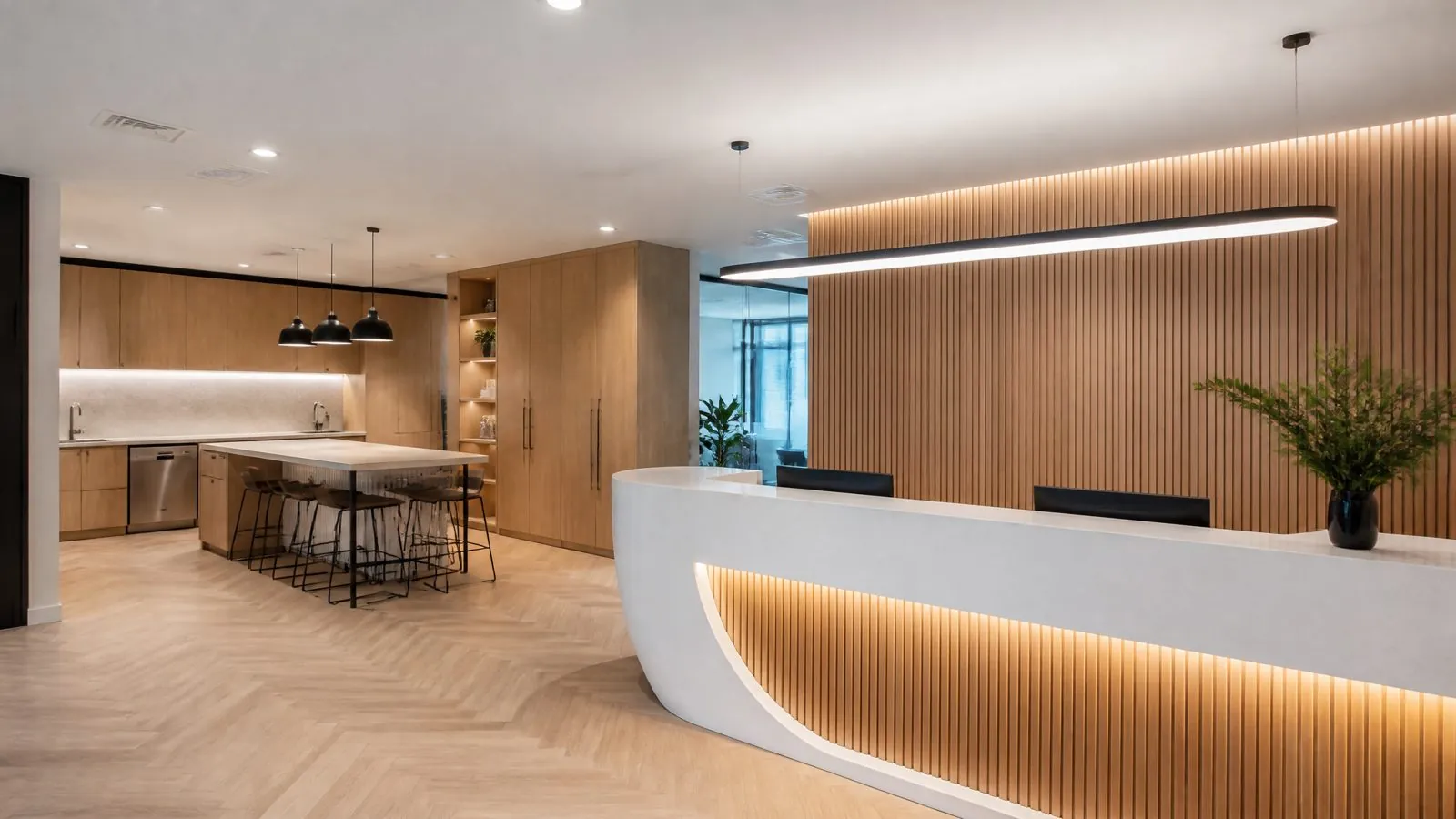
A step-by-step guide to sourcing custom office furniture from China: supplier selection, specifications, samples, quality control, packing, and common mistakes to avoid.
Why Do Buyers Source Custom Office Furniture from China?
Buyers source custom office furniture from China mainly to get project-specific joinery at factory-direct cost, with one supplier handling desks, storage, reception counters, and meeting tables. The savings are real, but only when the buyer controls specifications, samples, and inspection as carefully as price.
Custom office projects rarely fit catalog products. A tenant fit-out may need desks sized to a column grid, storage walls that match a brand color, and a reception desk that carries the company logo. Chinese cabinetry factories with panel processing lines can produce these items to drawings, often alongside the casegoods and joinery already being made for other interiors.
- Customization: sizes, finishes, cable management, and branding to project drawings.
- Consolidation: desks, storage, reception, meeting tables, and lockers from one source.
- Material choice: access to major board brands and a wide range of hardware levels.
- Scale: capacity for multi-floor fit-outs and repeat roll-outs for branch offices.
The risk is equally clear: distance, language, and different quality assumptions. The rest of this guide covers how to reduce those risks step by step.
Which Office Furniture Items Are Best Suited to Custom Manufacturing?
Panel-based items are the best fit for custom manufacturing: storage, desks with panel or simple metal frames, reception counters, meeting tables, and wall cabinetry. Highly engineered seating and complex height-adjustable mechanisms are usually better bought from specialist brands.
| Item | Custom Suitability | Why | Notes for Buyers |
|---|---|---|---|
| Storage walls and tall cabinets | High | Panel construction, sized to walls and ceilings | Confirm site dimensions and scribe allowances |
| Reception desks | High | One-off branded pieces built from panels, solid surface, and metal | Approve 3D drawings and material samples |
| Executive desks and credenzas | High | Veneer or lacquer finishes, custom sizes | Veneer matching across large tops needs attention |
| Meeting and boardroom tables | High | Custom shapes, integrated power boxes | Confirm power module type and local plug standard |
| Workstation desks | Medium to high | Panel tops on metal frames; repeatable | Specify frame source and screen system |
| Pantry and break-room cabinets | High | Same as kitchen cabinetry | Coordinate appliances and sinks |
| Ergonomic task chairs | Low | Requires specialist mechanisms and testing | Usually sourced separately |
A practical approach is to source all panel-based joinery from one cabinetry manufacturer and buy seating from a specialist. This keeps finishes consistent across desks, storage, and reception while protecting ergonomic performance. Browse typical items in our office furniture range.
How Do You Choose the Right Type of Supplier?
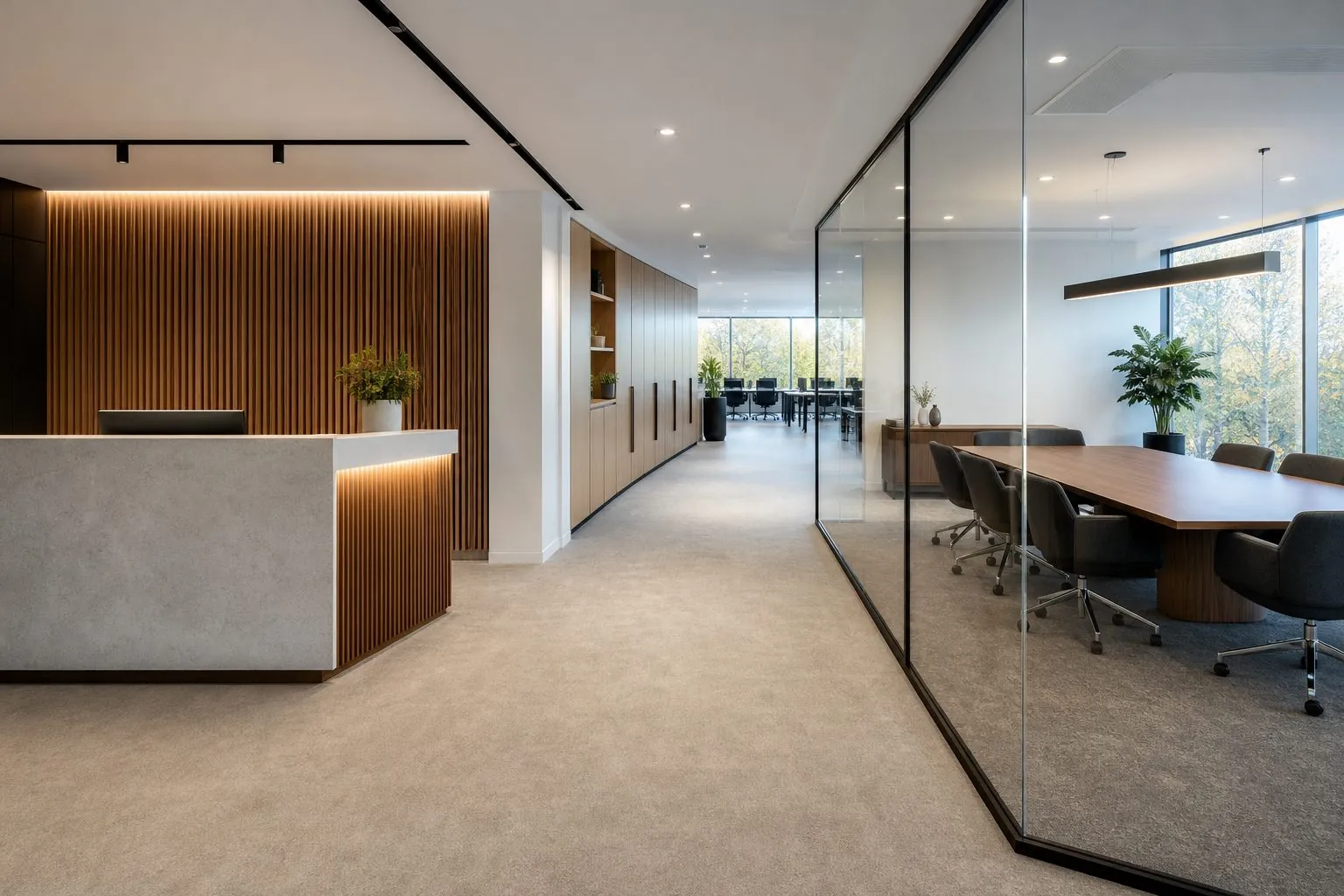
Choose a factory that makes panel furniture and joinery in-house rather than a trading company, unless you need many unrelated product categories. Direct factories give clearer control over materials, production schedules, and quality checks.
Supplier types compared
| Supplier Type | Strengths | Weaknesses | Best For |
|---|---|---|---|
| Cabinetry and joinery factory | In-house panel processing, custom sizes, consistent finishes | May outsource seating and metal frames | Fit-outs with lots of storage, reception, and wall joinery |
| Office furniture brand factory | Standard workstation systems, tested products | Less flexible on custom joinery | Large open-plan workstation orders |
| Trading company | One contact for many categories | Less control over production and quality | Small mixed orders with simple specifications |
| Fit-out contractor with sourcing team | Handles design and installation | Higher margin, less transparency on factory | Buyers without in-house project management |
What to verify before shortlisting
- Factory size, production lines, and which processes are done in-house.
- Certifications relevant to your market, such as ISO9001, FSC, and CARB.
- Engineering capacity to produce shop drawings from design-intent drawings.
- Photos or videos of comparable custom work, not only catalog renderings.
- Export experience to your region, including packing and documentation.
What Should Your Specification Package Include?
Your specification package should define dimensions, materials, finishes, hardware, and performance expectations clearly enough that two factories would quote the same product. Vague specifications are the main reason quotes vary widely and finished products disappoint.
- Drawings: plans, elevations, and sections for each item, with key dimensions marked.
- Board and core material: particleboard, MDF, or plywood, plus the required emission standard.
- Surface finishes: melamine, HPL, veneer species and cut, or lacquer color and gloss level.
- Edge treatment: edge banding type and thickness, or solid wood lipping for executive pieces.
- Hardware: hinge and runner brand or level, locks, handles, and soft-close requirements.
- Cable management: grommets, trays, vertical spines, and power module types.
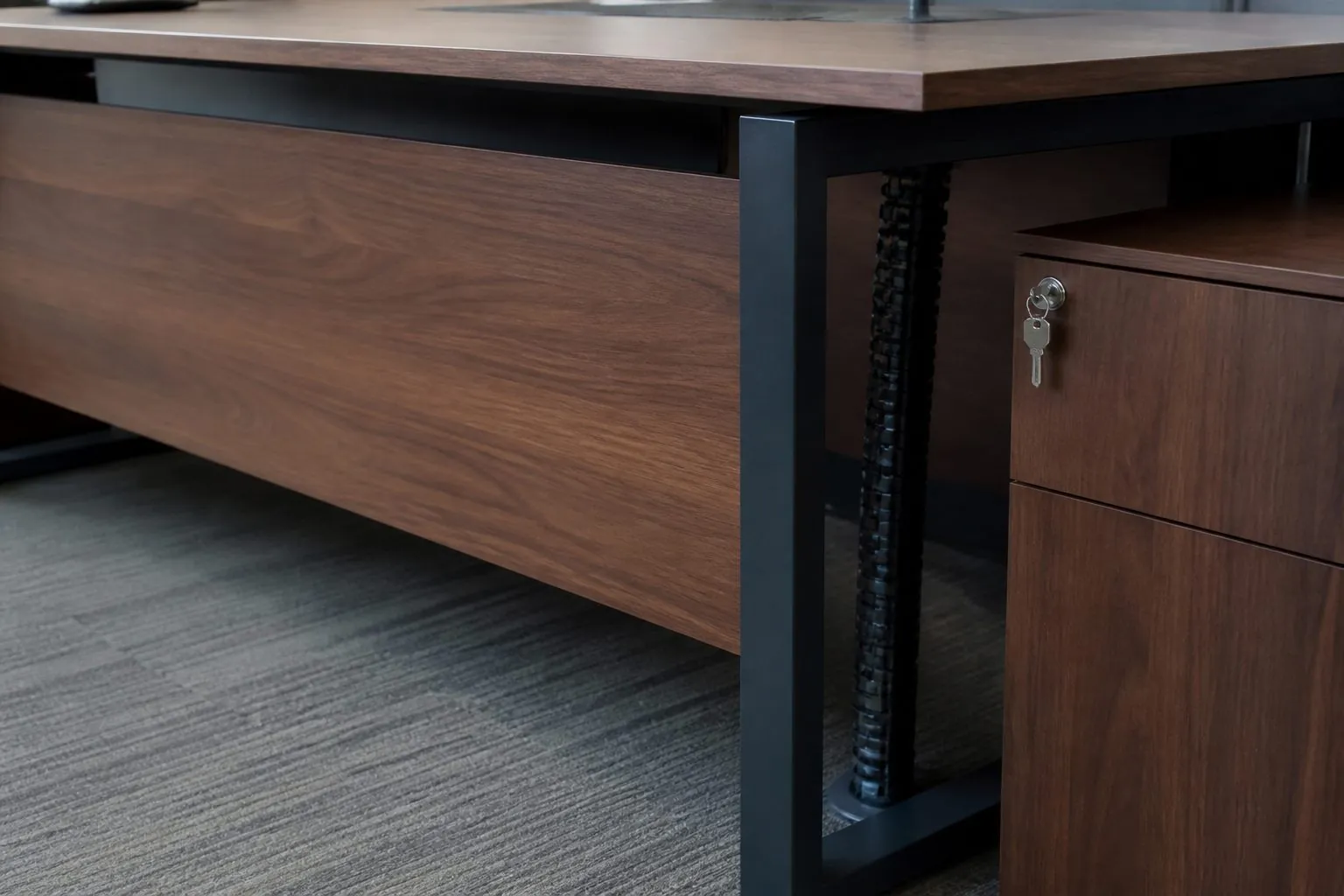
- Metal parts: frame profile, finish, and color for desks and tables.
- Labelling and packing: how items should be marked by floor, zone, or room.
If you only have design-intent drawings from an architect, ask the factory to produce shop drawings for approval. Arcova offers drawing deepening and 3D design so that every item is checked before cutting starts.
How Do Samples and Mock-Ups Reduce Project Risk?
Samples and mock-ups confirm color, texture, construction, and hardware feel before money is committed to mass production. They are the cheapest point at which to catch a mismatch between what the designer imagined and what the factory understood.
- Finish samples: chips or small panels of each board, veneer, lacquer, and laminate.
- Hardware samples: handles, hinges, and locks so the client can approve the look and feel.
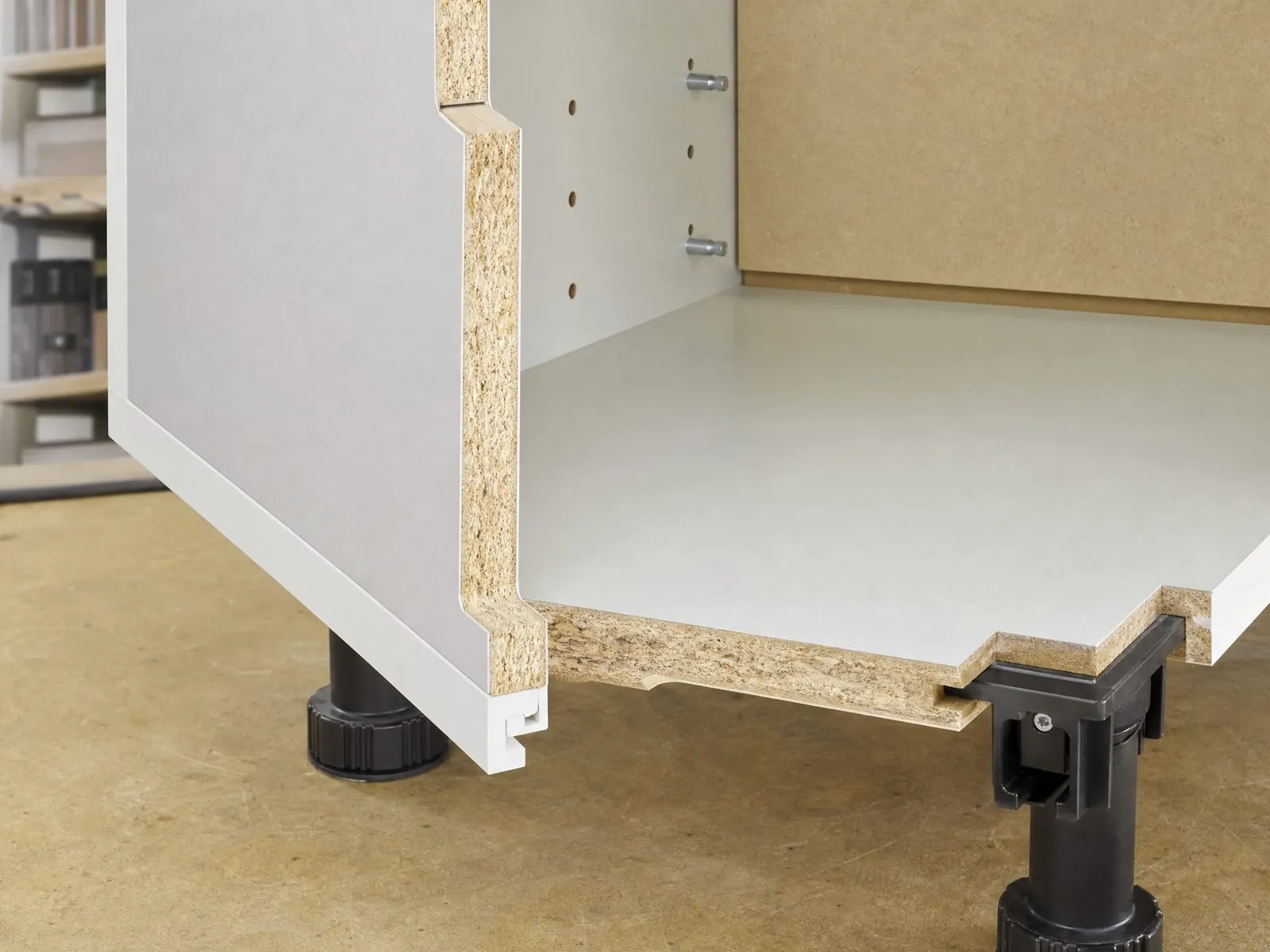
- Corner or section samples: show edge banding, joinery, and finish quality on a real construction.
- Full mock-up: one complete workstation, desk, or reception unit for large or high-visibility projects.
Sign and date approved samples and keep a matching set at both ends. During inspection, production pieces are compared against the approved reference, not against memory. Sample cost and timing should be agreed in advance: confirmed at quotation.
How Should You Manage Production and Quality Control?
Manage production with agreed milestones and inspections at the right stages: incoming materials, first articles, during production, and before loading. Waiting until the goods arrive to check quality leaves you with few options.
| Stage | What to Check | Evidence to Request |
|---|---|---|
| Material arrival | Board brand and grade, veneer batches, hardware brand | Photos of labels and delivery notes |
| First article | Dimensions, finish match to approved sample, assembly | Photo report with measurements |
| During production | Edge banding, drilling accuracy, lacquer quality | Progress photos or video calls |
| Pre-shipment | Quantities, labels, packing, random sample assembly | Inspection report with photos; third-party inspection if required |
| Loading | Container condition, loading sequence, securing | Loading photos and packing list |
Automated CNC cutting, edge banding, and drilling lines reduce dimensional variation, which matters when hundreds of desks must line up in rows. Ask how the factory checks finish consistency between batches, especially for veneer and colored lacquer.
Arcova provides inspection with photo reports, and buyers are welcome to appoint third-party inspectors. See our quality process for details.
How Do Packing and Logistics Affect Office Furniture Orders?
Packing and logistics decide whether furniture arrives undamaged and can be installed quickly. Specify flat-pack or assembled delivery, protective packing for finished surfaces, and labels that match the floor plan so installers can deliver each carton straight to its zone.
- Flat-pack vs. assembled: flat-pack saves container space; assembled items such as reception desks may need crating.
- Surface protection: corner guards, foam, and film for lacquer, veneer, and solid surface tops.
- Labelling: item code, floor, zone, and carton number on every package.
- Hardware kits: fittings packed and labelled per item, with spare parts included.
- Loading sequence: load in reverse installation order when the site can only take staged deliveries.
Incoterms, freight method, and customs documentation should be agreed when the order is placed. Confirm which certificates your importer needs, such as FSC chain-of-custody or CARB compliance documents, before shipping.
How Should You Compare Quotes and Total Landed Cost?
Compare quotes on total landed cost and on identical specifications, not on the factory unit price alone. A lower ex-works price can disappear once freight, duties, damage, site rework, and extra project management time are added.
- Specification match: check that board grade, finish, edge banding, and hardware brand are the same in every quote.
- Inclusions: confirm whether metal frames, power modules, locks, and spare parts are included or priced separately.
- Packing volume: flat-pack designs reduce the number of containers and therefore freight cost.
- Freight and duties: agree Incoterms and ask your forwarder or customs broker for current duty rates.
- Samples and mock-ups: include their cost and time in the comparison.
- Risk allowance: consider the supplier's inspection process and how claims for damaged or defective items are handled.
Ask each supplier for an itemized quotation that follows your item list and codes. This makes line-by-line comparison possible and becomes the reference document for production and inspection later.
What Are the Most Common Mistakes When Sourcing Office Furniture?
The most common mistakes are choosing on price alone, skipping shop drawing approval, and leaving hardware and cable details undefined. Each of these leads to rework, delays, or a finished office that looks different from the design.
- Comparing quotes with different specifications. Always compare on the same board, finish, and hardware level.
- Not confirming site dimensions. Columns, window mullions, and floor boxes move during construction.
- Ignoring power and data. Plug standards and module types vary by country.
- Skipping physical samples. Screen colors do not match lacquer or veneer reliably.
- No inspection before loading. Problems found on site cost far more to fix.
- Unclear packing labels. Installers waste days sorting cartons.
A short checklist signed by both sides at each stage prevents most of these issues.
How Can Arcova Help You Source Custom Office Furniture?
Arcova is a custom cabinetry and joinery manufacturer that produces office storage, desks, reception counters, meeting tables, and pantry cabinets to project drawings. Because we also make kitchens, Built-In Wardrobes, and hotel furniture, we are used to coordinating finishes and packing across complex projects.
- 12+ years of manufacturing experience and a 40,000 m² factory, the Arcova Contract Manufacturing Base.
- 12 production lines, including automated CNC cutting, edge banding, and drilling.
- Monthly capacity of 40 × 40HQ containers.
- ISO9001, BSCI and FSC certifications.
- Boards from EGGER, Kronospan, and DARE; hardware from Blum, Hettich, Häfele, Salice, DTC, or Hutlon by budget.
- Shop drawings, 3D design, finish sample approval, mock-ups, inspection photo reports, labelled export packing, and installation guidance.
- OEM and private label options for furniture distributors; see OEM/ODM services.
MOQ, lead time, and pricing are confirmed per project: confirmed at quotation. Send your drawings and item list via our contact page and our team will respond with questions and a quotation plan.