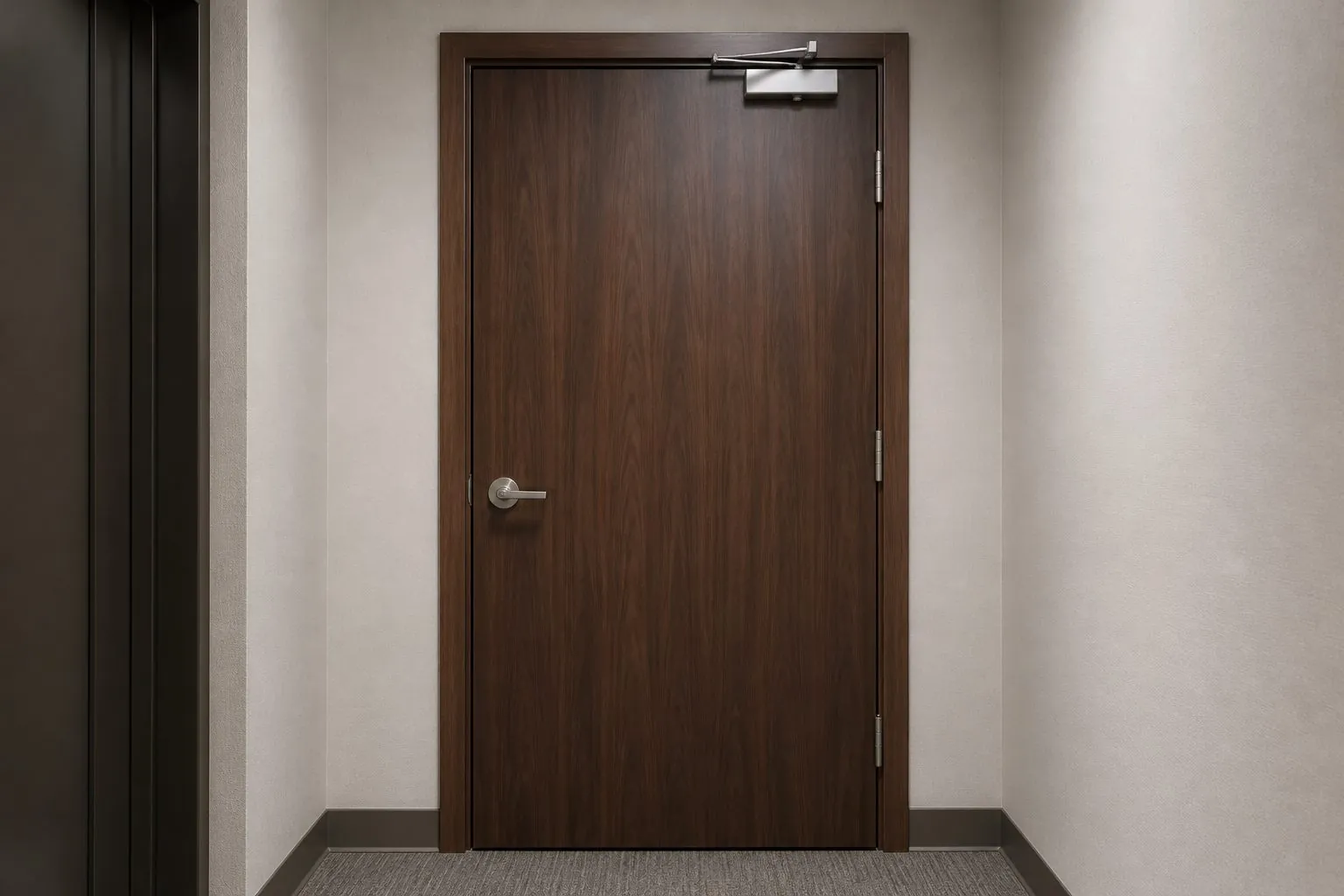
How buyers should verify fire-rated wooden doors: reading test reports, standards by market, certification, assembly components, marking, site installation and direct questions for suppliers.
What Should Buyers Check First on a Fire-Rated Wooden Door?
Check the evidence before the door: a current test report or certificate, from a recognized body, that covers the complete door assembly you are actually buying, for the market where it will be installed. A rating claimed in a brochure proves nothing, and neither does a certificate for a different product or manufacturer.
A fire door is a life safety product. If it fails an inspection, the buyer may face replacement costs, handover delays and legal exposure, whatever the purchase price was. The review therefore starts with five questions:
- Which rating does the project's fire strategy or code require for each opening?
- Which test standard and certification route does the authority having jurisdiction accept?
- Does the evidence name this manufacturer and this production site?
- Does its scope cover the door size, configuration, glazing and hardware on your schedule?
- Can the marking on each door be traced back to that evidence?
Only when all five answers are clear should you compare price, finish and delivery.
What Does a Fire Rating Actually Mean?
A fire rating states how long a tested door assembly met defined performance criteria under a specific test method. It is not a promise about any real fire, and it applies only to the configuration tested or formally assessed. A figure such as 30 or 60 minutes means little until the standard behind it is known.
Different systems express the result differently:
- Time-based classes: many systems describe resistance in minutes. The UK uses designations such as FD30 and FD60, while North America commonly labels doors at 20, 45, 60 or 90 minutes.
- Integrity and insulation: European classifications use letters, such as E for integrity and I for insulation, followed by the time. The two criteria are not interchangeable.
- Smoke control: separate smoke requirements may apply. Examples include an S suffix in UK practice and Sa or S200 in European classifications.
- Pressure conditions: tests can differ in how pressure is applied in the furnace, which is one reason a report from one system cannot simply be relabeled for another.
Which Standards and Documents Apply by Market?
Requirements depend on the destination and sometimes on the project or city, so the table below is an orientation guide only. Standards are revised, and local rules change. Confirm the current edition and the accepted route with the fire consultant or authority having jurisdiction before you place an order.
| Market | Standards Commonly Referenced | What Buyers Commonly Ask For |
|---|---|---|
| United States | NFPA 252, UL 10B or UL 10C for testing; NFPA 80 for installation and maintenance | Listing by a recognized body such as UL or Intertek, and a permanent label on each door and frame |
| Canada | CAN/ULC-S104 for testing; NFPA 80 commonly used for installation | Listing and label from an accredited certification body |
| European Union | EN 1634-1 test, EN 13501-2 classification; EN 16034 with EN 14351-1 or EN 14351-2 for applicable CE routes | Classification report and, where applicable, declaration of performance with CE marking |
| United Kingdom | BS 476-22 or BS EN 1634-1; BS 8214 guidance on fire door assemblies; UKCA or CE rules where applicable | Third-party certification scheme evidence, door label or plug, and installation data |
| Australia and New Zealand | AS 1530.4 test; AS 1905.1 for fire-resistant doorsets in Australia | Test report or assessment, plus door tag and evidence of suitability under the local building code |
| Middle East | Varies by country; UL or BS routes are often accepted | Local civil defense approval where required, plus source test evidence |
| China | GB 12955 for fire doors | Type inspection report and the certification required for fire products |
Do not assume reciprocity. A door tested in one system usually cannot be sold under another without testing or assessment recognized in the new market. Also, CE marking on a supplier's other products says nothing about fire resistance. Only the performance declared for the specific door counts.
How Do You Read a Fire Door Test Report?
Read the report for its limits, not just its result. A pass only proves that a specific sample performed under specific conditions, and the useful information is what was tested, who tested it and which variations are permitted.
| Item in the Report | What to Verify | Red Flag |
|---|---|---|
| Laboratory and accreditation | Laboratory is independent and accredited for the test | In-house or unverifiable laboratory |
| Sponsor and manufacturer | Matches the company and factory selling you the door | Name differs, and no authorization is provided |
| Test standard | Matches what your market accepts | Standard from a different system, or no standard named |
| Specimen description | Core, facings, edge details, seals and frame match your quote | Vague description, or missing construction pages |
| Size and configuration | Covers your leaf sizes, single or double configuration, and swing | Your sizes exceed what was tested or assessed |
| Hardware and glazing | Your hinges, locks, closers and glass are included | Substituted hardware without supporting evidence |
| Date and status | Validity and the current edition are accepted by your authority | Old report, or one with pages removed |
Ask for the complete document, not a summary or a certificate front page. If in doubt, contact the laboratory or certification body and verify the report number directly. Most recognized bodies keep public listings or can confirm a document.
Test evidence should also be separated from a field of application. Some systems allow a formal assessment or extended application report to cover sizes or details beyond the tested sample. These must be issued by a competent body, and a supplier's own statement does not count.
Why Is Certification Different From a Test Report?
A test report describes one past test, while third-party certification also reviews how the door is made over time. For buyers, certification adds confidence that the production door matches the tested one, and many projects or authorities require it.
Certification and listing schemes commonly include some or all of the following:
- Audits of the factory and its production control.
- Follow-up inspection and sampling.
- Marks, labels or tags that are controlled and traceable.
- A public directory of approved products and companies.
- Documented installation requirements.
Management certificates are a separate matter. ISO9001 addresses a quality management system, FSC addresses chain of custody for forest products, and CARB addresses formaldehyde emissions from composite wood. All of these can be useful purchasing criteria, but none of them is a fire rating, so they should not be accepted as fire door evidence.
Which Door Components Are Part of the Fire Rating?
Everything in the opening contributes to the rating: leaf, frame, seals, hinges, latch, closer and glazing. Fire door performance belongs to the assembly, and a good leaf in a wrong frame or with the wrong hardware may not perform as tested.
- Leaf core and facings: construction, density and lipping should match the tested specification. Do not accept substitutions for appearance or cost reasons.
- Frame: species or material, profile and fixing method should all be covered by the evidence.
- Intumescent and smoke seals: their type, size and position are specified, and they must be fitted exactly as documented.
- Hinges and latches: ask for hardware tested or approved for the application, with compatibility evidence. Check the number and position.
- Door closers: a closing device is usually needed so that the door can do its job. Follow the code for the opening.
- Vision panels: fire-rated glass, beads and glazing systems must be included in the evidence.
- Decorative veneers and laminates: check that the finish on your door is permitted by the certification.
If a designer wants a specific handle, an unusually thick veneer or a large vision panel, send the request to the supplier and certifier before approving the drawings. Do not wait for the site inspection.
What Is Commonly Missed in a Project Door Schedule?
Most errors arise from treating fire doors as ordinary doors with a label. The schedule should separate each fire-rated opening and state its rating, smoke requirement, wall type, hardware set and evidence reference, so that a substitution cannot pass unnoticed.
- Identify each opening's required rating from the fire strategy, not from a general note.
- Check wall type and thickness against the frame details permitted by the evidence.
- Coordinate acoustic, access control and accessibility requirements, because they can affect hardware.
- Confirm door undercuts and the threshold, as gaps can be controlled by the standard or listing.
- Decide who supplies and fits each component, and record the name in the schedule.
- Note any factory machining for locks, closers or electronic hardware.
Hotels and multi-unit residential buildings need special attention, because entrance doors from rooms to corridors often carry both fire and acoustic requirements. For more about non-rated openings, see our interior doors page.
How Do Marking and Traceability Work?
Each door should be identifiable on site, so an inspector can link it to its evidence without guessing. The form of marking varies by market, and may be a label, tag, plug or stamp, but the principle is the same everywhere: the mark must be genuine, durable and traceable.
Ask the supplier how the following are handled:
- Who is authorized to apply the mark, and at what stage of production.
- Whether frames are marked in addition to leaves, as many systems require.
- How the mark survives finishing, transport and installation.
- How the unit serial or batch number connects to production records.
- Which documents accompany each delivery.
Treat labels shipped loose, or bare doors that are to be "labeled later", with caution. Unless the certification program specifically allows this, it is a warning sign. Export cartons should also tie each door to its opening code, so that a door with a given rating reaches the correct opening.
Why Do Fire Doors Fail After Installation?
Many fire doors fail because of what happens on site rather than in the factory. Incorrect gaps, wrong screws, field-cut leaves, removed seals and unapproved hardware can all invalidate the door, however good the evidence on paper.
Set clear rules for the site team:
- Install only according to the manufacturer's documented instructions, and use trained installers where the market requires them.
- Do not trim, drill or plane the leaf or frame beyond what the evidence permits.
- Seal the gap between the frame and wall using an approved method.
- Check gaps and closing operation against the applicable standard, and record the results for each door.
- Add a periodic inspection and maintenance plan, such as NFPA 80 requires for applicable openings in the US.
Hand the installation records to the building owner with the door schedule. An inspector or insurer may ask for them years later.
What Questions Should You Ask a Fire Door Supplier?
Ask direct questions and require documents as answers. A supplier with real evidence can answer them quickly, while vague responses at this stage are a strong reason to stop the review.
- Can you send the complete, current report or certificate for the exact door I am buying?
- Is your company and this factory named on the evidence?
- Do my sizes, glazing, finish and hardware fall within its scope?
- Is it accepted for my destination market, and who has confirmed that?
- How will each door and frame be marked?
- Will you supply installation instructions and a hardware compatibility list?
- Can I verify the report directly with the laboratory or certifier?
If a factory proposes to manufacture under another company's listing, ask for written authorization and confirm with the scheme owner. Reports and listings typically cannot be transferred freely between companies.
How Can Arcova Help With Fire Door Enquiries?
Arcova can review your door schedule and tell you honestly which openings fall within our supply scope. Our certifications are ISO9001, BSCI and FSC. These are not fire ratings, so availability of fire-rated doors and supporting documents for your market is confirmed for each project, and we will not state it until the evidence has been reviewed.
For non-rated openings, we can supply interior doors alongside your cabinetry and joinery package, with drawing deepening, finish sample approval, mock-up, inspection with photo reports and export packing labeled by unit or room. Our 40,000 m² factory has 12 production lines, and technical support is available online 24 hours a day.
Send your door schedule, fire strategy requirements and destination market through our contact page. You can also review our quality process ahead of time.