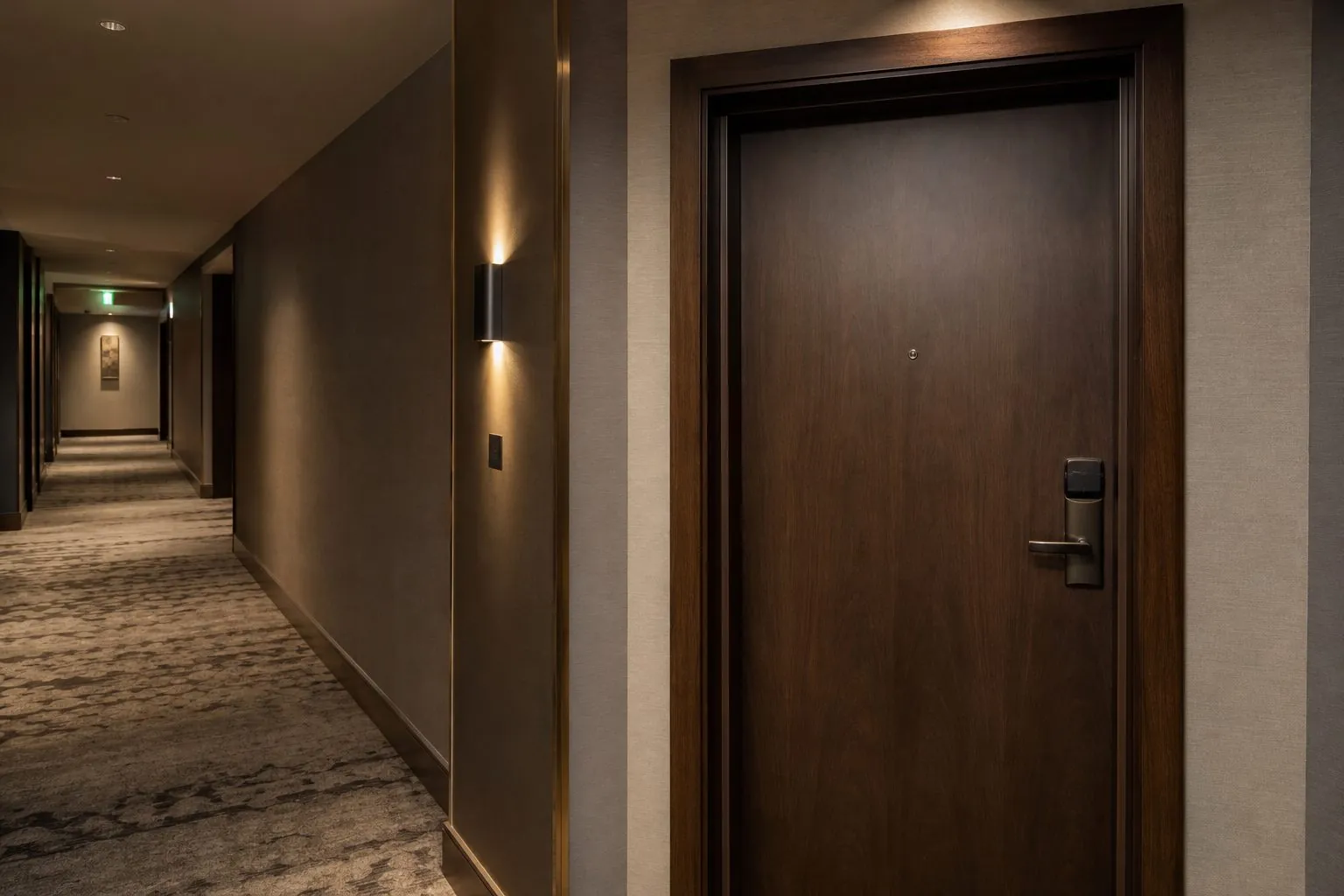
How soundproof hotel room doors work: acoustic ratings, leaf construction, seals, frames and walls, hardware, connecting doors, ordering checks and site installation.
What Makes a Hotel Room Door Soundproof?
A hotel room door blocks sound through three things working together: a heavy, dense leaf, a well-sealed frame on all four sides, and correct installation in a wall that performs as well as the door. If any of these fails, noise from corridors, lifts and neighboring rooms leaks into the room no matter how good the leaf is.
Guest complaints about noise are among the most common in hotel reviews, and the entrance door is often the weakest point in the room envelope. Corridor conversations, housekeeping trolleys, door closers and lift lobbies all generate noise right outside the room.
- Mass: a heavier, denser leaf blocks more airborne sound.
- Airtightness: small gaps leak a surprising amount of sound.
- Decoupling and damping: layered cores reduce vibration through the leaf.
- System performance: door, frame, seals, hardware and wall must all match.
Noise also travels around the door, not just through it. Gaps under the leaf, hollow frames, unsealed wall junctions and service penetrations nearby can all carry sound. That is why acoustic consultants talk about the door set and the wall as one system rather than judging the leaf alone.
How Are Door Acoustic Ratings Expressed?
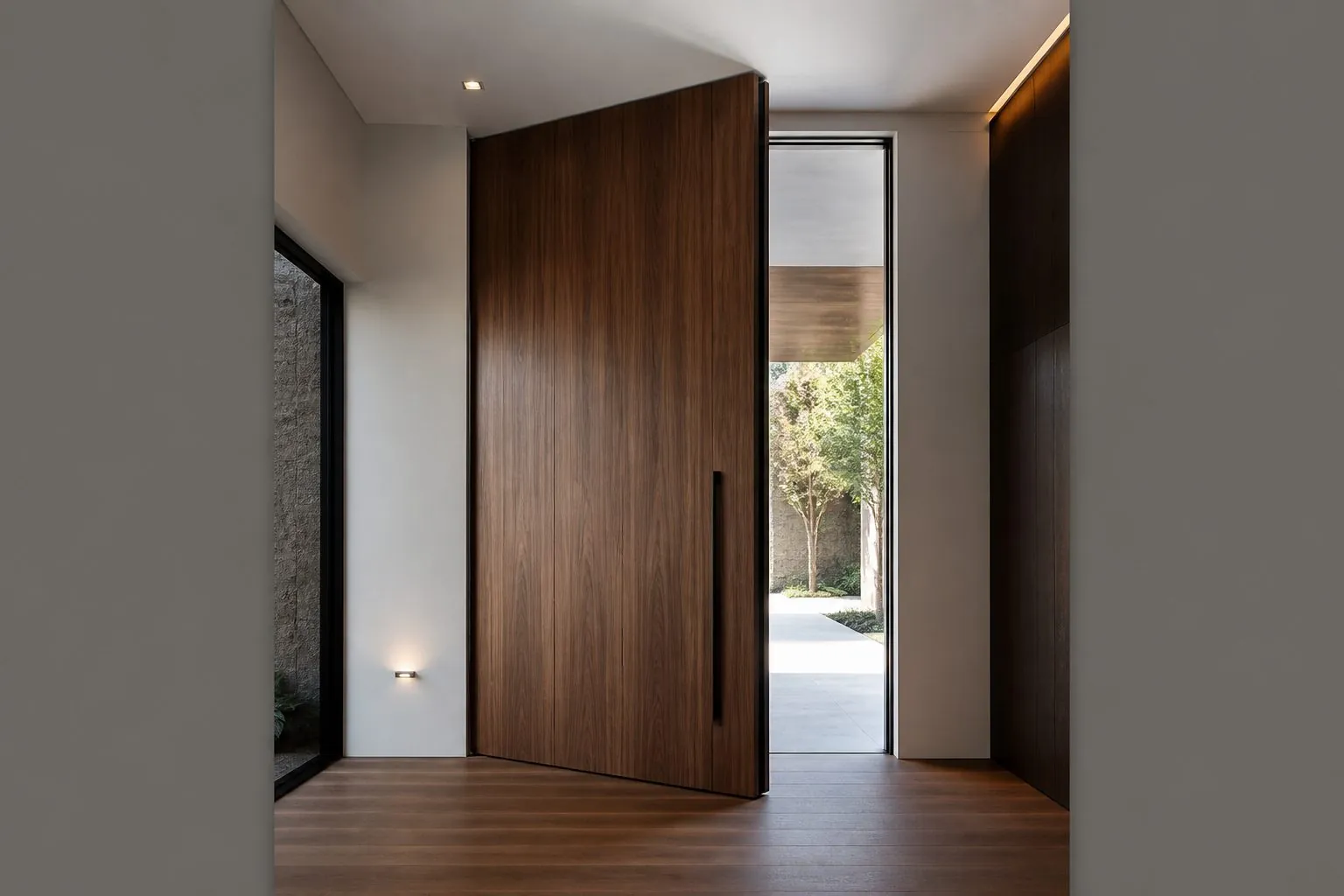
Door acoustic performance is usually expressed as a single-number rating measured in a laboratory, such as Rw under ISO standards or STC under ASTM standards. Higher numbers mean better sound reduction. Field performance on site is normally lower than the lab value because of installation and surrounding construction.
| Term | Meaning | Where Used |
|---|---|---|
| Rw | Weighted sound reduction index measured in a lab | Europe, Asia, many international hotel brands |
| STC | Sound Transmission Class measured in a lab | North America |
| DnT,w or field STC | Performance measured on site between spaces | Commissioning and acceptance testing |
| Ctr / C correction | Adjustment for low-frequency or traffic noise | Specifications needing low-frequency performance |
Hotel brand standards and local codes set the required values. The rating for any specific Arcova door design is confirmed at quotation by testing to the required standard, and should never be assumed from a similar-looking door.
Ask whether a quoted rating refers to the leaf only or the complete door set with frame, seals and hardware. Leaf-only values are usually higher and can be misleading. Test reports should describe the exact construction tested, including core, thickness, seals and hardware, and the door supplied should match that construction.
A difference of a few rating points is noticeable to guests, especially for speech from the corridor. When a brand standard sets a minimum value, plan a margin to cover installation losses on site.
How Is a Soundproof Door Leaf Constructed?
Acoustic door leaves use dense, layered cores rather than hollow or lightweight fillings. The combination of materials adds mass and damps vibration.
- Solid timber or engineered stiles and rails for frame strength and screw holding.
- Dense core layers such as particleboard, MDF or specialist acoustic boards.
- Damping layers between core sheets to reduce resonance.
- Face finishes such as veneer, laminate or lacquer over the core.
- Edge lippings to protect edges and hold seals.
Leaf thickness and weight depend on the required rating and are confirmed per design. Heavier leaves need stronger hinges and closers, which affects hardware selection and frame design.
Many hotel entrance doors must also be fire-rated. In that case, acoustic and fire performance must be achieved by the same tested construction, which limits material choices. See our interior doors for fire-rated and acoustic options.
Face materials have little acoustic effect on their own, so the designer can choose veneer, laminate or lacquer freely as long as the tested core is kept. Decorative grooves, glass vision panels and inset panels can weaken performance and must be checked against the test construction before they are added.
Why Do Seals and Gaps Matter So Much?
Seals often decide whether a door reaches its rated performance. Even a few millimeters of open gap around the leaf can reduce sound insulation significantly, because sound travels easily through air paths.
| Seal Type | Location | Purpose |
|---|---|---|
| Perimeter compression seals | Frame rebate on head and jambs | Close the gap when the door shuts |
| Automatic drop seal | Bottom of the leaf | Drops onto the floor when closed, retracts when opened |
| Threshold seal | Floor under the door | Provides a sealing surface for the drop seal |
| Intumescent and smoke seals | Frame or leaf edge | Fire and smoke performance, may also help acoustics |
Drop seals must be adjusted to the actual floor finish. A drop seal over a carpet edge or uneven tile will leave gaps. Coordinate the floor finish at the threshold with the interior designer before doors are installed.
Seals wear over time. Housekeeping trolleys, luggage and frequent use damage bottom seals and compress perimeter seals. Choose replaceable seal profiles and keep spare stock, so maintenance teams can restore performance without replacing the door.
How Does the Frame and Wall Affect Performance?
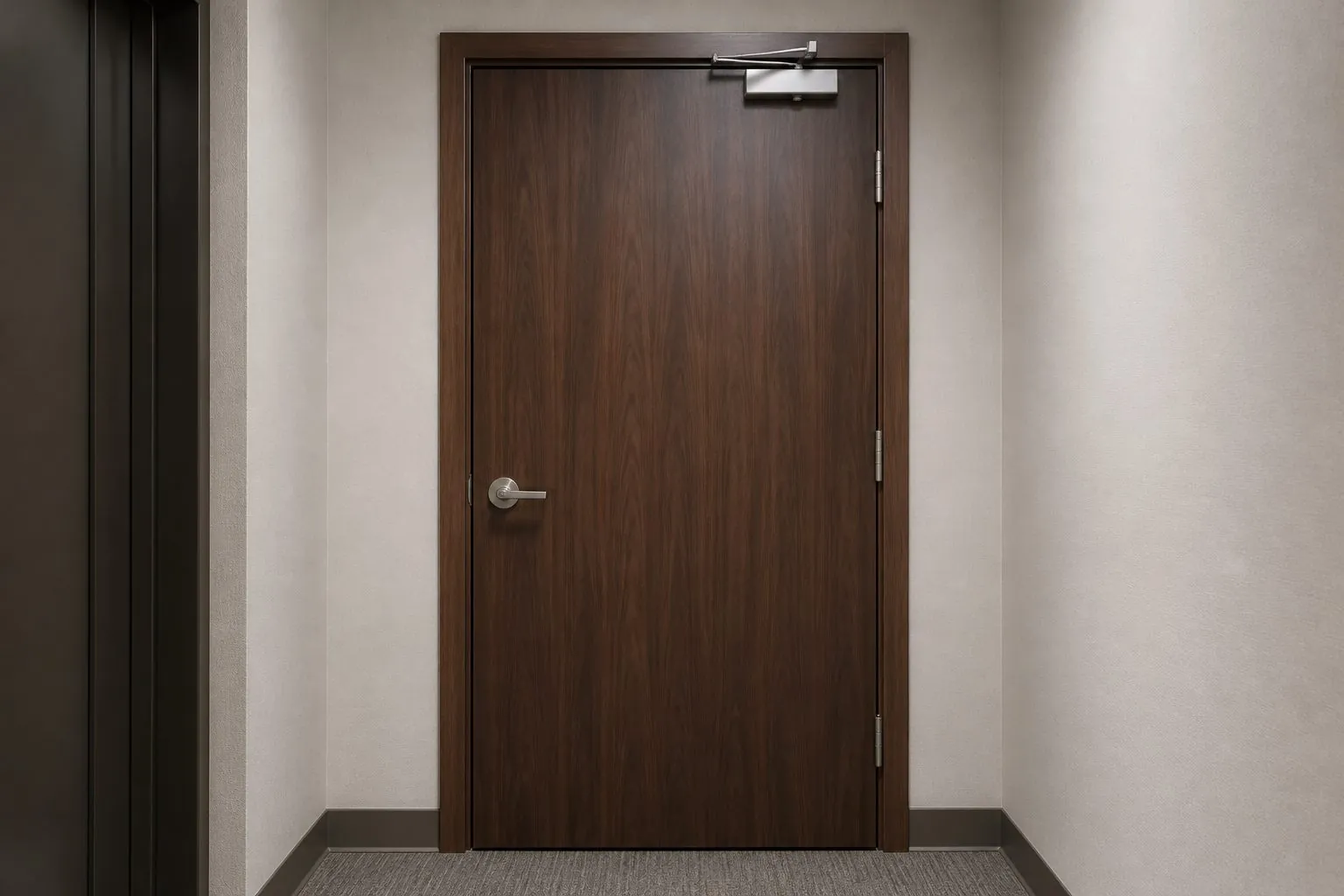
The frame and surrounding wall must perform at least as well as the door. A high-rated door installed in a lightweight wall, or with hollow gaps behind the frame, will not deliver its rating.
- Use solid or filled frames, not hollow profiles.
- Fill the gap between frame and wall with acoustic sealant or mineral wool, not just expanding foam.
- Seal around the frame on both sides with flexible acoustic sealant.
- Ensure the wall rating matches or exceeds the door requirement.
- Avoid sockets and services back to back near the door frame.
Coordinate wall construction with the acoustic consultant early. Frames are often installed by a different trade than the wall, so define responsibility for sealing in the scope documents.
Which Hardware Supports Acoustic Performance?
Hardware must hold the door firmly against its seals without creating new gaps or noise. The wrong hardware can undo good leaf and seal design.
- Hinges: rated for the leaf weight, with enough hinges to keep the leaf flat.
- Door closer: strong enough to compress seals, with adjustable closing and latching speed to avoid slamming.
- Lock and latch: hotel electronic locks with good latching force; the lock body should not create air paths.
- Door viewer: acoustic-rated or sealed viewers.
- Door stop and bumpers: soft materials to reduce impact noise.
Slam noise is a separate complaint from sound transmission. Closers with latch speed control and soft seals reduce the noise of doors closing along the corridor, which guests in neighboring rooms notice at night.
Electronic hotel locks are usually supplied by the lock brand chosen by the operator. Send the lock template early, because the mortise, cable routes and strike plate positions must be machined into the leaf and frame without breaking the tested construction or the fire rating.
How Do Connecting Doors Differ From Entrance Doors?
Connecting doors between adjacent rooms often need higher acoustic performance than entrance doors, because guests are separated from strangers by only this door. Many hotels specify a pair of doors, one on each side, with an air gap between them.
- Double doors with a gap give much better insulation than a single door.
- Each leaf needs perimeter and bottom seals.
- Locks must be operable only from each guest's own side.
- Fire rating may also apply, depending on the building.
Bathroom and wardrobe doors inside the room have different requirements, mainly privacy and moisture resistance rather than high acoustic ratings.
Where a pair of connecting doors is used, the frame and wall between them should also be solid, and both leaves need their own seals and closers. Guests rarely close both doors themselves, so closers matter.
What Should Buyers Confirm Before Ordering Acoustic Doors?
Confirm requirements in writing before shop drawings, because acoustic and fire performance depend on tested constructions that cannot be changed freely later.
- Required acoustic rating and test standard (Rw, STC or other).
- Whether the rating applies to the door alone or the door set.
- Fire rating and local certification requirements.
- Opening sizes, wall construction and frame type.
- Hotel lock brand and model, closer and viewer.
- Floor finish at threshold and drop seal type.
- Finish, color and any decorative details.
- Documents needed: test reports, certificates and installation instructions.
Clarify responsibilities in the contract. The door manufacturer supplies a tested door set and installation instructions, while the main contractor or installer is responsible for the wall, frame fixing and sealing. Clear scopes avoid disputes when field tests fall short of the target.
How Should Doors Be Installed and Checked on Site?
Install doors after walls, floors and ceilings are complete, then test before handover. Most failures found on site are installation issues rather than door defects.
- Check opening sizes and wall construction against drawings.
- Fix frames plumb and square, and fill gaps with acoustic materials.
- Hang leaves and adjust hinges for even gaps.
- Fit and adjust perimeter and drop seals.
- Install locks, closers and viewers.
- Seal frames to walls on both sides.
- Carry out spot field tests where required by the brand or consultant.
A mock-up room with a tested door set helps confirm the full system before the rest of the hotel is fitted out.
Record the installation of the mock-up door with photos and notes, and use it as the standard for all rooms. Periodic checks during installation, such as inspecting frame filling before architraves are fitted, catch hidden problems that cannot be fixed later without removing the frame.

How Can Arcova Help With Soundproof Hotel Room Doors?
Arcova manufactures hotel room door sets with frames, architraves and pre-machined hardware positions, coordinated with guestroom joinery in one finish. We prepare shop drawings, approve finish samples, build mock-ups and inspect with photo reports. Acoustic and fire ratings are confirmed per design against the required standard. We hold ISO9001, BSCI and FSC certifications and offer 24-hour online technical support. See our hotel furniture and quality control, or send your door schedule.